


Exit strategies for health interventions in low- and middle-income countries: a systematic review
- PMID: 40691652
- PMCID: PMC12281693
- DOI: 10.1186/s44263-025-00182-6
Exit strategies for health interventions in low- and middle-income countries: a systematic review
Abstract
Background: Sustaining the benefits of externally funded interventions in low- and middle-income countries (LMICs) remains a concern in global health. As many initiatives depend on time-limited official development assistance (ODA) or philanthropic funding, exit strategies are increasingly recognised as key to ensuring positive impact. This systematic review examines how exit strategies have been conceptualised and implemented across a range of global health initiatives. We aim to identify, categorise and analyse the components of exit strategies during or after the implementation of health interventions in LMICs and their effectiveness. The results of this review will inform future global health programme design and research, including mental health.
Methods: Database searches were conducted in Embase, Scopus, PubMed, PsycINFO (Elsevier), HMIC Health Management Information Consortium, MEDLINE, Social Policy and Practice, Web of Science and Global Health. The latest searches were run in January 2023. Data on study characteristics were descriptively synthesised. Extracted data regarding exit strategy processes and components were analysed using thematic synthesis.
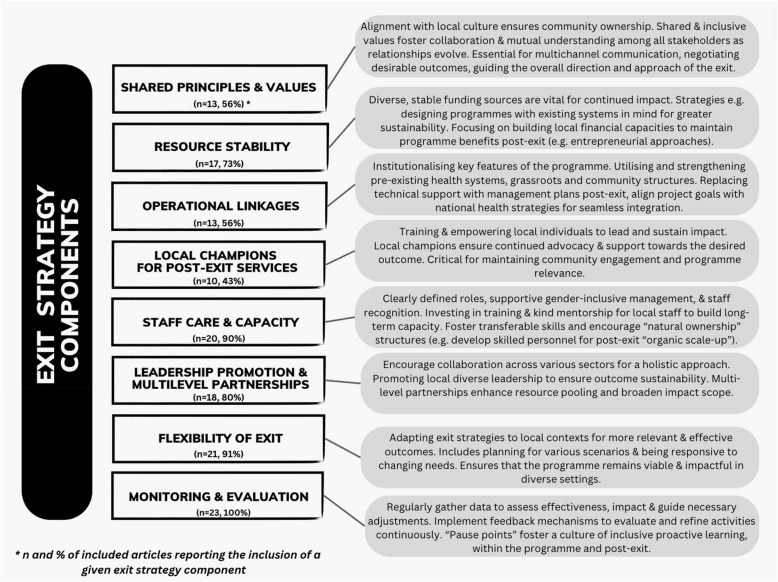
Results: Twenty-three articles (reflecting 22 studies) were identified for inclusion. Within these, eight key components of successful exit strategies were identified: (1) shared principles and values, (2) resource stability, (3) operational linkages, (4) local champions, (5) staff care and capacity, (6) leadership promotion, (7) mentoring and evaluation and (8) context-sensitive flexibility of exit. The studies showcased the complexity and interdependent nature of exit strategies in varied health contexts and provided insights into effective processes for sustained implementation.
Conclusions: This review highlights the importance of planning for sustainability from the outset of health programmes in LMICs. The application of effective, contextually adaptive exit strategies is critical to ensuring the continuity of health gains after external support ends. It emphasises the need for collaborative research focused on long-term impacts and offers concrete recommendations for policy and practice.
Trial registration: PROSPERO Registration: (ref. CRD42021236969).
Keywords: Exit strategies; Global health; International development; LMIC; ODA; Sustainability; Systematic review.
© 2025. The Author(s).
Conflict of interest statement
Declarations. Ethics approval and consent to participate: Not applicable. Consent for publication: Not applicable. Competing interests: PCG is an Editorial Board Member of BMC Global and Public Health. The remaining authors declare no competing interests.
Figures

References
-
- Gruen RL, Elliott JH, Nolan ML, Lawton PD, Parkhill A, McLaren CJ, et al. Sustainability science: an integrated approach for health-programme planning. Lancet. 2008;372(9649):1579–89. - PubMed
-
- Bond. Immediate cuts to UK aid budget announced 2025. Available from: https://www.bond.org.uk/press-releases/2025/03/immediate-cuts-to-uk-aid-....
-
- IDS. ‘Devastating blow to UK’s aid budget 2025. Available from: https://www.ids.ac.uk/press-releases/devastating-blow-to-uks-aid-budget/.
Publication types
Grants and funding
LinkOut - more resources
Full Text Sources
Research Materials