


Location of lateral tibial plateau fractures relative to the posterolateral complex predicts the need for extension of lateral approaches: A retrospective observational study
- PMID: 40691664
- PMCID: PMC12279580
- DOI: 10.1007/s00068-025-02933-4
Location of lateral tibial plateau fractures relative to the posterolateral complex predicts the need for extension of lateral approaches: A retrospective observational study
Abstract
Purpose: Extended lateral approaches have been proposed to improve visualization and therefore reduction quality of the articular surface in lateral tibial plateau fractures. However, recommendations regarding the exact morphology of lateral tibial fractures requiring extended approaches are lacking.
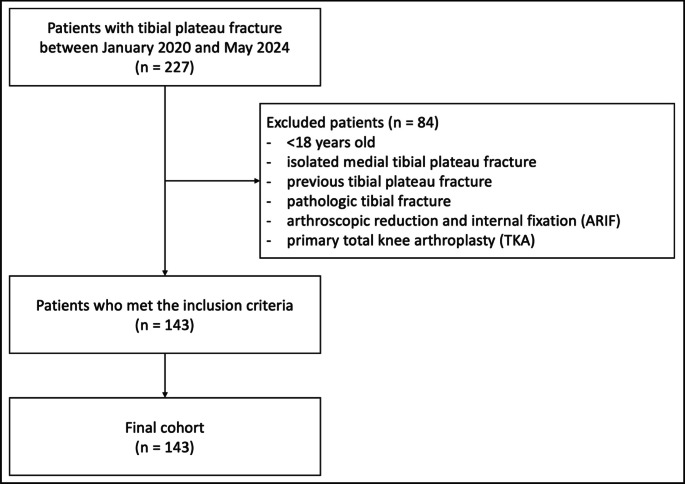
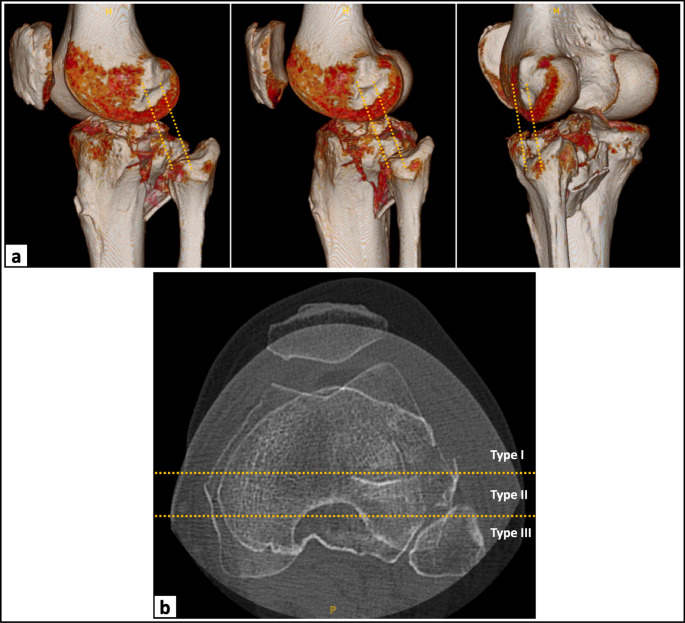
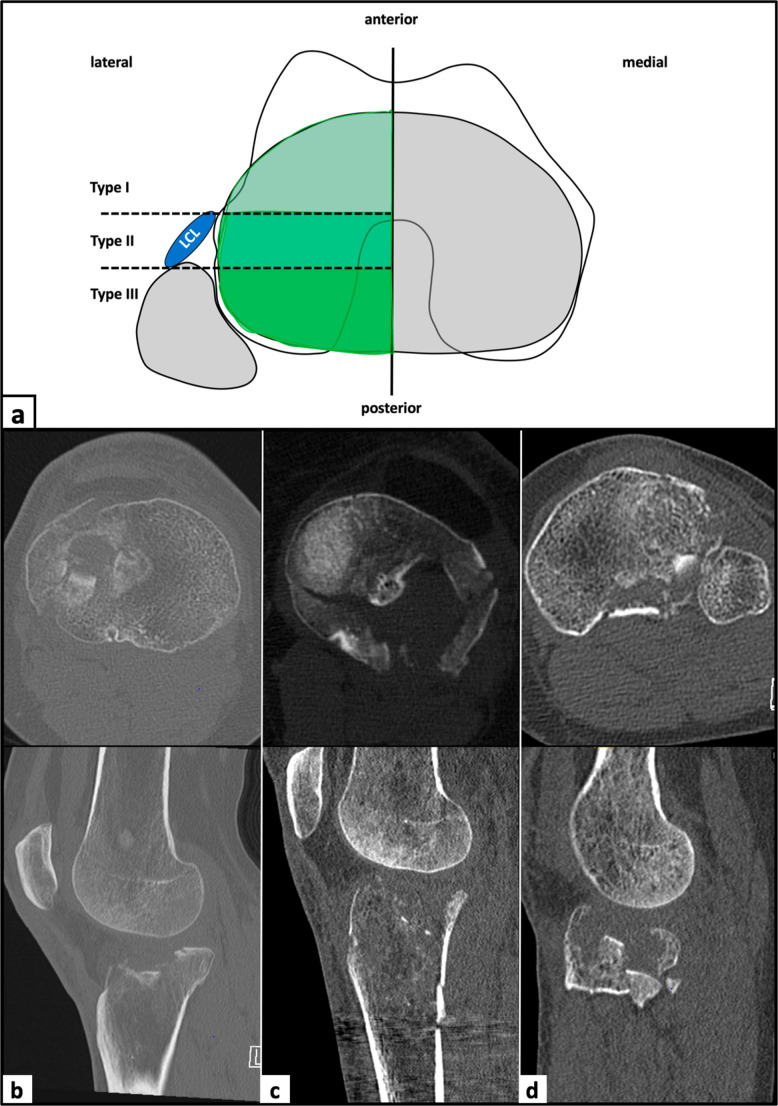
Methods: A retrospective observational cohort study was conducted using data from patients who underwent surgical treatment of a tibial plateau fracture involving the lateral tibial plateau (AO/OTA 41-B3 and 41-C3) at a level 1 trauma center between January 2020 and May 2024. Demographics, patient positioning, and surgical approaches were recorded. Comprehensive examinations on preoperative computed tomography (CT) scan were performed evaluating the morphology of lateral tibial plateau fractures relative to the posterolateral ligamentous structures.
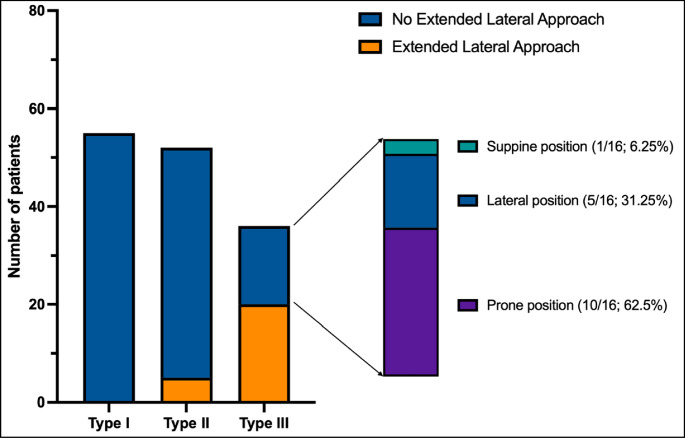
Results: 143 patients (53.8% female, 46.2% male) with a mean age of 51.3 ± 14.3 years were included. Three distinct types of lateral tibial plateau fractures were identified. The most frequent fracture types observed were anterior to the posterolateral ligamentous structures (38.5%) and at level of the posterolateral complex (36.4%), followed by a fracture location posterior to the posterolateral ligamentous structures (25.1%). Extended lateral approaches using lateral femoral epicondyle osteotomy were performed in 17.5% of cases, with fractures posterior to the posterolateral ligamentous structures more likely to have an extended approach (80.0%, p < 0.001).
Conclusions: Lateral tibial plateau fractures show three distinct fracture types, with the fracture location relative to the posterolateral ligamentous structures predicting extension of lateral approaches. For fractures extending posterior to the posterolateral complex, preoperative planning should include prone or lateral patient positioning and selection of an extended lateral approach.
Level of evidence: III.
Keywords: Extended lateral approaches; Fracture type-specific approach selection; Lateral epicondyle osteotomy; Tibial plateau fracture.
© 2025. The Author(s).
Conflict of interest statement
Declarations. Ethics approval: The study was reviewed and approved by the Institutional Ethics Committee of the University of Muenster (File number 2024-421-f-S). Social Media Summary: Location of lateral tibial plateau fractures relative to the posterolateral complex was found to be an indicator for extension of lateral approaches @UK_Muenster Competing interests: The authors declare no competing interests.
Figures
References
-
- Bormann M, Neidlein C, Gassner C, Keppler AM, Bogner-Flatz V, Ehrnthaller C, Prall WC, Bocker W, Furmetz J. Changing patterns in the epidemiology of tibial plateau fractures: a 10-year review at a level-I trauma center. Eur J Trauma Emerg Surg. 2023;49(1):401–9. 10.1007/s00068-022-02076-w. - DOI - PubMed
Publication types
MeSH terms
LinkOut - more resources
Full Text Sources
Research Materials
Miscellaneous
