


Validation of the Traditional Chinese Version of the Belief About Medicines Questionnaire-Specific Among Adults with Type 2 Diabetes in Taiwan
- PMID: 40692905
- PMCID: PMC12277085
- DOI: 10.2147/PPA.S531219
Validation of the Traditional Chinese Version of the Belief About Medicines Questionnaire-Specific Among Adults with Type 2 Diabetes in Taiwan
Abstract
Background: Understanding personal beliefs about medications is an effective approach to improving adherence. A validated tool is essential for identifying these beliefs in routine clinical practice.
Objective: To validate the factor structure and reliability of the Traditional Chinese version of the Beliefs about Medicines Questionnaire-Specific (BMQ-Specific) among individuals with type 2 diabetes (T2D) in Taiwan.
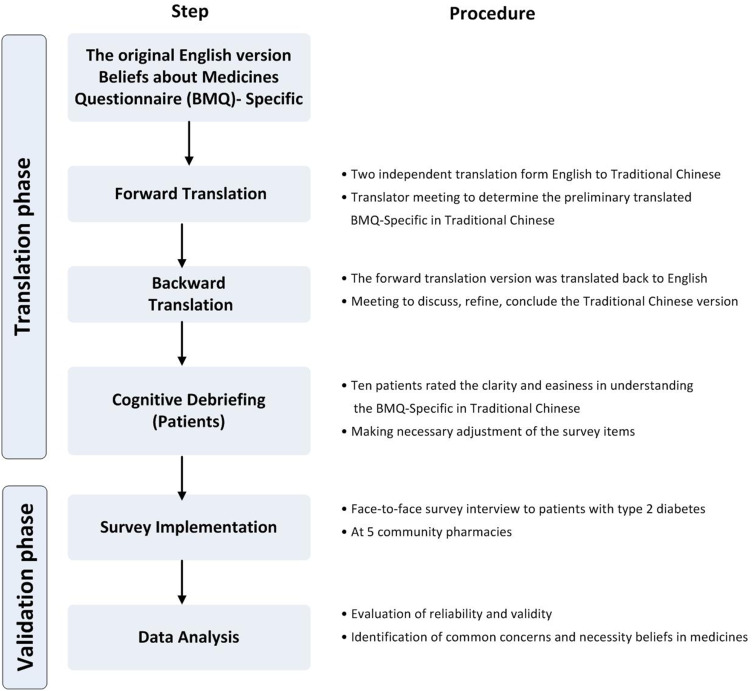
Methods: The original 10-item BMQ-Specific was translated into Traditional Chinese using a forward-backward translation process and reviewed by four experts in pharmacy practice and educational psychology. A cross-sectional study was conducted among adults with T2D who were using diabetes medications. Participants were recruited from five community pharmacies in Taiwan between June 2023 and May 2024. Internal consistency was assessed using McDonald's omega (ω). Construct validity was examined through exploratory factor analysis, and criterion validity was determined by exploring associations between concern beliefs, medication adherence, and glycemic control, as measured by A1C levels.
Results: Two hundred and seventy-three patients participated in the study. Exploratory factor analysis confirmed a two-factor structure consistent with the original English version, comprising the Specific-Necessity and Specific-Concerns subscales. All items loaded onto their respective subscales. The internal consistency reliability of the instrument was acceptable, with McDonald's ω values of 0.785 for both the BMQ-Specific Necessity and BMQ-Specific Concerns subscales. These satisfactory properties were further supported by predictive validity data, which demonstrated the impact of treatment beliefs on adherence levels. The BMQ-Specific Concerns subscale showed a positive correlation with higher barriers to medication-taking (r = 0.270, p < 0.001) and poorer glycemic control (r = 0.130, p = 0.032).
Conclusion: The Traditional Chinese BMQ-Specific is a reliable and valid tool for assessing medication beliefs among patients with T2D in Taiwan. It can be effectively incorporated into clinical practice to support patient-provider communication and improve medication adherence.
Keywords: Taiwan; adherence; belief; diabetes; medication; traditional Chinese; validation.
© 2025 Huang et al.
Conflict of interest statement
The authors have no competing interest to report.
Figures
References
LinkOut - more resources
Full Text Sources
