


Postoperative Rehabilitation and Return-to-Sport Criteria Lack Standardization Following Surgical Repair of Metacarpal Fractures: A Systematic Review
- PMID: 40692937
- PMCID: PMC12276531
- DOI: 10.1016/j.asmr.2025.101107
Postoperative Rehabilitation and Return-to-Sport Criteria Lack Standardization Following Surgical Repair of Metacarpal Fractures: A Systematic Review
Abstract
Purpose: To identify any postoperative rehabilitation parameters, as well as return-to-sport criteria after surgically treated fractures of the second through fifth metacarpals.
Methods: Level I to IV studies that examined nonthumb metacarpal fractures treated surgically, had a minimum 12-month follow-up, and provided explicit return-to-sport (RTS) criteria were reviewed. The selected studies were evaluated for RTS criteria, RTS outcomes, and methodologic quality.
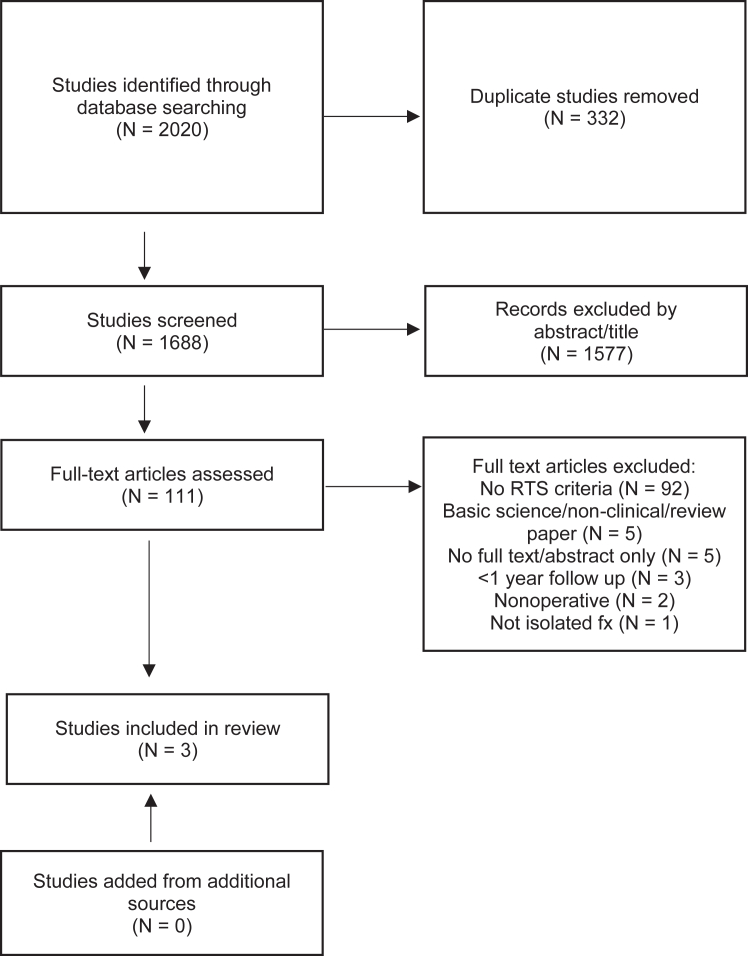
Results: Out of 1,688 studies initially identified, 3 met inclusion criteria. These studies comprised 91 patients from 6 distinct sports. The time frame for RTS varied from 1.8 to 3.4 weeks after surgery. Rehabilitation protocols emphasized range-of-motion exercises and bracing (67%). All studies included a rehabilitation protocol and subjective RTS criteria. However, none suggested specific objective measurement for RTS following metacarpal fracture surgery.
Conclusions: In the literature, there is a lack of agreement on the criteria for rehabilitation and returning to sport after surgical repair of metacarpal fractures. Each included study described the use of early ROM progression, and most reported using splint immobilization or bracing when returning to training or play. Subjective parameters for RTS were more widely reported than a specific postoperative amount of time, but these parameters varied based on sport and surgeon preference.
Level of evidence: Level IV, systematic review of Level III to IV studies.
© 2025 The Authors.
Conflict of interest statement
All authors (B.M.P., N.M., K.B., A.H., A.G., S.R.L., R.A.J.) declare that they have no known competing financial interests or personal relationships that could have appeared to influence the work reported in this paper.
Figures
References
-
- Chung K.C., Spilson S.V. The frequency and epidemiology of hand and forearm fractures in the United States. J Hand Surg Am. 2001;26:908–915. - PubMed
-
- Karl J.W., Olson P.R., Rosenwasser M.P. The epidemiology of upper extremity fractures in the United States, 2009. J Orthop Trauma. 2015;29:e242–e244. - PubMed
-
- Aitken S., Court-Brown C.M. The epidemiology of sports-related fractures of the hand. Injury. 2008;39:1377–1383. - PubMed
-
- Fufa D.T., Goldfarb C.A. Fractures of the thumb and finger metacarpals in athletes. Hand Clin. 2012;28:379–388. x. - PubMed
-
- Geissler W.B. Operative fixation of metacarpal and phalangeal fractures in athletes. Hand Clin. 2009;25:409–421. - PubMed
LinkOut - more resources
Full Text Sources
Research Materials
Miscellaneous
