


SHAP combined with machine learning to predict mortality risk in maintenance hemodialysis patients: a retrospective study
- PMID: 40692959
- PMCID: PMC12277357
- DOI: 10.3389/fmed.2025.1615950
SHAP combined with machine learning to predict mortality risk in maintenance hemodialysis patients: a retrospective study
Abstract
Background: Patients undergoing maintenance hemodialysis face a high mortality rate, yet effective tools for predicting mortality risk in this population are lacking. This study aims to develop an interpretable machine learning model to predict mortality risk among maintenance hemodialysis patients.
Methods: A retrospective analysis was conducted on clinical data from 512 maintenance hemodialysis patients treated at The Central Hospital of Wuhan between January 2021 and October 2024. The dataset included 50 feature variables. The data were split into a training set (70%) and a test set (30%). Five machine learning models-Random Forest, Extreme Gradient Boosting, Support Vector Machine, Logistic Regression, and K-Nearest Neighbor-were trained and evaluated for predicting patient mortality risk, using metrics such as the F1 score, precision, accuracy, AUC-ROC, and recall. SHAP values were used to assess the contribution of each feature in the best-performing model.
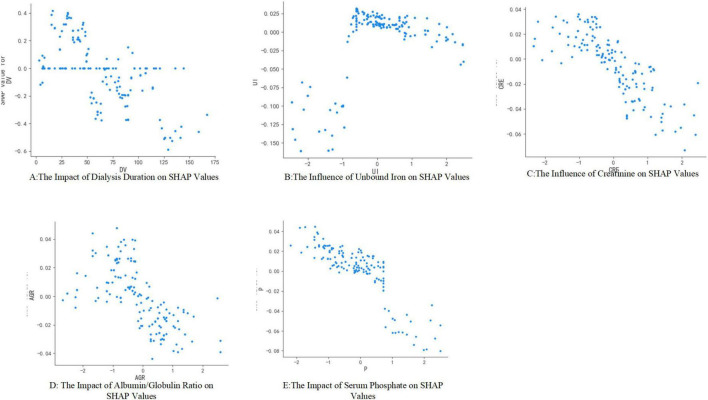
Results: The K-Nearest Neighbor model achieved the highest AUC-ROC of 0.9792 (95% CI: 0.9600-0.9929). SHAP analysis identified key factors influencing predictions, including dialysis duration, creatinine levels, white blood cell ratio, blood phosphorus concentration, and unconjugated iron.
Conclusion: The K-Nearest Neighbor model demonstrated high efficacy in predicting mortality risk among hemodialysis patients. SHAP analysis highlighted critical risk factors. While these findings show promise for future clinical research, they should be interpreted with caution due to the study's retrospective design and the need for external validation.
Keywords: SHAP; hemodialysis; machine learning; mortality risk; predictive modeling.
Copyright © 2025 Shu, Wang, Wen, Chen and Xu.
Conflict of interest statement
The authors declare that the research was conducted in the absence of any commercial or financial relationships that could be construed as a potential conflict of interest.
Figures




References
-
- Dong S, Liu Y, Ge H, Lin Y, Guan W, Su W, et al. Trend analysis of chronic kidney disease morbidity and mortality in the Chinese population based on age-period-cohort modeling. Public Health Preventive Medicine. (2024) 35: 12–5.
-
- Zhang X, Li H, Chen Y, Zhao S. Influence of hemodialysis and peritoneal dialysis on survival in elderly patients with end-stage renal disease. J Xinjiang Med Univ. (2021) 44:76–9.
LinkOut - more resources
Full Text Sources
