


Resolving the structural basis of therapeutic antibody function in cancer immunotherapy with RESI
- PMID: 40695789
- PMCID: PMC12284157
- DOI: 10.1038/s41467-025-61893-w
Resolving the structural basis of therapeutic antibody function in cancer immunotherapy with RESI
Abstract
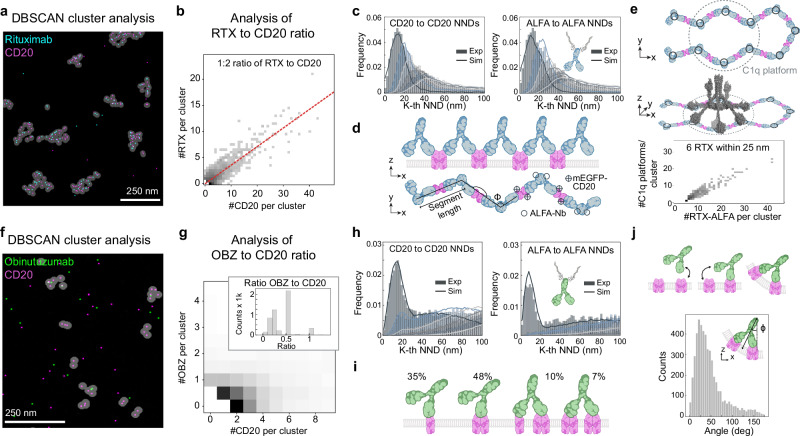
Monoclonal antibodies (mAb) are key therapeutic agents in cancer immunotherapy and exert their effects through Fc receptor-dependent and -independent mechanisms. However, the nanoscale receptor reorganization resulting from mAb binding and its implications for the therapeutic mode of action remain poorly understood. Here, we present a multi-target 3D RESI super-resolution microscopy technique that directly visualizes the structural organization of CD20 receptors and the Type I (e.g., Rituximab) and Type II (e.g., Obinutuzumab) anti-CD20 therapeutic antibodies and quantitatively analyze these interactions at single-protein resolution in situ. We discover that, while Type I mAbs promote higher-order CD20 oligomerization, Type II mAbs induce limited clustering, leading to differences in therapeutic function. Correlating RESI with functional studies for Type II antibodies with different hinge region flexibilities, we show that the oligomeric CD20 arrangement determines the Type I or Type II function. Thus, the nanoscale characterization of CD20-mAb complexes enhances our understanding of the structure-function relationships of therapeutic antibodies and offers insights into the design of next-generation mAb therapies.
© 2025. The Author(s).
Conflict of interest statement
Competing interests: M.L., S.H., M.B. and C.K. declare employment, patents (unrelated to this work) and stock ownership with Roche. The other authors declare no competing interests.
Figures




References
-
- Tebbutt, N., Pedersen, M. W. & Johns, T. G. Targeting the ERBB family in cancer: couples therapy. Nat. Rev. Cancer13, 663–673 (2013). - PubMed
MeSH terms
Substances
LinkOut - more resources
Full Text Sources
Medical
