


Total mixed ration enhances nutrient digestibility, blood biochemical parameters and faecal microbial diversity in horses
- PMID: 40696370
- PMCID: PMC12285169
- DOI: 10.1186/s12917-025-04937-z
Total mixed ration enhances nutrient digestibility, blood biochemical parameters and faecal microbial diversity in horses
Abstract
Background: Total Mixed Ration (TMR) is recognized for its balanced nutritional composition, improved feed efficiency, enhanced animal production, and stabilization of the gastrointestinal microbiome. It has been extensively implemented in intensive ruminant farming, particularly for cattle and sheep, with demonstrated positive outcomes. However, its effects on the nutritional health of non-ruminant herbivores, such as horses, remain insufficiently investigated. This study aims to evaluate the comparative effects of TMR feeding versus conventional feeding practices in Akhal-Teke horses while maintaining identical dietary compositions and nutritional levels. By analyzing body weight, growth in body measurements, nutrient metabolism, and faecal microbiome diversity, the study aims to determine the potential advantages of TMR feeding for monogastric herbivores.
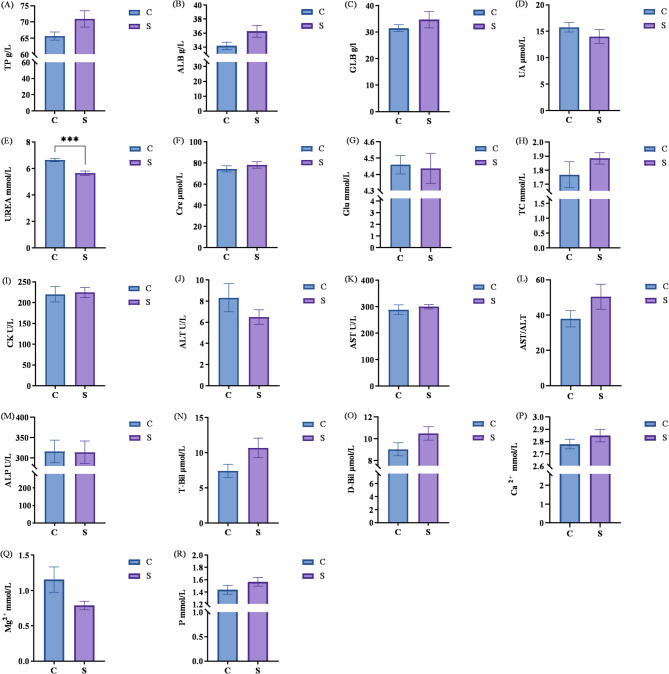
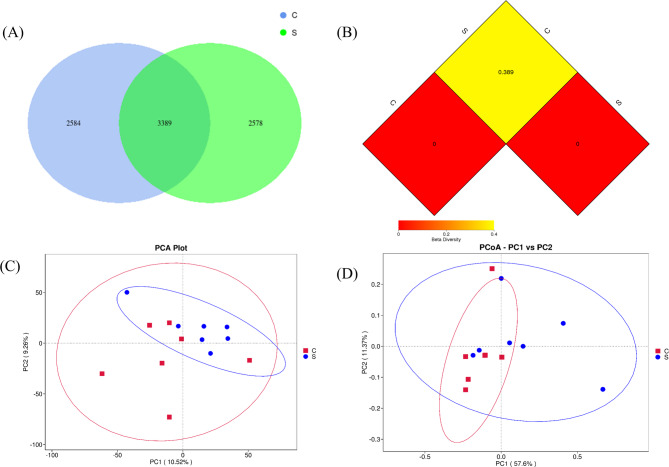
Results: Compared The TMR group (S) demonstrated a significant increase in total weight gain and average daily weight gain, surpassing the control group (C) by 47.53% (P < 0.05) and 48.28% (P < 0.05), respectively. Moreover, the S group showed substantial improvements in DM (Dry Matter ), DE (Digestible Energy), CP (Crude Protein), ADF (Acid Detergent Fiber), and P (Phosphorus), with increases of 8.27% (P < 0.01), 11.97% (P < 0.01), 14.30% (P < 0.01), 39.52% (P < 0.01), and 38.35% (P < 0.01), respectively, compared to the C group. No significant differences were observed in serum parameters, including TP (Total Protein), ALB (Albumin), Cre (Creatinine), UA (Uric Acid), UREA (Urea), Glu (Glucose), T-Bil (Total Bilirubin), D-Bil (Direct Bilirubin), TC (Total Cholesterol), ALT (Alanine Aminotransferase), AST (Aspartate Aminotransferase), AST/ALT, ALP (Alkaline Phosphatase), CK (Creatine Kinase), Ca2+ (Calcium), Mg2+ (Magnesium), and Inorganic Phosphorus (P > 0.05). However, UREA was significantly reduced by 14.90% (P < 0.01). While faecal pH and VFA were unaffected (P > 0.05), the abundance of Spirochaetota, Treponema, Christensenellaceae_R-7_group, and Lactobacillus_hayakitensis was significantly elevated (P < 0.05). However, Prevotellaceae abundance was significantly reduced (P < 0.05).
Conclusions: In conclusion, under the conditions of this study, TMR feeding notably improved body weight, nutrient digestibility, gut microbiota composition, and fiber degradation in Akhal-Teke horses when compared to traditional feeding methods.
Keywords: Akhal-Teke horse; Apparent digestibility; Blood biochemical parameters; Faecal microbiota; TMR.
Conflict of interest statement
Declarations. Ethics approval and consent to participate: All protocols were approved by the Animal Care and Use Committee of Xinjiang Agricultural University (permission number 2018012). Informed consent - Owners gave informed consent for their animals’ inclusion in the study. All methods were carried out in accordance with relevant guidelines and regulations for the use of animal subjects. The study was carried out in compliance with the ARRIVE guidelines. Consent for publication: Not applicable. Competing interests: The authors declare no competing interests.
Figures




References
-
- Hendricks BL. International encyclopedia of horse breeds. Choice Reviews Online. 1996;33(09):33–4847.
-
- Kuznecova Y. K 70 Letiyu Konnogo Perehoda Ashabad Moskva. Ahal Teke IrIfo. 2005;78–83.
-
- Mackay-Smith A. Speed and the thoroughbred: the complete history. New York, NY, USA: Derrydale; 2000.
-
- Kätlin K, Priit K, Ülle J, Teet S. Myosin heavy chain pattern in the Akhal-Teke horses animal. 2011;5(5):658–62. - PubMed
-
- Hou F, Xu XL, Hou Y, Li XG, Zhao HQ, Wang JQ, et al. Study on the stress response of Akhaltegin horses to long-distance transport. China Anim Husb Veterinary Med. 2017;44(11):3156–62.
Grants and funding
- 2022A02013-2-3/Major Science and Technology Special Project of Xinjiang Uygur Autonomous Region
- 2022A02013-2-3/Major Science and Technology Special Project of Xinjiang Uygur Autonomous Region
- 2022A02013-2-3/Major Science and Technology Special Project of Xinjiang Uygur Autonomous Region
- 2022A02013-2-3/Major Science and Technology Special Project of Xinjiang Uygur Autonomous Region
- 2022A02013-2-3/Major Science and Technology Special Project of Xinjiang Uygur Autonomous Region
LinkOut - more resources
Full Text Sources
Research Materials
Miscellaneous
