


Impact of genetic risk and lifestyles on cardiovascular disease-free and total life expectancy: a cohort study
- PMID: 40696436
- PMCID: PMC12285114
- DOI: 10.1186/s13073-025-01487-9
Impact of genetic risk and lifestyles on cardiovascular disease-free and total life expectancy: a cohort study
Abstract
Background: Understanding the role of genetic risk and lifestyles on life expectancy (LE) without cardiovascular disease (CVD) and total LE may help optimize healthy aging strategies after taking genetic background into account.
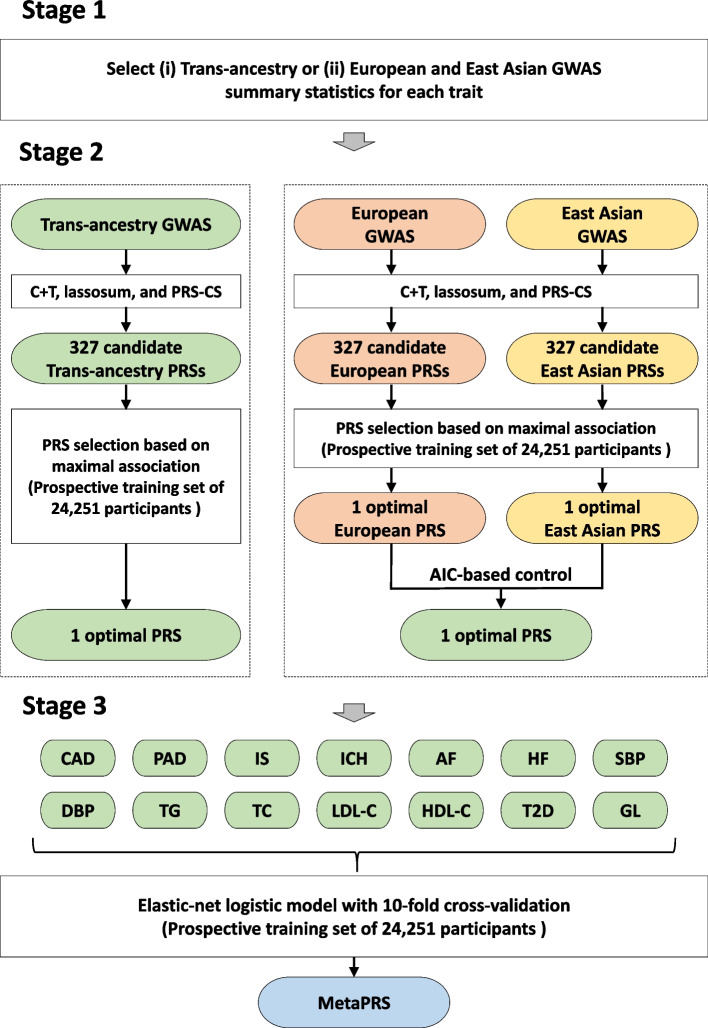
Methods: The China Kadoorie Biobank recruited participants from five urban and five rural areas across China during 2004-2008 and followed them up till December 31, 2018. A polygenic risk score (PRS) comprising 3.5 million genetic variants for overall CVD was constructed by combining multiple PRSs for CVD and CVD-related risk factors in 96,400 participants. Genetic risk was categorized into low, intermediate, and high according to the PRS, and lifestyles were categorized as favorable, intermediate, and unfavorable according to the number of unfavorable lifestyles. Using multistate life tables, we estimated CVD-free and total LE at age 40 for different genetic and lifestyle risk groups.
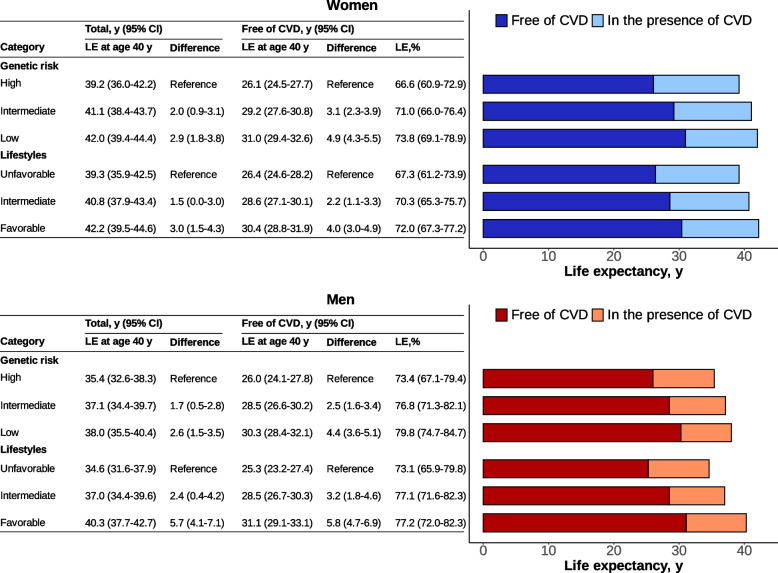
Results: Genetic risk was more strongly associated with CVD onset than post-CVD mortality. As a result, the increase in LE without CVD associated with low genetic risk (4.9 years (95% CI 4.3-5.5) for women and 4.4 years (3.6-5.1) for men) was greater than the increase in total LE (2.9 years (1.8-3.8) for women and 2.6 years (1.5-3.5) for men) when compared to high genetic risk. In contrast, the association strengths of lifestyles with CVD onset and mortality after CVD were similar. Correspondingly, compared to those with unfavorable lifestyles, participants with favorable lifestyles had longer total LE and LE without CVD of 3.0 (1.5-4.3) and 4.0 (3.0-4.9) years in women and 5.7 (4.1-7.1) and 5.8 (4.7-6.9) years in men, respectively. Participants with high genetic risk benefited more from favorable lifestyles than those with low and intermediate genetic risk, gaining 5.9 (2.3-9.3) and 5.3 (3.0-7.6) years in women and 6.1 (0.8-10.6) and 6.2 (2.3-9.8) years in men for total and CVD-free LE, respectively.
Conclusions: Improving lifestyles is critical for reducing CVD-related healthcare burden and promoting healthy aging, especially for individuals with high genetic risk.
Keywords: Cardiovascular disease-free life expectancy; Cohort study; Lifestyles; Polygenic risk score.
© 2025. The Author(s).
Conflict of interest statement
Declarations. Ethics approval and consent to participate: The study was conducted in accordance with Declaration of Helsinki and approved by the Ethics Committee of the Chinese Centre for Disease Control and Prevention (005/2004, Beijing, China), the Peking University Health Science Center (IRB00001052-20040, Beijing, China), and the Oxford Tropical Research Ethics Committee of the University of Oxford (025–04, Oxford, UK). All participants provided written informed consent. Consent for publication: Not applicable. Competing interests: The authors declare no competing interests.
Figures

References
-
- Arnett DK, Blumenthal RS, Albert MA, Buroker AB, Goldberger ZD, Hahn EJ, et al. 2019 ACC/AHA Guideline on the Primary Prevention of Cardiovascular Disease: A Report of the American College of Cardiology/American Heart Association Task Force on Clinical Practice Guidelines. Circulation. 2019;140(11):e596–646. - PMC - PubMed
MeSH terms
Grants and funding
- 212946/Z/18/Z, 202922/Z/16/Z, 104085/Z/14/Z, 088158/Z/09/Z/WT_/Wellcome Trust/United Kingdom
- 2011BAI09B01/Chinese Ministry of Science and Technology
- 2016YFC0900500/National Key Research and Development Program of China
- 82192901, 82192904, 82192900, 82388102, 823B2090, 81390540, 91846303, 81941018/National Natural Science Foundation of China
- WT_/Wellcome Trust/United Kingdom
LinkOut - more resources
Full Text Sources
Research Materials
