


Impact of liraglutide on albumin-to-creatinine ratio in type 2 diabetes mellitus: a meta-analysis
- PMID: 40696486
- PMCID: PMC12281775
- DOI: 10.1186/s40001-025-02801-2
Impact of liraglutide on albumin-to-creatinine ratio in type 2 diabetes mellitus: a meta-analysis
Abstract
Aims: Emerging evidence suggested that liraglutide possessed the potential to improve the albumin-to-creatinine ratio (ACR) in patients with type 2 diabetes mellitus (T2DM). This study aimed to ascertain the impact of liraglutide on ACR in T2DM.
Methods: PubMed, Embase, the Cochrane Library, WanFang and CNKI were searched for randomized controlled trials (RCTs) from inception to November 30, 2024 (PROSPERO: CRD52025336785). The data were pooled using fixed- or random-effects models based on the heterogeneity. Sensitivity analyses and publication bias assessments were performed.
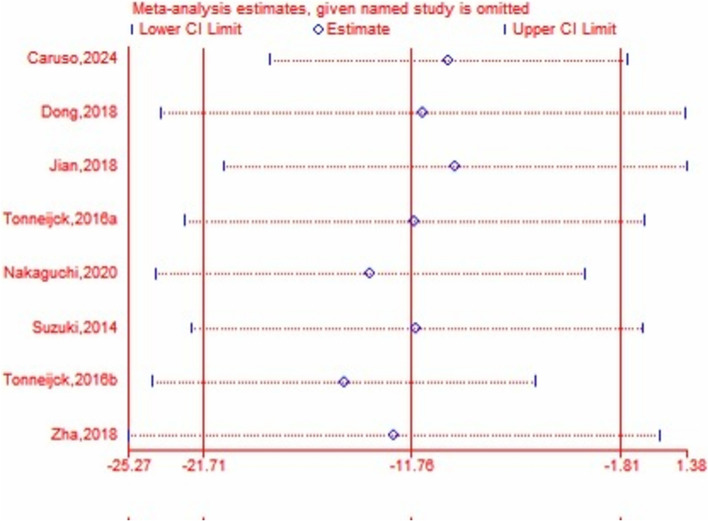
Results: Seven RCTs involving 473 participants were included. Liraglutide significantly reduced ACR (WMD: - 11.76 mg/g, 95% CI, - 21.71 to - 1.81, I2 = 75%, P = 0.02) compared to controls (placebo or active drugs). Subgroup analysis revealed significant ACR reductions in patients with HbA1c > 8.0%, follow-up > 12 weeks, and age < 60 years. Meta regression indicated that heterogeneity was not influenced by sample size, HbA1c, baseline ACR, treatment duration, or liraglutide dosage (P = 0.92; 95% CI, - 322.34 to 340.66). The results were stable based in sensitivity analysis, and no publication bias was detected (Begg's P = 0.46; Egger's P = 0.57).
Conclusions: Liraglutide significantly reduced ACR in T2DM, particularly in patients with poor glycemic control, longer treatment duration, and younger age. Future studies with extended follow-up are needed to confirm its renoprotective benefits.
Keywords: Albumin-to-creatinine ratio; Liraglutide; Randomized controlled trials; Type 2 diabetes mellitus.
© 2025. The Author(s).
Conflict of interest statement
Declarations. Ethics approval and consent to participate: Not applicable. Competing interests: The authors declare no competing interests.
Figures



References
-
- Rayego-Mateos S, Rodrigues-Diez RR, Fernandez-Fernandez B, Mora-Fernández C, Marchant V, Donate-Correa J, Navarro-González JF, Ortiz A, Ruiz-Ortega M. Targeting inflammation to treat diabetic kidney disease: the road to 2030. Kidney Int. 2023;103:282–96. - PubMed
-
- Shamim MA, Patil AN, Amin U, Roy T, Tiwari K, Husain N, Kumar J, Chenchula S, Rao P, Ganesh V, et al. Glucagon-like peptide-1 receptor agonists in adolescents with overweight or obesity with or without type 2 diabetes multimorbidity—a systematic review and network meta-analysis. Diabetes Obes Metab. 2024;26:4302–17. - PubMed
Publication types
MeSH terms
Substances
LinkOut - more resources
Full Text Sources
Medical
