A Patch-Type Electrocardiography Is Superior to Holter Monitoring for Detecting Paroxysmal Cardiac Arrhythmias
- PMID: 40696526
- PMCID: PMC12284308
- DOI: 10.3346/jkms.2025.40.e168
A Patch-Type Electrocardiography Is Superior to Holter Monitoring for Detecting Paroxysmal Cardiac Arrhythmias
Abstract
Background: Patch-electrocardiography (ECG) enables prolonged ECG monitoring beyond 24 hours. However, diagnostic yield between patch-ECG and Holter monitoring needs further validation. We aimed to compare diagnostic capabilities of 14-day patch-ECG and one day Holter monitoring to detect cardiac arrhythmias.
Methods: Patients with suspected cardiac arrhythmias but could not be diagnosed by 12-lead ECG were enrolled from two tertiary centers. Patch-ECG and Holter monitoring was attached simultaneously in enrolled patients. Primary endpoint was detection of major arrhythmias which was defined as atrial fibrillation (AF), atrial tachycardia, atrial flutter, paroxysmal supraventricular tachycardia (PSVT), ventricular tachycardia, 2nd or 3rd degree atrioventricular block, sick pause (> 2 seconds of pause), sick sinus syndrome, tachycardia-bradycardia syndrome, and Wolff-Parkinson-White syndrome.
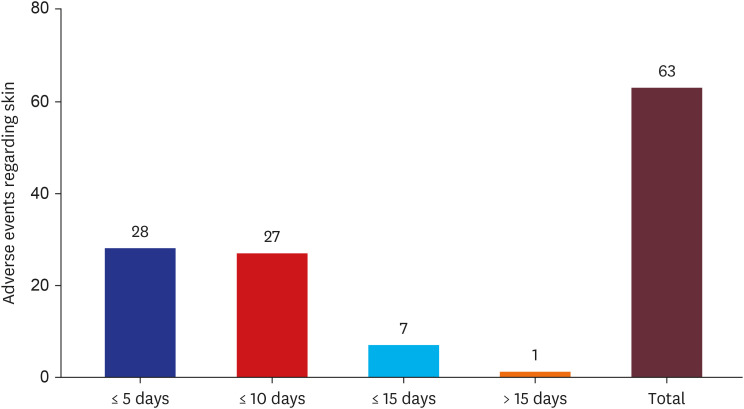
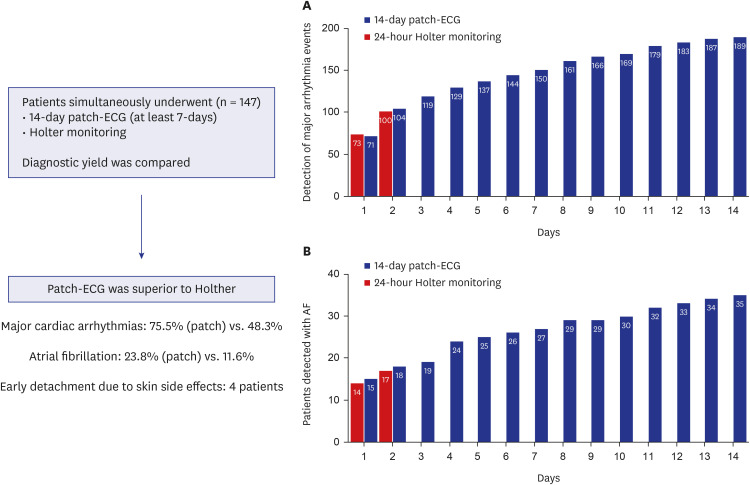
Results: A total of 147 patients were analyzed. Major arrhythmias were detected in 75.5% and 48.3% in patch-ECG and Holter monitoring, respectively (P < 0.001). Detection rate between the first day of patch-ECG and Holter monitoring was identical. Detection rate for AF was significantly higher in patch-ECG (23.8% vs. 11.6%; P < 0.001). Substantial proportion of AF events were detected in the first day of monitoring (42.9%) but diagnosis rate increased steadily between day 2-14 of monitoring. Detection rate of supraventricular tachycardia (atrial tachycardia or PSVT), ventricular tachycardia, and brady-arrhythmias was higher in the patch-ECG. Four patients had to detach their patch-ECG due to skin side effects.
Conclusion: Patch-ECG has higher diagnostic capabilities compared to Holter monitoring for diagnosis of various cardiac arrhythmias.
Keywords: Arrhythmia; Electrocardiography; Holter Monitor; Patch-ECG; Wearable Device.
© 2025 The Korean Academy of Medical Sciences.
Conflict of interest statement
The authors have no potential conflicts of interest to disclose.
Figures
References
-
- Freedman B, Potpara TS, Lip GY. Stroke prevention in atrial fibrillation. Lancet. 2016;388(10046):806–817. - PubMed
-
- Anter E, Jessup M, Callans DJ. Atrial fibrillation and heart failure: treatment considerations for a dual epidemic. Circulation. 2009;119(18):2516–2525. - PubMed
-
- Kim YG, Lee HS, Kim H, Kim M, Jeong JH, Choi YY, et al. Association of antiarrhythmic drug therapy with syncope and pacemaker implantation in patients with atrial fibrillation. J Am Coll Cardiol. 2024;83(11):1027–1038. - PubMed
MeSH terms
Grants and funding
LinkOut - more resources
Full Text Sources
Medical