


Association between neutrophil-lymphocyte ratio and female breast cancer: an observational study from NHANES 2001-2018 with external validation
- PMID: 40697377
- PMCID: PMC12280361
- DOI: 10.3389/fonc.2025.1564238
Association between neutrophil-lymphocyte ratio and female breast cancer: an observational study from NHANES 2001-2018 with external validation
Abstract
Background: In the 21st century, breast cancer is the most frequent malignant tumor threatening women's health. Previous research has confirmed that inflammatory response processes play key roles in tumor occurrence, development, and metastasis. The neutrophil-to-lymphocyte ratio (NLR), an emerging disease biomarker, has become a focus of cancer research. However, analysis of the relationship between NLR and breast cancer remains scarce. Therefore, our study explored NLR levels in relation to female breast cancer (FBC) prevalence.
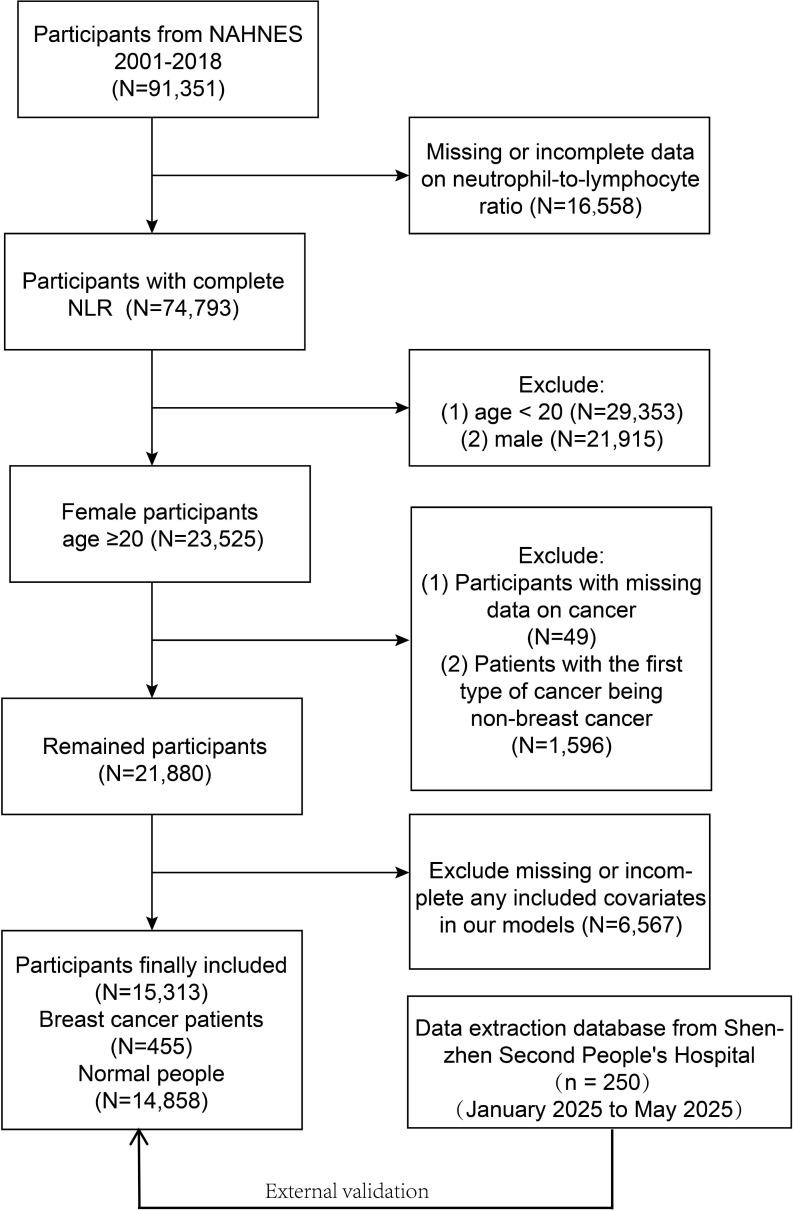
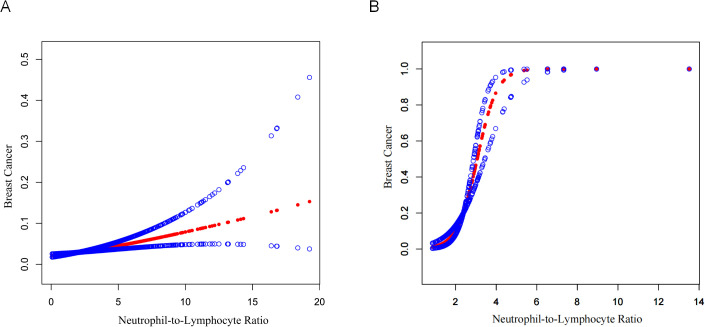
Methods: We analyzed data from 15,313 adult females aged 20 and above, using the 2001 to 2018 National Health and Nutrition Examination Survey (NHANES). We explored the association between NLR and FBC prevalence using multiple statistical approaches, including descriptive analysis, multivariate logistic regression, and subgroup analyses. We applied Akaike Information Criterion (AIC) and Bayesian Information Criterion (BIC) to measure model performance. Additionally, smooth curve fitting examined the potential non-linear relationship. To validate our findings, an independent external validation dataset comprising 250 participants (50 breast cancer cases and 200 controls) from Shenzhen Second People's Hospital was utilized, and correlation between NLR values and breast cancer prevalence was calculated.
Results: NLR was positively associated with FBC prevalence among US women. In the fully adjusted model, each unit NLR elevation increased FBC prevalence odds by 14% [OR = 1.14 (95% CI: 1.08, 1.22)]. Participants in the highest quartile of NLR had 67% higher FBC prevalence compared to those in the lowest quartile [OR = 1.67 (95% CI: 1.24, 2.24)], with statistical significance across three models at P for trend values <0.001. Based on AIC and BIC criteria, multivariable-adjusted models showed superior fit over unadjusted ones for both continuous and categorical NLR specifications. Subgroup analysis showed the positive association between NLR and breast cancer prevalence was consistent across the general population. External validation confirmed robustness, demonstrating positive associations between elevated NLR and breast cancer prevalence.
Conclusions: In the U.S. adult female population, NLR levels were positively correlated with breast cancer prevalence. External validation in Chinese clinical participants supported the generalizability of these findings across different populations.
Keywords: AIC/BIC; NHANES; cross-sectional study; female breast cancer; neutrophil-lymphocyte ratio.
Copyright © 2025 Xiong, Zhang, Wu, Yang, Shi, Zhou, Yuan, Quan and Xie.
Conflict of interest statement
The authors declare that the research was conducted in the absence of any commercial or financial relationships that could be construed as a potential conflict of interest.
Figures
References
LinkOut - more resources
Full Text Sources
