


Plantar flexors are the main engine of walking in healthy adults
- PMID: 40697531
- PMCID: PMC12279496
- DOI: 10.3389/fspor.2025.1595065
Plantar flexors are the main engine of walking in healthy adults
Abstract
Introduction: The plantar flexors contribute to the uniqueness of man's walking across bipeds (including apes). This role is achieved in late infancy through neural maturation. This may explain why this mechanism is lost with all corticospinal lesions despite the spared power of plantar flexors in segmental motions. During adult human walking, the plantar flexor muscles at the rear limb, during double stance, are suspected to provide most of the work and power required to translate the body system, which can be represented mechanically by its centre of mass (CoM). However, direct evidence of the dominant role of the ankle muscles in CoM translation is scarce. Experimental evidence requires synchronously assessing the lower limb joints' and CoM's power.
Methods: In this work, ten healthy adults were requested to walk on a split-belt force treadmill at speeds ranging from 0.3 to 1.2 m s-1. A series of eight subsequent strides was analysed at each different speed. The synchronous analysis of ground reaction forces (through force platforms) and joint rotations (through an optoelectronic system) allowed us to simultaneously measure the CoM and the lower limb joints' power.
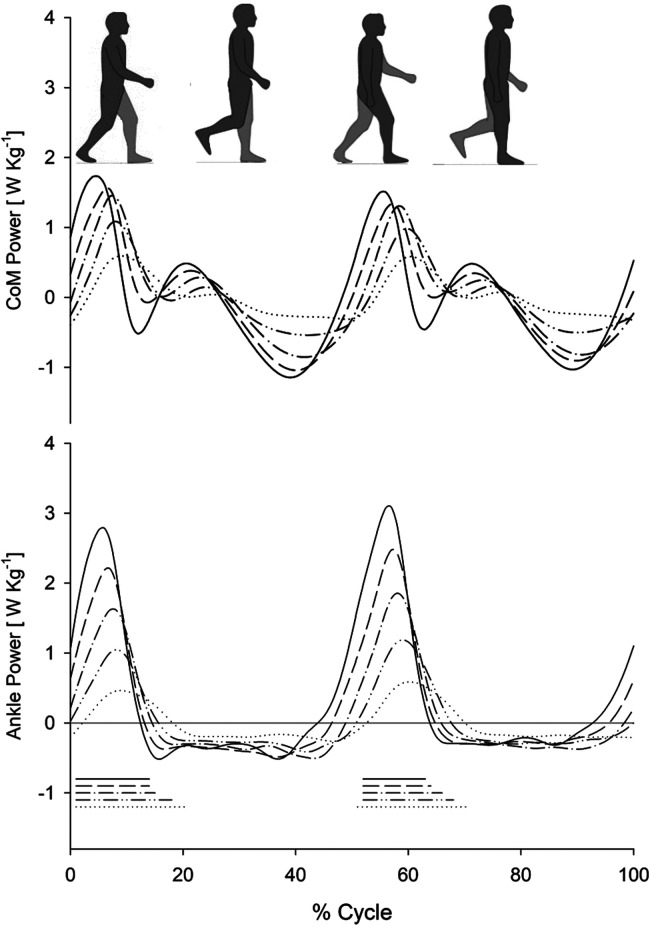
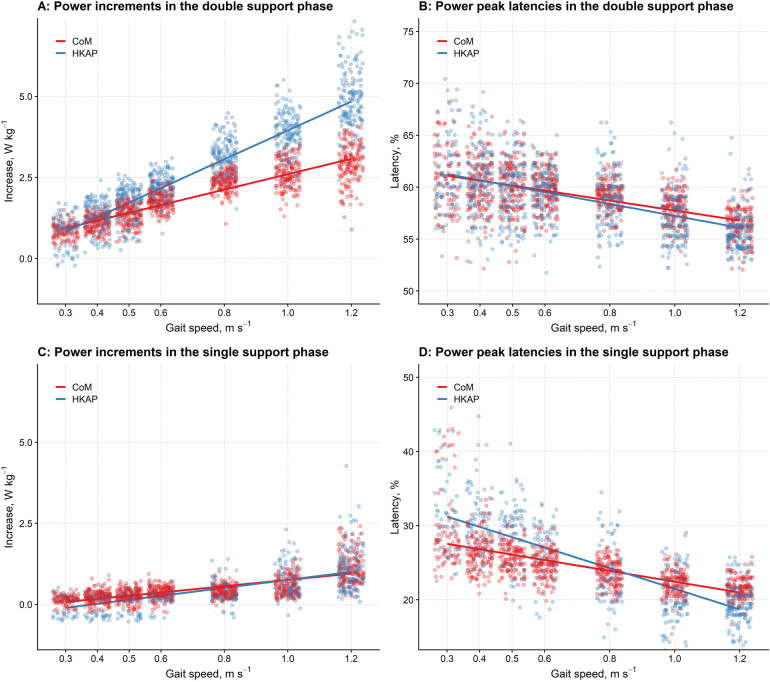
Results: The dominant role of the ankle plantar flexors, suggested by previous studies focusing on speeds above 0.9 m s-1, was confirmed by observing that changes in ankle power during the push-off phase (end of single stance and initial double stance) mirror the changes in power of the CoM. In the double support phase, the amplitude of the increments in ankle joint power was a strong predictor of the increments in CoM power (R 2 = 82%).
Discussion: Low walking speeds have been included to foster the interpretation of pathologic gaits, and clinical correlates of these findings in motor impairments are highlighted.
Clinical trial registration: ClinicalTrials.gov, identifier NCT05778474.
Keywords: centre of mass; foot; man; muscle power; neural maturation; walking.
© 2025 Rota, Caronni, Scarano, Amadei and Tesio.
Conflict of interest statement
The authors declare that the research was conducted in the absence of any commercial or financial relationships that could be construed as a potential conflict of interest. The author(s) declared that they were an editorial board member of Frontiers, at the time of submission. This had no impact on the peer review process and the final decision.
Figures


References
Associated data
LinkOut - more resources
Full Text Sources
Medical
