


The mediating effect of alexithymia in the symptom burden and depression in patients with maintenance hemodialysis
- PMID: 40697735
- PMCID: PMC12282167
- DOI: 10.3389/fpsyg.2025.1570190
The mediating effect of alexithymia in the symptom burden and depression in patients with maintenance hemodialysis
Abstract
Aim: This study aimed to investigate the prevalence of alexithymia among patients receiving maintenance haemodialysis (MHD) and whether it plays a role in the relationship between symptom burden and depression in this population.
Background: The prevalence of depression among patients undergoing MHD is increasing. Numerous studies have found strong links between alexithymia, symptom burden, and the development of depression in this population. However, the underlying mechanisms and alexithymia's specific mediating role in the relationship between symptom burden and depression are poorly understood and have received little attention in the existing literature.
Methods: This study included 380 MHD patients in a haemodialysis center, with a mean age of 58.98 ± 13.86 years, using a self-designed patient general information questionnaire, disease-related information questionnaire, dialysis patient symptom burden scale, depression scale, and Toronto Alexithymia Scale (TAS-20). A regression model of the factors influencing depression was developed using structural equation modeling.
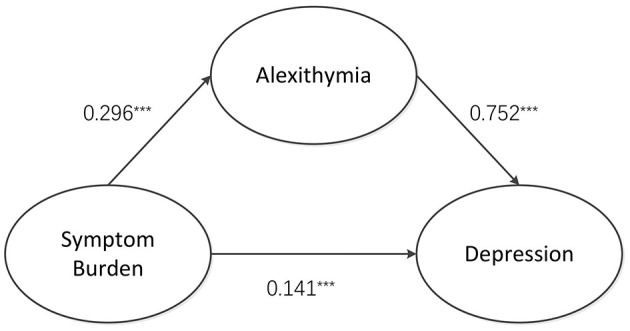
Results: MHD patients had a DFSSBI score of 77.41 ± 45.74, a TAS-20 score of 55.36 ± 11.17, and a Patient Health Questionnaire (PHQ-9) score of 6.07 ± 4.60. The burden of symptoms was positively correlated with alexithymia and depression (r = 0.367, 0.776, P = 0.000). The regression model had a high goodness of fit (χ2/df = 1.604, RMSEA = 0.040, GFI = 0.986, CFI = 0.999, TLI =0.997). The structural equation model analysis found the following: symptom burden was a positive predictor of alexithymia, β = 0.296, P < 0.001; alexithymia was a positive predictor of depression, β = 0.752, P < 0.001; and symptom burden was a positive predictor of depression, β = 0.141, P < 0.001.
Conclusion: The level of depression in MHD patients is closely related to the burden of symptoms and alexithymia, with alexithymia serving as a partial intermediary between the two. Addressing the emotional wellbeing and symptom load of MHD patients is critical to relieving their depressive symptoms.
Keywords: alexithymia; depression; maintenance haemodialysis; mediating effect; symptom burden.
Copyright © 2025 Liu, Xia, Wang, Yuan, Xiao and Xiang.
Conflict of interest statement
The authors declare that the research was conducted in the absence of any commercial or financial relationships that could be construed as a potential conflict of interest.
Figures
References
LinkOut - more resources
Full Text Sources
Miscellaneous
