


A case of schizophrenia with Parkinson's disease: Reduced dopamine transporter binding in unilateral striatum and normal uptake pattern of 123I-MIBG myocardial scintigraphy
- PMID: 40697761
- PMCID: PMC12280043
- DOI: 10.1002/pcn5.70149
A case of schizophrenia with Parkinson's disease: Reduced dopamine transporter binding in unilateral striatum and normal uptake pattern of 123I-MIBG myocardial scintigraphy
Abstract
Background: In rare instances, Parkinson's disease may develop in patients with schizophrenia receiving antipsychotic treatment, highlighting the need for comprehensive clinical evaluation and imaging investigations. We present a case of schizophrenia coexisting with suspected familial Parkinson's disease, characterized by a discrepancy between dopamine transportor single photon emission computed tomography (DAT SPECT) and 123I meta-iodo benzylguanidine (MIBG) myocardial scintigraphy results.
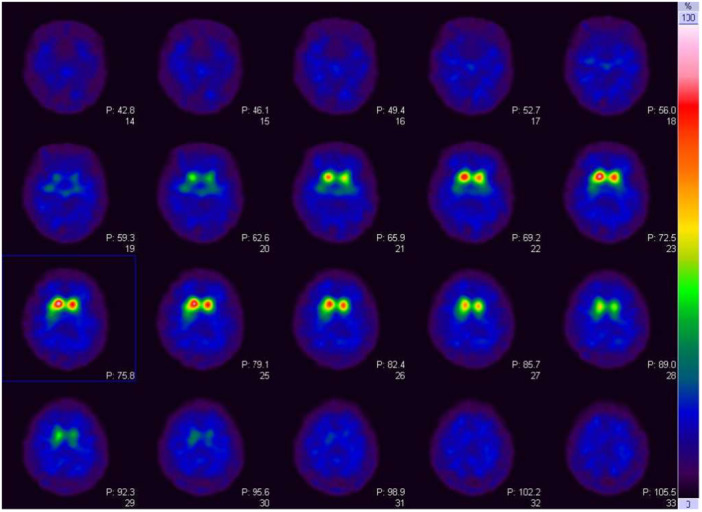
Case presentation: The patient was a woman in her 50s who first exhibited paranoid delusions and auditory hallucinations in her 20s and was continuously treated on an outpatient basis for schizophrenia. Three years ago, she sought consultation at a neurology clinic due to resting tremor in the right upper limb and difficulty walking. Given the asymmetry of her symptoms and the notable decrease in left-sided uptake observed on the DAT SPECT, she was diagnosed with Parkinson's disease, and her symptoms improved with levodopa therapy. One year later, she developed lower limb rigidity and weakness, and was seen at another hospital's neurology department. Despite these findings, MIBG myocardial scintigraphy revealed no significant uptake reduction, leading to a diagnosis of drug-induced parkinsonism. After reducing both anti-Parkinson's and antipsychotic medications, her auditory hallucinations and motor difficulties worsened, prompting her referral to our department for inpatient care. On reassessment, Parkinson's disease was confirmed and anti-Parkinson's medication was reintroduced, leading to improvement in her motor symptoms without exacerbation of psychiatric symptoms, and she was discharged home.
Conclusion: Prompt and accurate diagnosis through detailed clinical evaluation and appropriate imaging studies is crucial for the effective management of both schizophrenia and parkinsonism, ensuring optimal control of both conditions. Clinical trial registration. This report is not a clinical trial.
Keywords: 123I‐MIBG myocardial scintigraphy; DAT SPECT; Parkinson's disease; schizophrenia.
© 2025 The Author(s). Psychiatry and Clinical Neurosciences Reports published by John Wiley & Sons Australia, Ltd on behalf of Japanese Society of Psychiatry and Neurology.
Conflict of interest statement
The authors declare no conflicts of interest.
Figures
References
-
- Tijero B, Gomez‐Esteban JC, Llorens V, Lezcano E, Gonzalez‐Fernández MC, dePancorbo MM, et al. Cardiac sympathetic denervation precedes nigrostriatal loss in the E46K mutation of the α‐synuclein gene (SNCA). Clin Auton Res. 2010;20(4):267–269. - PubMed
-
- Orimo S, Uchihara T, Nakamura A, Mori F, Ikeuchi T, Onodera O, et al. Cardiac sympathetic denervation in Parkinson's disease linked to SNCA duplication. Acta Neuropathol. 2008;116(5):575–577. - PubMed
-
- Orimo S, Amino T, Yokochi M, Kojo T, Uchihara T, Takahashi A, et al. Preserved cardiac sympathetic nerve accounts for normal cardiac uptake of MIBG in PARK2. Mov Disorders. 2005;20(10):1350–1353. - PubMed
-
- Orimo S. Pathological background of reduced cardiac MIBG uptake. In: Iwase S, Hayano J, Orimo S eds. Clinical Assessment of Autonomic Nervous System. Tokyo: Springer; 2016.
LinkOut - more resources
Full Text Sources