


Hypertension promotes neuroinflammation, brain injury and cognitive impairment
- PMID: 40697973
- PMCID: PMC12281552
- DOI: 10.1016/j.bbih.2025.101059
Hypertension promotes neuroinflammation, brain injury and cognitive impairment
Abstract
Background: Hypertension increases the risk for cognitive impairment and promotes vascular and renal inflammation. We tested if immune cell infiltration occurs in the brain during hypertension and if it is associated with cognitive impairment.
Methods: Male C57Bl/6 mice were administered vehicle, angiotensin II (0.7 mg/kg/d S.C.) or aldosterone (0.72 mg/kg/d S.C.) via osmotic minipumps. A subset of mice also received hydralazine (50 mg/kg) in their drinking water after minipump implantation. We measured systolic blood pressure, markers of inflammation, working memory and transcriptomic changes in the brain.
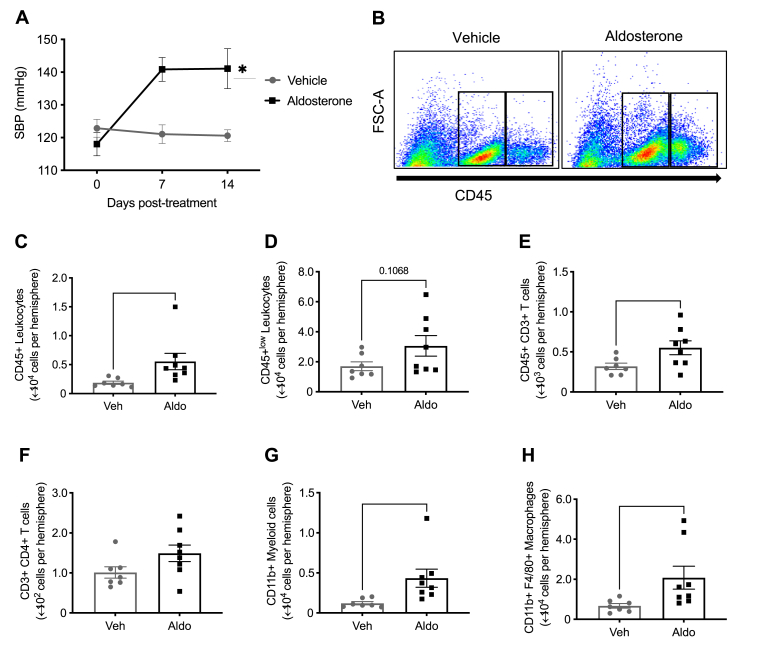
Results: Administration of angiotensin II or aldosterone increased blood pressure and promoted blood-brain barrier dysfunction, leukocyte accumulation and impairment of working memory in mice. When co-administered with angiotensin II, hydralazine prevented the development of these changes. In a separate cohort of mice in which angiotensin II-induced changes were first established, intervention with hydralazine lowered blood pressure but did not reverse brain inflammation or cognitive impairment. Finally, angiotensin II infusion altered the transcriptomic profile of the whole brain, as well as specifically within the hippocampus, and co-treatment with hydralazine modulated these changes.
Conclusions: Experimental hypertension leads to brain inflammation and was associated with impaired working memory. Cognitive impairment that develops during hypertension can be inhibited, but not readily reversed, by anti-hypertensive therapy.
Keywords: Blood-brain barrier; Brain; Cognition; Hypertension; Inflammation.
© 2025 The Authors.
Conflict of interest statement
The authors declare the following financial interests/personal relationships which may be considered as potential competing interests:Christopher G. Sobey reports financial support was provided by the 10.13039/501100000925National Health and Medical Research Council, Australia. If there are other authors, they declare that they have no known competing financial interests or personal relationships that could have appeared to influence the work reported in this paper.
Figures



References
-
- Baik S.H., Selvaraji S., Fann D.Y., Poh L., Jo D.G., Herr D.R., Zhang S.R., Kim H.A., Silva M., Lai M.K.P., et al. Hippocampal transcriptome profiling reveals common disease pathways in chronic hypoperfusion and aging. Aging (Albany NY) 2021;13:14651–14674. doi: 10.18632/aging.203123. - DOI - PMC - PubMed
-
- Bowman G.L., Dayon L., Kirkland R., Wojcik J., Peyratout G., Severin I.C., Henry H., Oikonomidi A., Migliavacca E., Bacher M., et al. Blood-brain barrier breakdown, neuroinflammation, and cognitive decline in older adults. Alzheimer's Dement. 2018;14:1640–1650. doi: 10.1016/j.jalz.2018.06.2857. - DOI - PubMed
-
- Bozoki A., Giordani B., Heidebrink J.L., Berent S., Foster N.L. Mild cognitive impairments predict dementia in nondemented elderly patients with memory loss. Arch. Neurol. 2001;58:411–416. - PubMed
LinkOut - more resources
Full Text Sources
