


Liquid Biopsy: Current advancements in clinical practice for bladder cancer
- PMID: 40698358
- PMCID: PMC12281373
- DOI: 10.1016/j.jlb.2025.100310
Liquid Biopsy: Current advancements in clinical practice for bladder cancer
Abstract
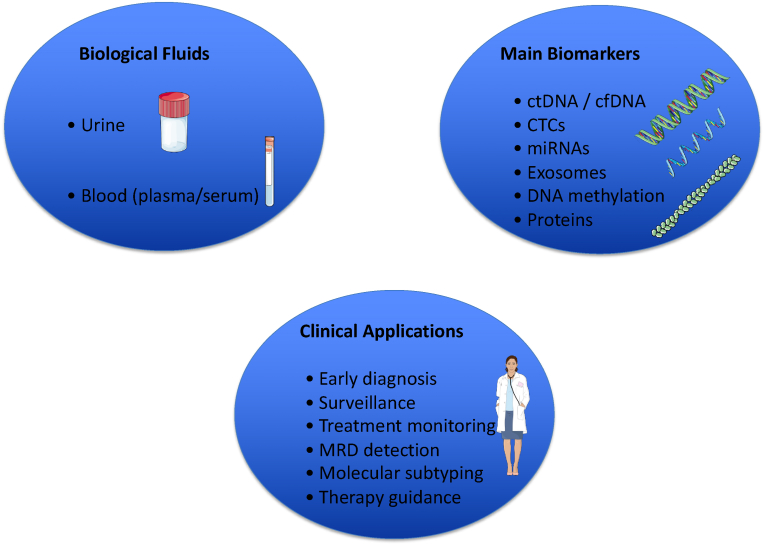
Bladder cancer is the ninth most common malignancy worldwide, with two clinically distinct forms: non-muscle-invasive disease, characterized by high recurrence and excellent long-term survival, and muscle-invasive disease, associated with poorer outcomes. Current surveillance-cystoscopy and urine cytology-offers high specificity but is invasive, costly, and insensitive to low-grade tumors, underscoring the need for reliable, non-invasive biomarkers. Liquid biopsy approaches in urine and blood have demonstrated promise for real-time assessment of tumor burden, molecular heterogeneity, and early recurrence. Circulating tumor DNA (ctDNA) assays detect tumor-derived genetic and epigenetic alterations, enabling dynamic monitoring of minimal residual disease and treatment response. Methylation-based tests and CpG-targeted sequencing in urine achieve high diagnostic accuracy, potentially reducing dependence on cystoscopy. Molecular classification of bladder tumors into luminal and basal subtypes has refined therapeutic strategies: FGFR inhibitors for luminal-papillary tumors, EGFR-targeted and chemotherapy approaches for basal/squamous cases, and immune-checkpoint inhibitors guided by immune-infiltration profiles. Integration of artificial intelligence with multi-omic liquid biopsy data further enhances predictive modeling for recurrence, treatment response, and minimal residual disease detection. Despite these advances, clinical implementation faces challenges including pre-analytical variability, lack of standardized assays, limited prospective validation, and unclear cost-effectiveness. Harmonized protocols, large multicenter trials, and health-economic evaluations are essential to translate liquid biopsy technologies into routine practice. Future integration with advanced imaging, tissue biopsy, and digital pathology-supported by multidisciplinary collaboration and formal guideline endorsement-holds the potential to personalize bladder cancer management, reduce invasive procedures, and improve patient outcomes.
Keywords: Biomarkers; Biopsy; Bladder cancer; Circulating; Liquid.
© 2025 The Authors.
Conflict of interest statement
The authors declare that they have no known competing financial interests or personal relationships that could have appeared to influence the work reported in this paper.
Figures
References
-
- Antoni S., Ferlay J., Soerjomataram I., et al. Bladder cancer incidence and mortality: a global overview and recent trends. Eur Urol. 2017;71(1):96–108. - PubMed
-
- Cumberbatch M.G.K., Jubber I., Black P.C., et al. Epidemiology of bladder cancer: a systematic review and contemporary update of risk factors in 2018. Eur Urol. 2018;74(6):784–795. - PubMed
-
- Babjuk M., Burger M., Capoun O., et al. European association of Urology guidelines on non-muscle-invasive bladder cancer (TaT1 and carcinoma in situ) - 2021 update. Eur Urol. 2021;80(5):447–461. - PubMed
Publication types
LinkOut - more resources
Full Text Sources
Research Materials
Miscellaneous
