


Comparison of the incidence of slow flow following rotational atherectomy to severely calcified coronary artery lesions between short single session and long single session strategies: the randomized ROTASOLO trial
- PMID: 40699521
- PMCID: PMC12432047
- DOI: 10.1007/s12928-025-01177-8
Comparison of the incidence of slow flow following rotational atherectomy to severely calcified coronary artery lesions between short single session and long single session strategies: the randomized ROTASOLO trial
Abstract
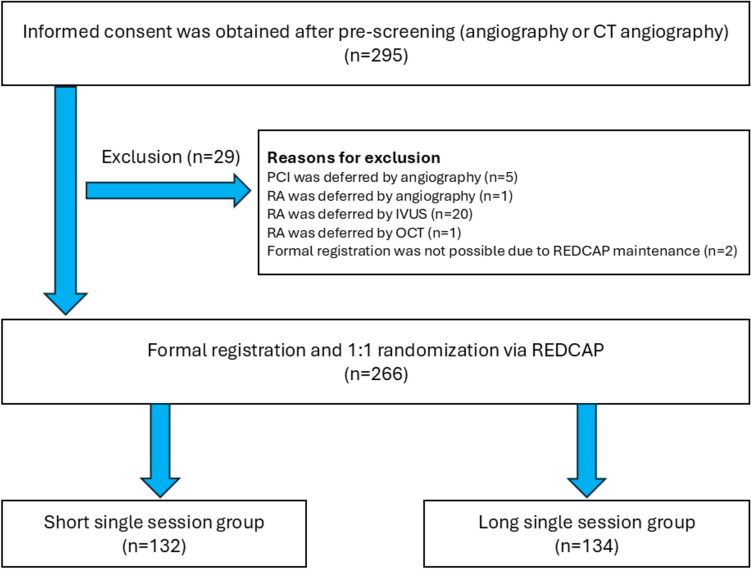
Slow flow is the most common complication of rotational atherectomy (RA). Compared with long single sessions, short single sessions may reduce the incidence of slow flow just after RA. This study aimed to compare the incidence of slow flow just after RA between short single session and long single session strategies. This multicenter, 1:1 randomized clinical trial was conducted at 3 hospitals in Japan. The short single session strategy was defined as repeating short single sessions (up to 15 s) of RA, whereas the long single session strategy was defined as repeating long single sessions (20-30 s) until the burr crossed the target lesion. The primary outcome was slow flow just after RA, which was defined as [(initial TIMI-frame count before RA) × 1.1 minus (TIMI-frame count just after RA)] less than 0. During the study period, 266 patients were included in the final study population and were randomly assigned to the Short single session group (n = 132) or the long single session group (n = 134). The protocol adherence rate was equally high in both groups (Short single session: 98.5% versus long single session 94.8%, p = 0.172). The incidence of slow flow just after RA was similar between the 2 groups (short single session:14.4% versus long single session: 14.9%, p > 0.999). In conclusion, this randomized trial did not show a benefit of the short single session strategy compared with the long single session strategy in RA with respect to the prevention of slow flow (Unique identifier: UMIN000047231).
Keywords: Complications; Percutaneous coronary intervention; Randomized control study; Rotational atherectomy; Slow flow.
© 2025. The Author(s).
Conflict of interest statement
Declarations. Conflict of interest: Dr. Sakakura has received speaking honoraria from Boston Scientific; he has served as a proctor for Rotablator for Boston Scientific; and he has served as a consultant for Boston Scientific. Dr. Jinnouchi and Dr. Taniguchi have received speaking honoraria from Boston Scientific. Dr. Yamamoto has received speaking honoraria from Boston Scientific, and has served as a consultant for Boston Scientific.
Figures

References
-
- Bourantas CV, Zhang YJ, Garg S, Iqbal J, Valgimigli M, Windecker S, et al. Prognostic implications of coronary calcification in patients with obstructive coronary artery disease treated by percutaneous coronary intervention: a patient-level pooled analysis of 7 contemporary stent trials. Heart. 2014;100(15):1158–64. - PubMed
-
- Kawashima H, Serruys PW, Hara H, Ono M, Gao C, Wang R, et al. 10-year all-cause mortality following percutaneous or surgical revascularization in patients with heavy calcification. JACC Cardiovasc Interv. 2022;15(2):193–204. - PubMed
-
- O’Neill WW. Mechanical rotational atherectomy. Am J Cardiol. 1992;69(15):12f-f18. - PubMed
-
- Tomey MI, Kini AS, Sharma SK. Current status of rotational atherectomy. JACC Cardiovasc Interv. 2014;7(4):345–53. - PubMed
Publication types
MeSH terms
Grants and funding
LinkOut - more resources
Full Text Sources
Medical
