Review
. 2025 Apr 18;47(4):290.
doi: 10.3390/cimb47040290.

FNIP1 Deficiency: Pathophysiology and Clinical Manifestations of a Rare Syndromic Primary Immunodeficiency

Affiliations
Review

FNIP1 Deficiency: Pathophysiology and Clinical Manifestations of a Rare Syndromic Primary Immunodeficiency

Samuele Roncareggi et al. Curr Issues Mol Biol. .

Abstract

Folliculin-interacting protein 1 (FNIP1) is a key regulator of cellular metabolism and immune homeostasis, integrating nutrient signaling with proteostasis. FNIP1 forms a complex with folliculin (FLCN) to regulate the mechanistic target of rapamycin complex 1 (mTORC1), functioning as a GTPase-activating protein (GAP) for RagC/D. Additionally, FNIP1 interacts with heat shock protein 90 (HSP90) and undergoes phosphorylation, glycosylation, and ubiquitination, which dynamically regulate its stability and function. Evidence from murine models suggests that FNIP1 loss disrupts immune cell development and mitochondrial homeostasis. However, FNIP1 deficiency in humans remains incompletely characterized, and its full phenotypic spectrum is likely underestimated. Notably, FNIP1-deficient patients exhibit immunological and hematological abnormalities, immune dysregulation, and metabolic perturbations, emphasizing its role in cellular adaptation to stress. Understanding the mechanistic basis of FNIP1 dysfunction in human tissues will be critical for delineating its contributions to immune and metabolic disorders and identifying targeted interventions.

Keywords: FNIP1 deficiency; agammaglobulinemia; hypertrophic cardiomyopathy; inborn error of immunity; neutropenia; primary immunodeficiency.


Conflict of interest statement

The authors declare no conflicts of interest.

Figures

Figure 1
Figure 1
Protein domains, functional roles, and tissue-specific expression of FNIP1. (A) Schematic representation of FNIP1 protein structure and post-translational modifications. FNIP1 contains distinct domains, including longin, degron, and DENN-like domains. FNIP1 undergoes AMPK-dependent phosphorylation at serine residues S220, S230, S232, S261, and S593, regulating its function in metabolic sensing. Additional casein kinase 2 (CK2)-mediated phosphorylation at S938, S939, S941, S946, and S948 facilitates HSP90 inhibition and client protein activation. Conversely, protein phosphatase 5 (PP5)-mediated dephosphorylation allows for O-GlcNAc transferase (OGT)-dependent glycosylation of S938, thereby preventing HSP90 interaction and leading to K1119 ubiquitination and proteasomal degradation. The degron motif (C580, C582, and C585) enables FEM1B binding and FNIP1 ubiquitylation, facilitating degradation in response to reductive stress. (B) Tissue-specific FNIP1 RNA expression. Expression levels (nTPM) of FNIP1 transcripts across various human tissues. FNIP1 shows high expression in immune-related tissues, including the thymus, spleen, and bone marrow, as well as in metabolically active tissues such as the kidney and liver. (C) Tissue-specific FNIP1 protein expression. Protein expression levels, categorized as high, medium, low, or not detected with strong FNIP1 presence in immune and metabolic active tissues (https://v22.proteinatlas.org/ENSG00000217128-FNIP1/tissue, accessed on 4 March 2025).
Figure 2
Figure 2
FNIP1 cellular signaling and metabolism. FNIP1, in complex with folliculin (FLCN), functions as a GAP (GTPase-activating protein) for RagC/D to regulate mTORC1 activity at the lysosome. Under low energy conditions (high AMP/low ATP) ①, FNIP1 is phosphorylated by AMPK, which prevents RagC activation ② and inhibits mTORC1 signaling. This results in the activation of TFE family transcription factors (TFEB and TFE3) ③④, which drive lysosomal ⑤ and mitochondrial biogenesis ⑥ via PGC1α and PGC1β transcription. Created in BioRender. Iritani, B. (2025), https://BioRender.com/f18p969, accessed on 4 March 2025.
Figure 3
Figure 3
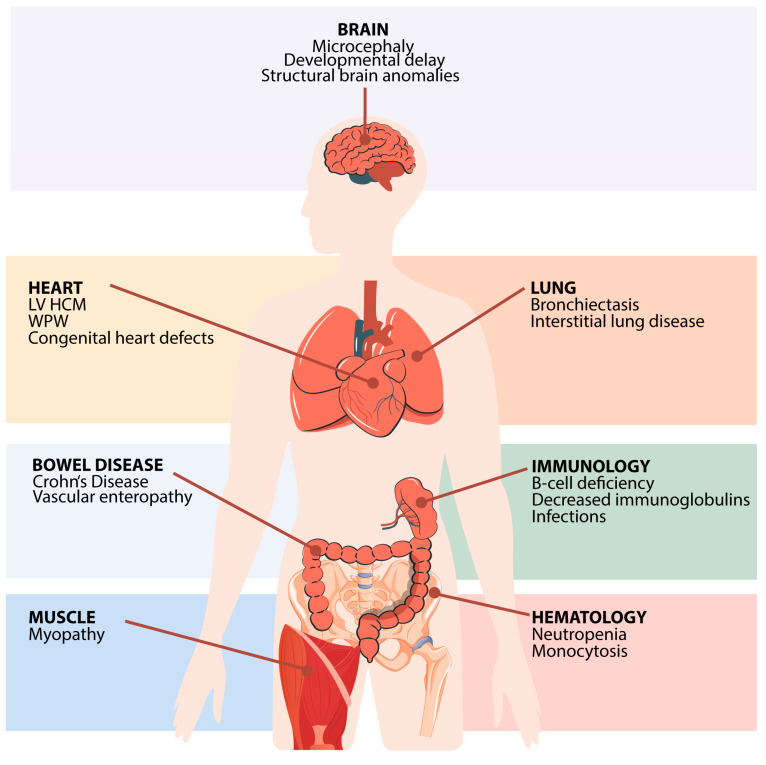
Clinical features of FNIP1 deficiency by organ system. Common clinical findings are shown by the affected organ system. Vectors from Freepik. LV HCM = left ventricular hypertrophic cardiomyopathy. WPW = Wolff–Parkinson–White syndrome.

Similar articles

  • Clinical and Immunologic Features of a Patient With Homozygous FNIP1 Variant.
    Ulaş S, Naiboğlu S, Özyilmaz İ, Öztürk Demir AG, Turan I, Yuzkan S, Ayaz A, Çeliksoy MH. Ulaş S, et al. J Pediatr Hematol Oncol. 2024 Aug 1;46(6):e472-e475. doi: 10.1097/MPH.0000000000002862. Epub 2024 May 14. J Pediatr Hematol Oncol. 2024. PMID: 38748614
  • Muscle-bone cross-talk through the FNIP1-TFEB-IGF2 axis is associated with bone metabolism in human and mouse.
    Mao Y, Jin Z, Yang J, Xu D, Zhao L, Kiram A, Yin Y, Zhou D, Sun Z, Xiao L, Zhou Z, Yang L, Fu T, Xu Z, Jia Y, Chen X, Niu FN, Li X, Zhu Z, Gan Z. Mao Y, et al. Sci Transl Med. 2024 Jun 5;16(750):eadk9811. doi: 10.1126/scitranslmed.adk9811. Epub 2024 Jun 5. Sci Transl Med. 2024. PMID: 38838134
  • Systemic Inflammatory Response Syndrome.
    Baddam S, Burns B. Baddam S, et al. 2025 Jun 20. In: StatPearls [Internet]. Treasure Island (FL): StatPearls Publishing; 2025 Jan–. 2025 Jun 20. In: StatPearls [Internet]. Treasure Island (FL): StatPearls Publishing; 2025 Jan–. PMID: 31613449 Free Books & Documents.
  • Management of urinary stones by experts in stone disease (ESD 2025).
    Papatsoris A, Geavlete B, Radavoi GD, Alameedee M, Almusafer M, Ather MH, Budia A, Cumpanas AA, Kiremi MC, Dellis A, Elhowairis M, Galán-Llopis JA, Geavlete P, Guimerà Garcia J, Isern B, Jinga V, Lopez JM, Mainez JA, Mitsogiannis I, Mora Christian J, Moussa M, Multescu R, Oguz Acar Y, Petkova K, Piñero A, Popov E, Ramos Cebrian M, Rascu S, Siener R, Sountoulides P, Stamatelou K, Syed J, Trinchieri A. Papatsoris A, et al. Arch Ital Urol Androl. 2025 Jun 30;97(2):14085. doi: 10.4081/aiua.2025.14085. Epub 2025 Jun 30. Arch Ital Urol Androl. 2025. PMID: 40583613 Review.
  • Citrullinemia Type I.
    Quinonez SC, Lee KN. Quinonez SC, et al. 2004 Jul 7 [updated 2022 Aug 18]. In: Adam MP, Feldman J, Mirzaa GM, Pagon RA, Wallace SE, Amemiya A, editors. GeneReviews® [Internet]. Seattle (WA): University of Washington, Seattle; 1993–2025. 2004 Jul 7 [updated 2022 Aug 18]. In: Adam MP, Feldman J, Mirzaa GM, Pagon RA, Wallace SE, Amemiya A, editors. GeneReviews® [Internet]. Seattle (WA): University of Washington, Seattle; 1993–2025. PMID: 20301631 Free Books & Documents. Review.

References

    1. IJspeert H., Edwards E.S.J., O’Hehir R.E., Dalm V.A.S.H., van Zelm M.C. Update on inborn errors of immunity. J. Allergy Clin. Immunol. 2024;155:470–751. doi: 10.1016/j.jaci.2024.12.1075. - DOI - PubMed
    1. Saettini F., Herriot R., Prada E., Nizon M., Zama D., Marzollo A., Romaniouk I., Lougaris V., Cortesi M., Morreale A., et al. Prevalence of Immunological Defects in a Cohort of 97 Rubinstein-Taybi Syndrome Patients. J. Clin. Immunol. 2020;40:851–860. doi: 10.1007/s10875-020-00808-4. - DOI - PubMed
    1. Saettini F., Guerra F., Mauri M., Salter C.G., Adam M.P., Adams D., Baple E.L., Barredo E., Bhatia S., Borkhardt A., et al. Biallelic PI4KA Mutations Disrupt B-Cell Metabolism and Cause B-Cell Lymphopenia and Hypogammaglobulinemia. J. Clin. Immunol. 2024;45:15. doi: 10.1007/s10875-024-01793-8. - DOI - PubMed
    1. Rossini L., Ricci S., Montin D., Azzari C., Gambineri E., Tellini M., Conti F., Pession A., Saettini F., Naviglio S., et al. Immunological Aspects of Kabuki Syndrome: A Retrospective Multicenter Study of the Italian Primary Immunodeficiency Network (IPINet) J. Clin. Immunol. 2024;44:105. doi: 10.1007/s10875-024-01676-y. - DOI - PubMed
    1. Saettini F., Guerra F., Fazio G., Bugarin C., McMillan H.J., Ohtake A., Ardissone A., Itoh M., Giglio S., Cappuccio G., et al. Antibody Deficiency in Patients with Biallelic KARS1 Mutations. J. Clin. Immunol. 2023;43:2115–2125. doi: 10.1007/s10875-023-01584-7. - DOI - PubMed

LinkOut - more resources