


Comparative Efficiency of Whole-Body Electromyostimulation and Resistance Training in Enhancing 1-Repetition Maximum
- PMID: 40700179
- PMCID: PMC12286242
- DOI: 10.3390/jfmk10030243
Comparative Efficiency of Whole-Body Electromyostimulation and Resistance Training in Enhancing 1-Repetition Maximum
Abstract
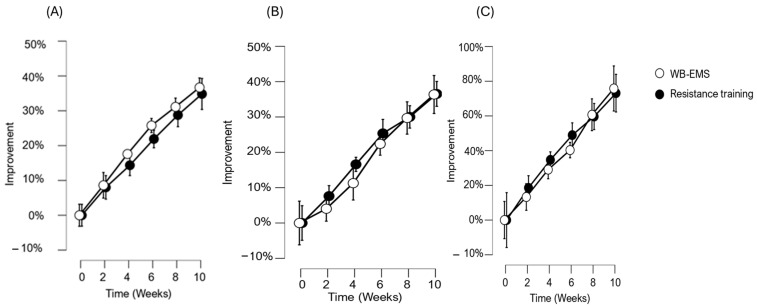
Background: Whole-body electromyostimulation (WB-EMS) combines full-body electrical muscle stimulation with instructor-assigned exercise. Electrical impulses are transmitted to the peripheral muscles through electrodes applied to the body. This study compared two training methodologies, WB-EMS training and traditional resistance training, to determine which approach leads to greater strength improvement in terms of 1-repetition maximum (1-RM). Methods: Twenty sedentary women participated in a 10 weeks protocol with five evaluations conducted every two weeks. The WB-EMS group trained for 20 min per week, and the resistance training group (RT) performed an average of two training sessions per week, lasting 60 min each. Both groups were evaluated using three exercises: back squat and hammer curl (1-RM), and plank exercise (time to exhaustion). Results: Both groups increased their performance in squat (WB-EMS +36%, p = 0.0001; RT +34%, p = 0.0001), curl (WB-EMS +42%, p = 0.0001; RT +33%, p = 0.0001), and plank (WB-EMS +103%, p = 0.0001; RT +65%, p = 0.0001). No significant time × training interaction was found for any exercise, indicating that the two groups improved similarly. Conclusions: Although WB-EMS did not confer greater strength improvement than traditional resistance training, it offers a time-efficient alternative, achieving similar results with reduced time commitment.
Keywords: WB-EMS; back squat; hammer curl; plank; resistance training; women.
Conflict of interest statement
The authors declare no conflicts of interest.
Figures
References
-
- Kemmler W., Schliffka R., Mayhew J.L., von Stengel S. Effects of whole-body electromyostimulation on resting metabolic rate, body composition, and maximum strength in postmenopausal women: The Training and ElectroStimulation Trial. J. Strength Cond. Res. 2010;24:1880–1887. doi: 10.1519/JSC.0b013e3181ddaeee. - DOI - PubMed
-
- D’Ottavio S., Briotti G., Rosazza C., Partipilo F., Silvestri A., Calabrese C., Bernardini A., Gabrielli P.R., Ruscello B. Effects of Two Modalities of Whole-body Electrostimulation Programs and Resistance Circuit Training on Strength and Power. Int. J. Sports Med. 2019;40:831–841. doi: 10.1055/a-0982-3311. - DOI - PubMed
-
- Kemmler W., Grimm A., Bebenek M., Kohl M., von Stengel S. Effects of combined whole-body electromyostimulation and protein supplementation on local and overall muscle/fat distribution in older men with sarcopenic obesity: The randomized controlled Franconia Sarcopenic Obesity (FranSO) study. Calcif. Tissue Int. 2018;103:266–277. doi: 10.1007/s00223-018-0424-2. - DOI - PubMed
LinkOut - more resources
Full Text Sources
