


Seroprevalence of IgG and IgE Antibodies Against Anisakis in the Presumably Healthy Population of the Canary Islands
- PMID: 40700300
- PMCID: PMC12286113
- DOI: 10.3390/antib14030060
Seroprevalence of IgG and IgE Antibodies Against Anisakis in the Presumably Healthy Population of the Canary Islands
Abstract
Food-borne zoonoses, particularly anisakiosis caused by Anisakis spp., are an increasing public health concern due to the rising consumption of raw fish. Anisakiosis results from the ingestion of third-stage larvae of Anisakidae nematodes, with the genus Anisakis re-sponsible for approximately 97% of human cases. While regulatory protocols exist to minimize infection risk in commercial settings, domestic food preparation often lacks such safeguards, creating a gap in public health protection. In the Canary Islands, a major Spanish aquaculture region, farmed fish exhibit a low Anisakis prevalence, suggesting minimal risk from aquaculture products. In contrast, wild-caught fish demonstrate varia-ble parasitism, with recent studies reporting a 25% prevalence among commercial species.
Methods: This study assessed Anisakis exposure in the Canary Islands by measuring specific IgG and IgE antibodies in 1043 serum samples collected from all seven islands between March 2014 and October 2015. ELISA assays detected anti-Anisakis antibodies, and the results were analyzed by age, sex, island, and isoclimatic zone.
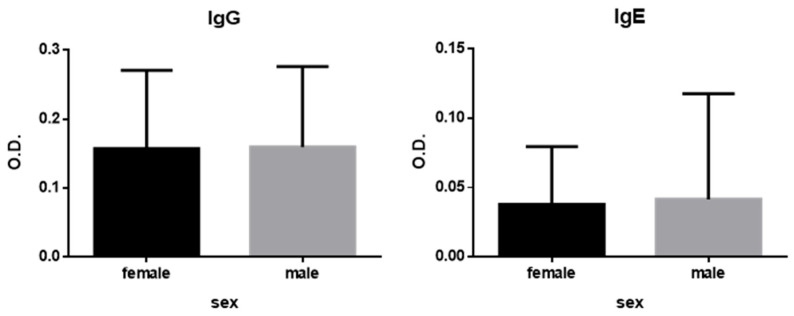
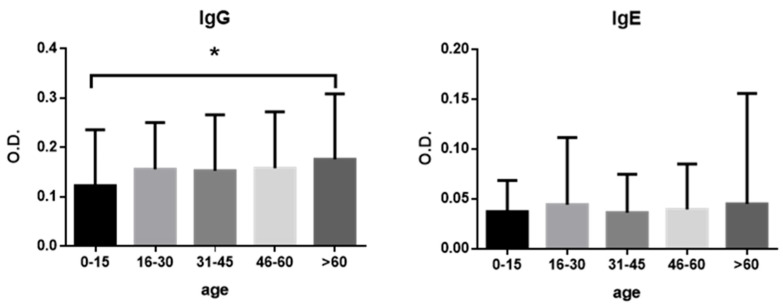
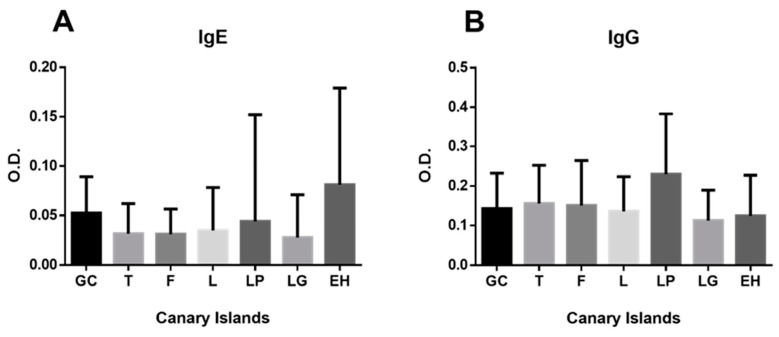
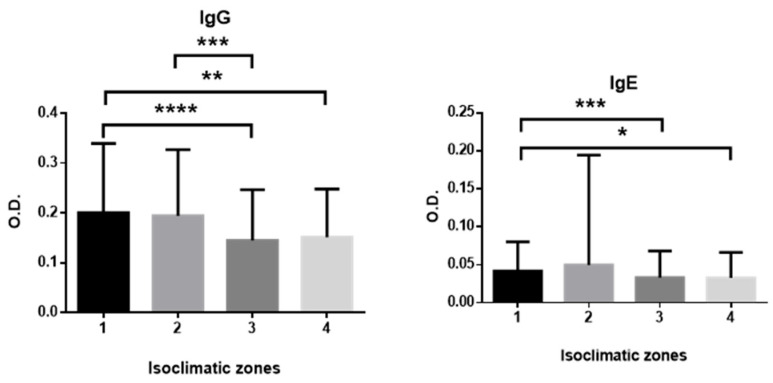
Results: Overall, 16.9% of samples were IgG-positive and 6.8% were IgE-positive. Seroprevalence was significantly higher in indi-viduals aged 60 years and above. Geographic heterogeneity was notable: La Palma had the highest IgG seroprevalence (35.3%), while El Hierro showed the highest IgE prevalence (16.3%). Temperate isoclimatic zones exhibited higher antibody prevalence than dry zones. These findings indicate variable Anisakis exposure across the Canary Islands, likely influenced by environmental and behavioral factors.
Conclusions: The results highlight the need for targeted public health interventions to reduce the anisakiosis risk, particularly in regions and populations with elevated exposure.
Keywords: Canary Islands; ELISA; IgE antibodies; IgG antibodies; anisakiosis; parasitic infection; seroprevalence; zoonoses.
Conflict of interest statement
The authors declare no conflicts of interest.
Figures
References
-
- Colombo F., Cattaneo P., Castelletti M., Bernardi C. Prevalence and Mean Intensity of Anisakidae Parasite in Seafood Caught in the Mediterranean Sea Focusing on Fish Species at Risk of Being Raw-consumed. A Meta Analysis and Systematic Review. Crit. Rev. Food Sci. Nutr. 2016;56:1405–1416. doi: 10.1080/10408398.2012.755947. - DOI - PubMed
-
- Pravettoni V., Primavesi L., Piantanida M. Anisakis simplex: Current knowledge. Eur. Ann. Allergy Clin. Immunol. 2012;44:150–156. - PubMed
LinkOut - more resources
Full Text Sources
Miscellaneous
