


Radiomics analysis for the early diagnosis of common sexually transmitted infections and skin lesions
- PMID: 40700364
- PMCID: PMC12286352
- DOI: 10.1371/journal.pdig.0000926
Radiomics analysis for the early diagnosis of common sexually transmitted infections and skin lesions
Erratum in
-
Correction: Radiomics analysis for the early diagnosis of common sexually transmitted infections and skin lesions.PLOS Digit Health. 2025 Oct 31;4(10):e0001079. doi: 10.1371/journal.pdig.0001079. eCollection 2025 Oct. PLOS Digit Health. 2025. PMID: 41171693 Free PMC article.
Abstract
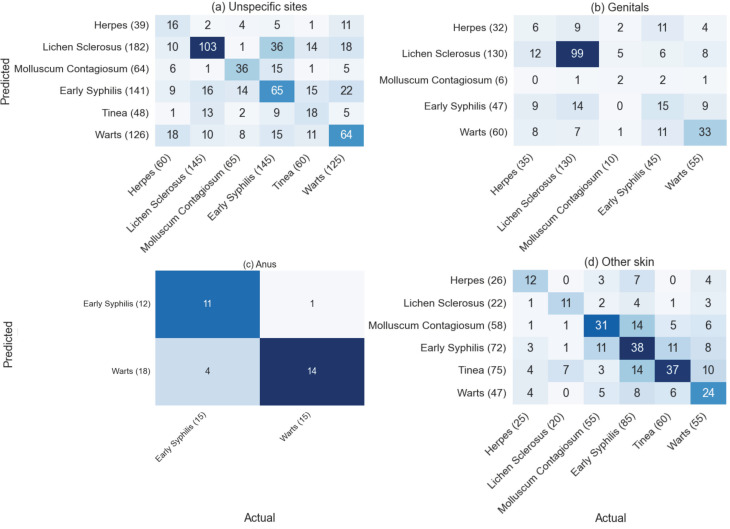
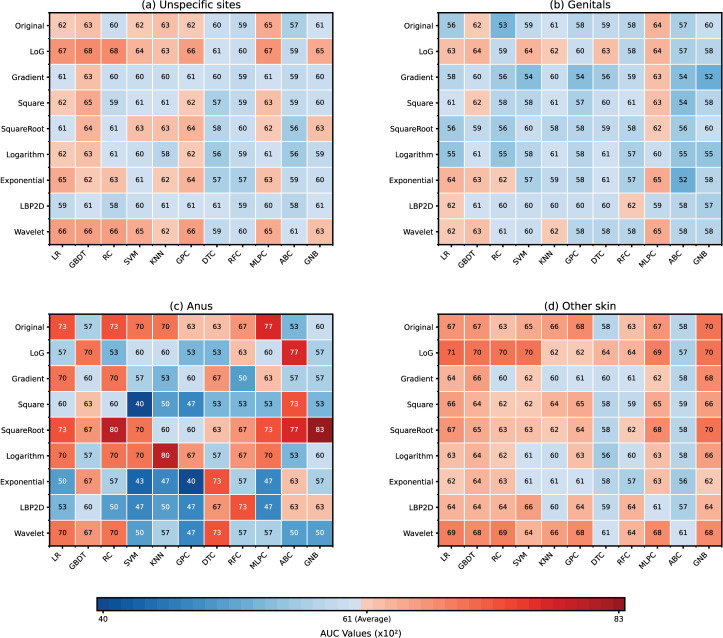
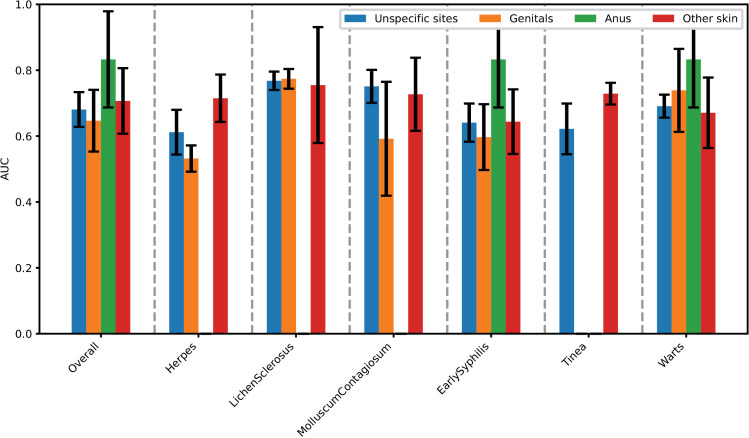
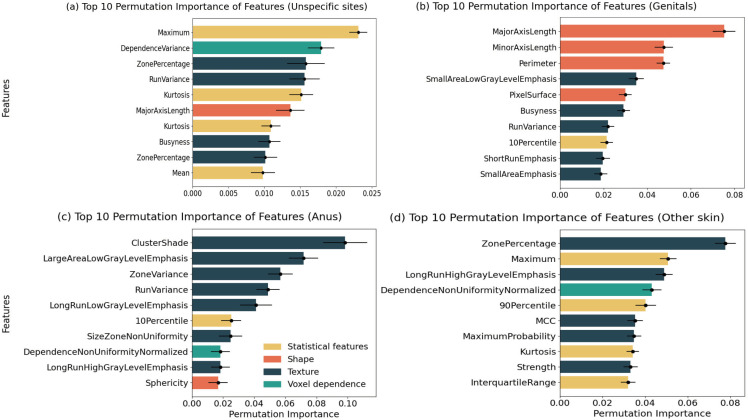
Early identification of sexually transmitted infection (STI) symptoms can prevent subsequent complications and improve STI control. We analysed 597 images from STIAtlas and categorised the images into four typical STIs and two skin lesions by the anatomical sites of infections. We first applied nine image filters and 11 machine-learning image classifiers to the images. We then extracted radiomics features from the filtered images and trained them with 99 models that combined image filters and classifiers. Model performance was evaluated by area under curve (AUC) and permutation importance. When the information of infection sites was unspecified, a combined Gradient-Boosted Decision Trees (GBDT) classifier and Laplacian of Gaussian (LoG) filter model achieved the best overall performance with an average AUC of 0.681 (95% CI 0.628-0.734). This model predicted best for lichen sclerosus (AUC = 0.768, 0.740-0.796). The incorporation of infection site information led to a substantial improvement in the model's performance, with 22.3% improvement for anal infections (AUC = 0.833, 0.687-0.979) and 3.8% for skin infections (AUC = 0.707, 0.608-0.806). Lesion texture and statistical radiomics features were the most predictive for STIs. Combining machine learning and radiomics techniques is an effective method to categorise skin lesions associated with STIs clinically.
Copyright: © 2025 Sun et al. This is an open access article distributed under the terms of the Creative Commons Attribution License, which permits unrestricted use, distribution, and reproduction in any medium, provided the original author and source are credited.
Conflict of interest statement
The authors have declared that no competing interests exist.
Figures
References
-
- World Health Organization. Sexually transmitted infections (STIs) [cited 2023 1 December]. Available from: https://www.who.int/news-room/fact-sheets/detail/sexually-transmitted-in...
-
- Du M, Yan W, Jing W, Qin C, Liu Q, Liu M, et al. Increasing incidence rates of sexually transmitted infections from 2010 to 2019: an analysis of temporal trends by geographical regions and age groups from the 2019 Global Burden of Disease Study. BMC Infect Dis. 2022;22(1):574. doi: 10.1186/s12879-022-07544-7 - DOI - PMC - PubMed
-
- WHO. Global progress report on HIV, viral hepatitis and sexually transmitted infections. World Health Organization; 2021.
LinkOut - more resources
Full Text Sources