. 2025 Jul 23;19(7):e0013372.
doi: 10.1371/journal.pntd.0013372. eCollection 2025 Jul.

The long-term persistence of the wMel strain in Rio de Janeiro is threatened by poor integrated vector management and bacterium fitness cost on Aedes aegypti

Affiliations

The long-term persistence of the wMel strain in Rio de Janeiro is threatened by poor integrated vector management and bacterium fitness cost on Aedes aegypti

Márcio Galvão Pavan et al. PLoS Negl Trop Dis. .

Abstract

New tools and methods are currently under evaluation by the World Health Organization for preventing arbovirus transmission, such as dengue, Zika, and chikungunya. One promising approach involves deploying Aedes aegypti with the endosymbiotic bacterium Wolbachia pipientis to disrupt arbovirus transmission within endemic urban environments. The release program of mosquitoes with the Wolbachia's wMel strain started in August 2017 in 6.88% of the city area of Rio de Janeiro, where 13.1% of the city's population live (~890,000 inhabitants). The deployment of Wolbachia wMel strain in Rio finished in December 2019 with a suboptimal 32% introgression of wMel strain, which coincided with a 38% and 10% reduction of dengue and chikungunya, respectively. We conducted an independent evaluation during 20 consecutive months to evaluate whether the wMel distribution and frequency would expand or retract. More than 50,000 mosquitoes were sampled in 12 neighborhoods with estimated 500,000 inhabitants, of which 39.2% were Ae. aegypti. In total, 7,613 of 19,427 collected Ae. aegypti were screened individually for wMel. Climate, environmental and insecticide application data was used to model the spatiotemporal introgression of wMel. The routine insecticide rotation adopted by the Brazilian Ministry of Health caused the crash of both wMel-infected and -uninfected populations shortly after an increase in coverage with spinosad. However, the wMel-uninfected mosquitoes recovered soon to levels even higher than before, whereas the wMel-infected failed to recover after the population crash. The well documented fitness cost of wMel in egg hatching leads to the absence of an egg bank necessary to recover after adult population was disrupted. Finally, we observed the mtDNA haplotype associated with released Wolbachia at a frequency of ~25% in field-caught uninfected mosquitoes. The reason underlying the poor introgression of Wolbachia wMel strain is multifold. The adoption of an effective larvicide that crashed both wMel-infected and -uninfected populations, the absence of an egg bank due to high fitness cost of egg hatching in the wMel-infected mosquitoes, a suboptimal Wolbachia invasion before the intervention, and Wolbachia loss synergically contributed to the lower invasion and, by corollary, modest epidemiological outcome in Rio de Janeiro. Our results highlight the need to plan and implement technical guidance on Integrated Vector Management in Brazil prior and during the nationwide release of Wolbachia-infected mosquitoes to optimize dengue mitigation efforts while ensuring the judicious use of resources.


Conflict of interest statement

The authors have declared that no competing interests exist.

Figures

Fig 1
Fig 1. Map of Rio de Janeiro showing the study area.
BG-sentinel traps are shown in yellow. The base layer map was downloaded from the open-source site of IBGE: https://www.ibge.gov.br/geociencias/downloads-geociencias.html.
Fig 2
Fig 2. Number and frequencies of Wolbachia-infected and -uninfected Ae. aegypti over time in Rio de Janeiro.
(A) The frequency over time of Wolbachia-infected mosquitoes aggregated over neighborhoods with and without wMel releases. The dots represent observations per neighborhood. The blue color indicates areas with Wolbachia releases and the red color those without releases. The curve and shaded areas indicate a smoothed curve constructed with these observations over time. (B) The average number of mosquitoes captured fortnightly per trap over the study period in all neighborhoods. wMel deployment: August 2017 –December 2019; Monitoring: August 2021 – March 2023.
Fig 3
Fig 3. Wolbachia atributes during the monitoring period in Rio de Janeiro.
(A) The trajectories of Wolbachia frequency (%) over time as evaluated by the model. Points represent observations used for the inference, whereas the lines and shaded areas indicate the mean values and credibility intervals, respectively, given by the model. (B) The basic adult recruiting rate (x-axis) as inferred from the statistical model on number of mosquitoes per day. This variable excludes the effects of external variables such as environmental variables. The areas (color blue and red) depict density distributions from the MCMC simulations. The boxplots distinguish the distributions inferred for the parameter estimation for Wolbachia-uninfected mosquitoes (NW) and Wolbachia-infected mosquitoes (W); (C) Impact of external variables - air temperature, change to spinosad (lagged by 4 months), land temperature (LST), NDVI, presence of other mosquitoes, rainfall - as inferred from the MCMC simulations. The colors indicate Wolbachia-infected and -uninfected Ae. aegypti mosquitoes. NDVI is the index of vegetation coverage. ‘OtherSpecies’ refer to the proportion of species collected at traps, other than Aedes aegypti mosquitoes. The effect is a multiplicative factor (no unit) and a zero value for the y-axis indicates no effect.
Fig 4
Fig 4. Generalized Additive Model (GAM) fitted to the proportion of wMel-infected Ae. aegypti mosquitoes collected in the BG-Sentinel traps spread over our study area for each of the five-month periods.
The legend represents the frequency of wMel in the landscape. A = the period between Aug.2021-Dec.2021, B = Jan.2022-May.2022, C = Jun.2022-Oct.2022, and D = Nov.2022-March.2023. wMel deployment: August 2017 –December 2019; Monitoring: August 2021 – March 2023. The base layer map was downloaded from the open-source site of IBGE: https://www.ibge.gov.br/geociencias/downloads-geociencias.html.
Fig 5
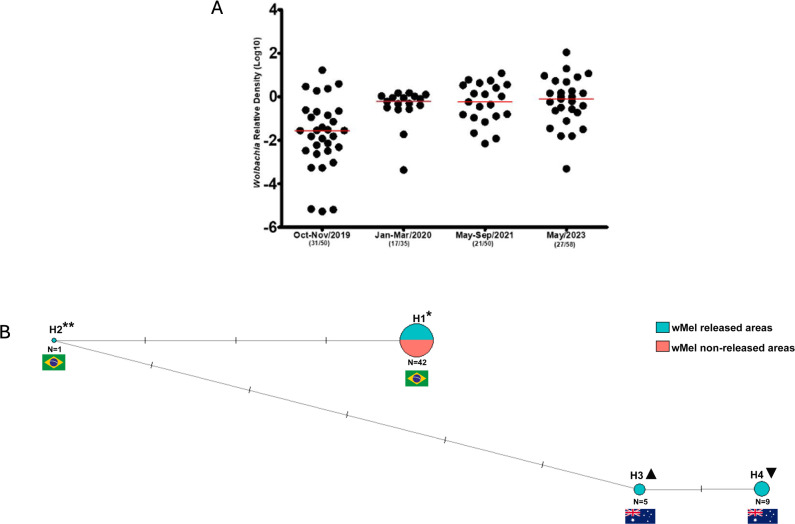
Fig 5. Wolbachia density and mtDNA status of uninfected mosquitoes in Rio de Janeiro.
(A) Relative density of wMel strain from field-caught mosquitoes between 2019-2023, (B) Network analysis of COI sequences of Ae. aegypti mosquitoes PCR-negative for wMel, showing that 24.56% of mosquitoes had the ancestral mtDNA of Australian Ae. aegypti populations. The bars on the lines represent mutational steps. The number of sequences in each haplotype does not include reference sequences. Reference sequences: H1* - Brazil (GenBank accession KU936162, JX456411); H2** – Colombia, South America (KM203142, KM203172); H3▲ – Townsville, Australia (GQ143718); H4▼– Yorkeys Knob, Australia (OM214532). Their positions in the network are evidenced with country flags (Brazil, Colombia, and Australia).
Fig 6
Fig 6. Biological assays for spinosad and Aedes aegypti mosquitoes and the field application of spinosad by Rio de Janeiro public health department.
(A) Spinosad mortality in a Wolbachia-infected, -uninfected, and the Rockefeller Ae. aegypti strains. The susceptible strain Rockefeller was used as an internal quality control and an insecticide susceptible reference lineage; (B) Linear regression obtained by exposing larvae of the Urca, wMel and Rockefeller strains to the larvticide spinosad; (C) Total number of dwellings treated with spinosad (bars) and percentage of wMel introgression in field Ae. aegypti population (red line). wMel deployment: August 2017 –December 2019; Monitoring: August 2021 – March 2023.

References

    1. Bhatt S, Gething PW, Brady OJ, Messina JP, Farlow AW, Moyes CL, et al. The global distribution and burden of dengue. Nature. 2013;496(7446):504–7. doi: 10.1038/nature12060 - DOI - PMC - PubMed
    1. Kraemer MUG, Sinka ME, Duda KA, Mylne AQN, Shearer FM, Barker CM, et al. The global distribution of the arbovirus vectors Aedes aegypti and Ae. albopictus. Elife. 2015;4:e08347. doi: 10.7554/eLife.08347 - DOI - PMC - PubMed
    1. Nunes MRT, Faria NR, de Vasconcelos JM, Golding N, Kraemer MUG, de Oliveira LF, et al. Emergence and potential for spread of Chikungunya virus in Brazil. BMC Med. 2015;13:102. doi: 10.1186/s12916-015-0348-x - DOI - PMC - PubMed
    1. Faria NR, Azevedo R do S da S, Kraemer MUG, Souza R, Cunha MS, Hill SC, et al. Zika virus in the Americas: Early epidemiological and genetic findings. Science. 2016;352(6283):345–9. doi: 10.1126/science.aaf5036 - DOI - PMC - PubMed
    1. Weaver SC, Charlier C, Vasilakis N, Lecuit M. Zika, Chikungunya, and Other Emerging Vector-Borne Viral Diseases. Annu Rev Med. 2018;69:395–408. doi: 10.1146/annurev-med-050715-105122 - DOI - PMC - PubMed

Supplementary concepts

LinkOut - more resources