


Prognostic Impact of Different Definitions of White-Coat Hypertension
- PMID: 40703060
- PMCID: PMC12620022
- DOI: 10.1093/ajh/hpaf136
Prognostic Impact of Different Definitions of White-Coat Hypertension
Abstract
Background: Different definitions of white-coat hypertension (WCH) may explain its variable outcome across studies.
Methods: In an Italian study started in 1986, we followed 3,153 people with (office blood pressure (BP) >=140/90 mmHg) and 457 without office hypertension for a mean of 10.4 years. None had previous cardiovascular disease. All underwent 24-h ambulatory BP (ABP) monitoring. We defined white-coat hypertension (WCH) as an average 24-h ABP < 130/80 mmHg or <125/75 mmHg. The primary outcome was a composite of major adverse cardiovascular events (MACE) and all-cause mortality.
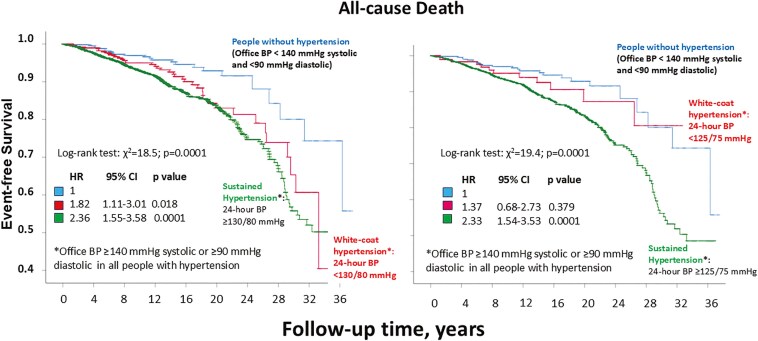
Results: Baseline office BP was 156/97 mmHg in people with and 127/81 mmHg without hypertension. At follow-up, MACE events were 344 and 23, and all-cause deaths were 318 and 24 in people with and without hypertension, respectively. Compared to normotensive group, MACE risk was not higher in people with WCH and 24-h ABP < 125/75 mmHg (hazard ratio (HR), 0.94; 95% confidence interval (CI), 0.42-2.10). Compared to normotensive group, MACE risk was higher in people with WCH and 24-h ABP < 130/80 mmHg (HR: 1.79; 95% CI, 1.07-2.29). All-cause death did not differ between the normotensive group and people with WCH and 24-h ABP < 125/75 mmHg (HR 1.37; 95% CI, 0.68-2.73), but it was higher than in the normotensive group when WCH was defined by a 24-h ABP < 130/80 mmHg (HR 1.82; 95% CI, 1.55-3.58).
Conclusions: WCH defined by an average 24-h ABP < 125/75 mmHg identifies people at low risk of MACE and death in the long term. Even modestly above these threshold values, the risk associated with WCH increases.
Keywords: ambulatory blood pressure monitoring; blood pressure; cardiovascular death; heart failure; hypertension; myocardial infarction; stroke; white-coat hypertension.
© The Author(s) 2025. Published by Oxford University Press on behalf of American Journal of Hypertension, Ltd.
Conflict of interest statement
The authors declared no conflict of interest.
Figures


References
-
- Verdecchia P, Porcellati C, Schillaci G, Borgioni C, Ciucci A, Battistelli M, Guerrieri M, Gatteschi C, Zampi I, Santucci A, Santucci C, Reboldi G.. Ambulatory blood pressure. An independent predictor of prognosis in essential hypertension. Hypertension 1994; 24:793–801. - PubMed
-
- Verdecchia P, Schillaci G, Borgioni C, Ciucci A, Porcellati C.. White-coat hypertension. Lancet 1996; 348:1444–5; author reply 1445. - PubMed
-
- Ohkubo T, Imai Y, Tsuji I, Nagai K, Ito S, Satoh H, Hisamichi S.. Reference values for 24-hour ambulatory blood pressure monitoring based on a prognostic criterion: the Ohasama Study. Hypertension 1998; 32:255–259. - PubMed
-
- Asayama K, Li Y, Franklin SS, Thijs L, O’Brien E, Staessen JA.. Cardiovascular risk associated with white-coat hypertension: con side of the argument. Hypertension 2017; 70:676–682. - PubMed
MeSH terms
Grants and funding
LinkOut - more resources
Full Text Sources
