


Clinical and epidemiological characteristics of influenza and SARS-CoV-2 virus among patients with acute febrile illness in selected sites of Ethiopia 2021-2022
- PMID: 40703157
- PMCID: PMC12283578
- DOI: 10.3389/fpubh.2025.1549159
Clinical and epidemiological characteristics of influenza and SARS-CoV-2 virus among patients with acute febrile illness in selected sites of Ethiopia 2021-2022
Erratum in
-
Correction: Clinical and epidemiological characteristics of influenza and SARS-CoV-2 virus among patients with acute febrile illness in selected sites of Ethiopia 2021-2022.Front Public Health. 2025 Aug 4;13:1664179. doi: 10.3389/fpubh.2025.1664179. eCollection 2025. Front Public Health. 2025. PMID: 40832026 Free PMC article.
Abstract
Background: Viral respiratory pathogens have become the leading cause of acute undifferentiated febrile illness (AFI). We determined the fraction of AFI attributable to influenza and SARS-CoV-2 in Ethiopia, along with an understanding of their epidemiological characteristics.
Methods: From February 2021 to June 2022, we enrolled patients meeting an AFI case definition (age >5 years with fever ≥38°C) who presented at one of four selected sentinel hospital sites in Jimma, Harari, Addis Ababa, and Gonder. Clinical and epidemiological information was collected, Nasopharyngeal swab samples were collected and analyzed using real-time PCR for respiratory viruses (influenza and SARS-CoV-2). A quasi-binomial regression model and multivariable regression were performed to compute fractions and establish associations with the agent detected.
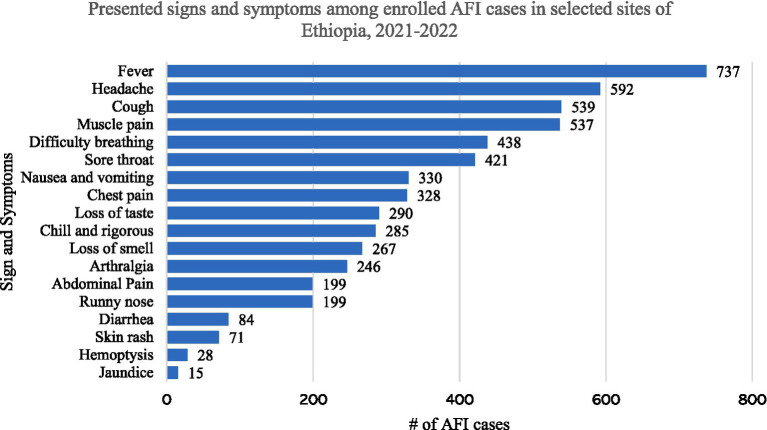
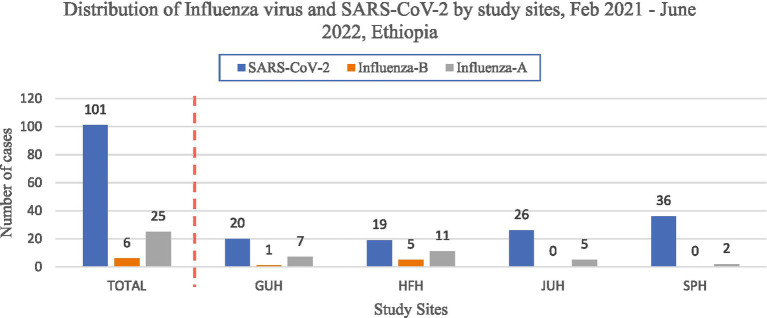
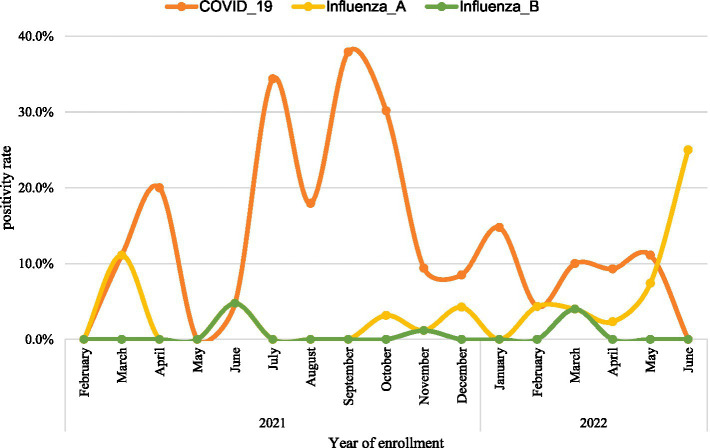
Result: A total of 737 AFI cases were enrolled. The overall proportion of SARS-CoV-2, influenza A, and influenza B among AFI patients were 7.8, 1.9, and 0.5 per 100,000 population, respectively. Among the enrolled AFI cases tested for SARS-CoV-2 and Influenza virus, SARS-CoV-2 was the most detected pathogen with a positivity rate of 13.7% (95% CI:11.3-16.4), followed by influenza A and influenza B, which have a positivity rate of 3.3% (95% CI: 2.2-5.1) and 0.8% (95% CI:0.3-1.8), respectively. The positivity rate of SARS-CoV-2 peaked at 37.4% in September 2021. Per the multivariable analysis, cases ≥65 years of age were three [AOR = 3.3,95% CI:(1.9-5.7)] times more likely to be positive for SARS-CoV-2.
Conclusion: SARS-CoV-2 and influenza viruses were highly prevalent among AFI cases. The proportion of SARS-CoV-2 was higher among older adults. Further study is recommended to characterize influenza subtypes, SARS-CoV-2 variants and determine their attributable fraction among a broader panel of AFI-causing pathogens that contributes for guiding the proper diagnostics, treatment and surveillance measures.
Keywords: AFI; Ethiopia; SARS-CoV-2; influenza virus; proportion.
Copyright © 2025 Chekol, Sugerman, Tayachew, Mekuria, Tesfaye, Alemu, Gashu, Shura, Gonta, Agune, Hailemariam, Assefa, Wossen, Hassen, Michele, Silver, Delelegn, Briana, Kasa and Kebede.
Conflict of interest statement
The authors declare that the research was conducted in the absence of any commercial or financial relationships that could be construed as a potential conflict of interest.
Figures
References
MeSH terms
LinkOut - more resources
Full Text Sources
Medical
Miscellaneous
