


Parabrachial Foxp2-expressing neurons are necessary for sustaining core body temperature in the cold
- PMID: 40703448
- PMCID: PMC12283563
- DOI: 10.1016/j.isci.2025.112764
Parabrachial Foxp2-expressing neurons are necessary for sustaining core body temperature in the cold
Abstract
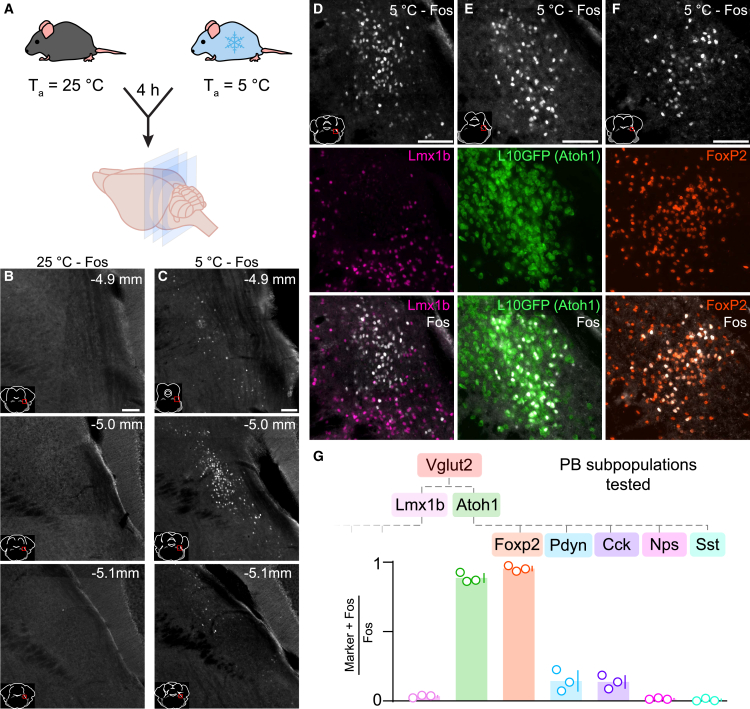
Cold environmental temperature is a threat to survival. Sustaining core body temperature in the cold requires a dynamic set of adaptive responses known as "cold defense," but the neural circuitry orchestrating these responses remains unclear. We identified a cluster of Atoh1-derived, Foxp2-expressing glutamatergic neurons in the lateral parabrachial nucleus (PB) that are activated by exposing mice to cold environmental temperature. Eliminating Foxp2-expressing PB neurons caused body temperature to plummet in the cold. Mice lacking these neurons had normal wakefulness, movement and appetite at room temperature, and their autonomic cold-defense responses remained intact. However, these mice had reduced metabolism and locomotor activity in the cold, and thermal discrimination was impaired. Our results indicate that thermosensory information relayed through Foxp2-expressing PB neurons is essential for sensing and surviving a cold environment.
Keywords: Biological sciences; Natural sciences; Neuroscience; Physiology; Sensory neuroscience; Systems neuroscience.
© 2025 The Authors.
Conflict of interest statement
The authors declare no competing interests.
Figures



References
-
- Dhaka A., Murray A.N., Mathur J., Earley T.J., Petrus M.J., Patapoutian A. TRPM8 is required for cold sensation in mice. Neuron. 2007;54:371–378. - PubMed
-
- Bautista D.M., Siemens J., Glazer J.M., Tsuruda P.R., Basbaum A.I., Stucky C.L., Jordt S.-E., Julius D. The menthol receptor TRPM8 is the principal detector of environmental cold. Nature. 2007;448:204–208. - PubMed
-
- Craig A.D., Krout K., Andrew D. Quantitative response characteristics of thermoreceptive and nociceptive lamina I spinothalamic neurons in the cat. J. Neurophysiol. 2001;86:1459–1480. - PubMed
LinkOut - more resources
Full Text Sources
Molecular Biology Databases
Research Materials
