


Catalytic Borylation of Poly(vinyl chloride) Produces Adhesive Materials
- PMID: 40704884
- PMCID: PMC12356650
- DOI: 10.1021/jacs.5c08083
Catalytic Borylation of Poly(vinyl chloride) Produces Adhesive Materials
Abstract
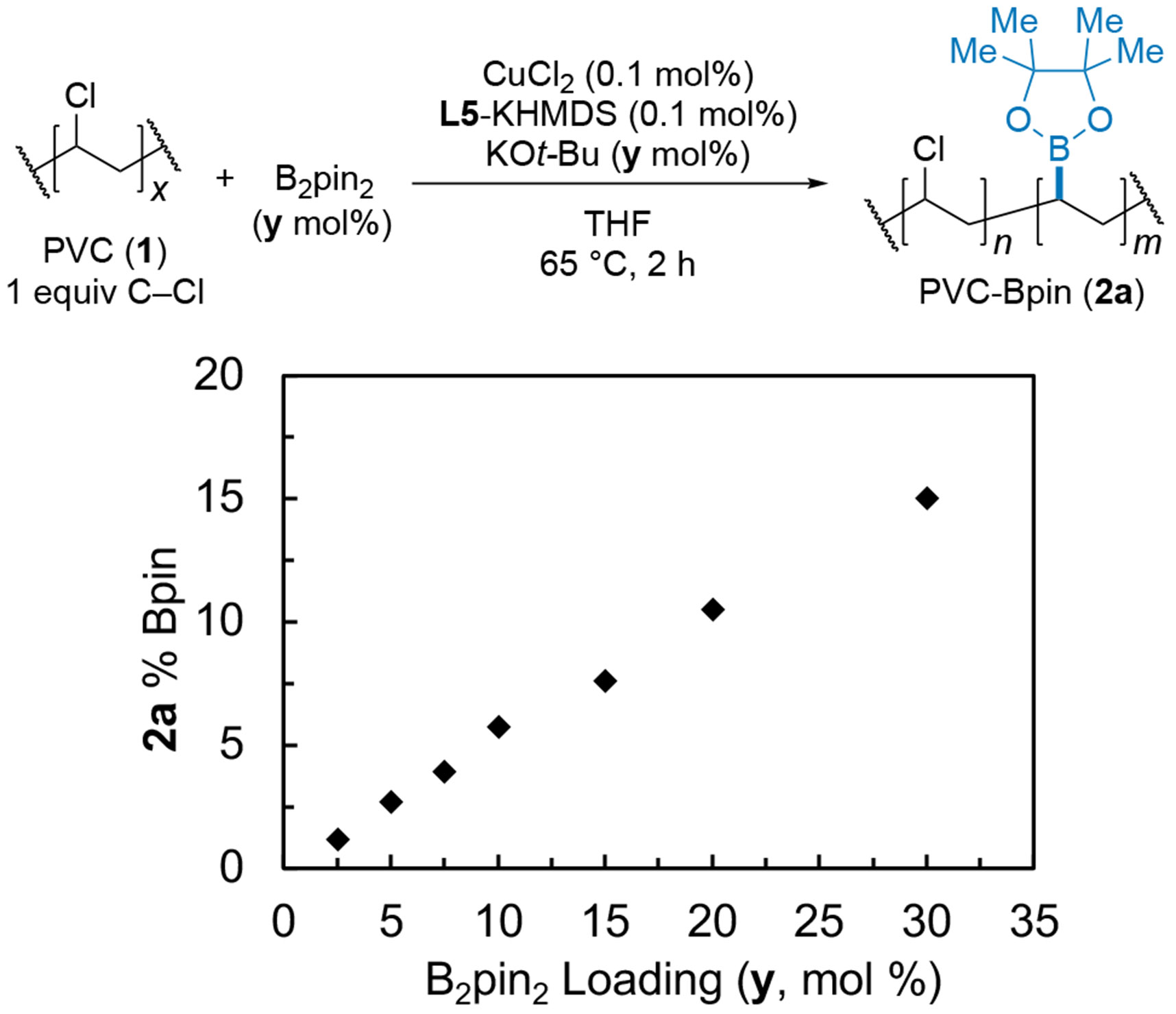
Postpolymerization functionalization of polymers can create new applications for existing materials, while retaining their most favorable, intrinsic properties. Polyvinyl chloride (PVC) is a widely used, commodity polymer that is particularly challenging to modify. We report a copper-catalyzed protocol that replaces a small fraction of the C-Cl bonds in PVC with C-B bonds to boronic esters. The reaction occurs with an inexpensive catalyst comprising copper(II) chloride and an NHC ligand derived from a common ionic liquid that is distinct from the N-heterocyclic carbene (NHC) used for the borylation of small alkyl halides. The resulting materials adhere strongly to common surfaces, such as glass and metals, even more strongly than do commercial glues.
Figures



References
-
- Mijangos C; Calafel I; Santamaría A Poly(vinyl chloride), a historical polymer still evolving. Polymer 2023, 266, 125610.
-
- Fischer I; Schmitt WF; Porth H-C; Allsopp MW; Vianello G Poly(Vinyl Chloride). In Ullmann's Encyclopedia of Industrial Chemistry, 2014; pp 1–30.
-
- Yu Q; Selvadurai APS Mechanical behaviour of a plasticized PVC subjected to ethanol exposure. Polym. Degrad. Stab 2005, 89, 109–124.
Grants and funding
LinkOut - more resources
Full Text Sources
