


Precision generalized phase I-II designs
- PMID: 40705487
- PMCID: PMC12288667
- DOI: 10.1093/biomtc/ujaf043
Precision generalized phase I-II designs
Abstract
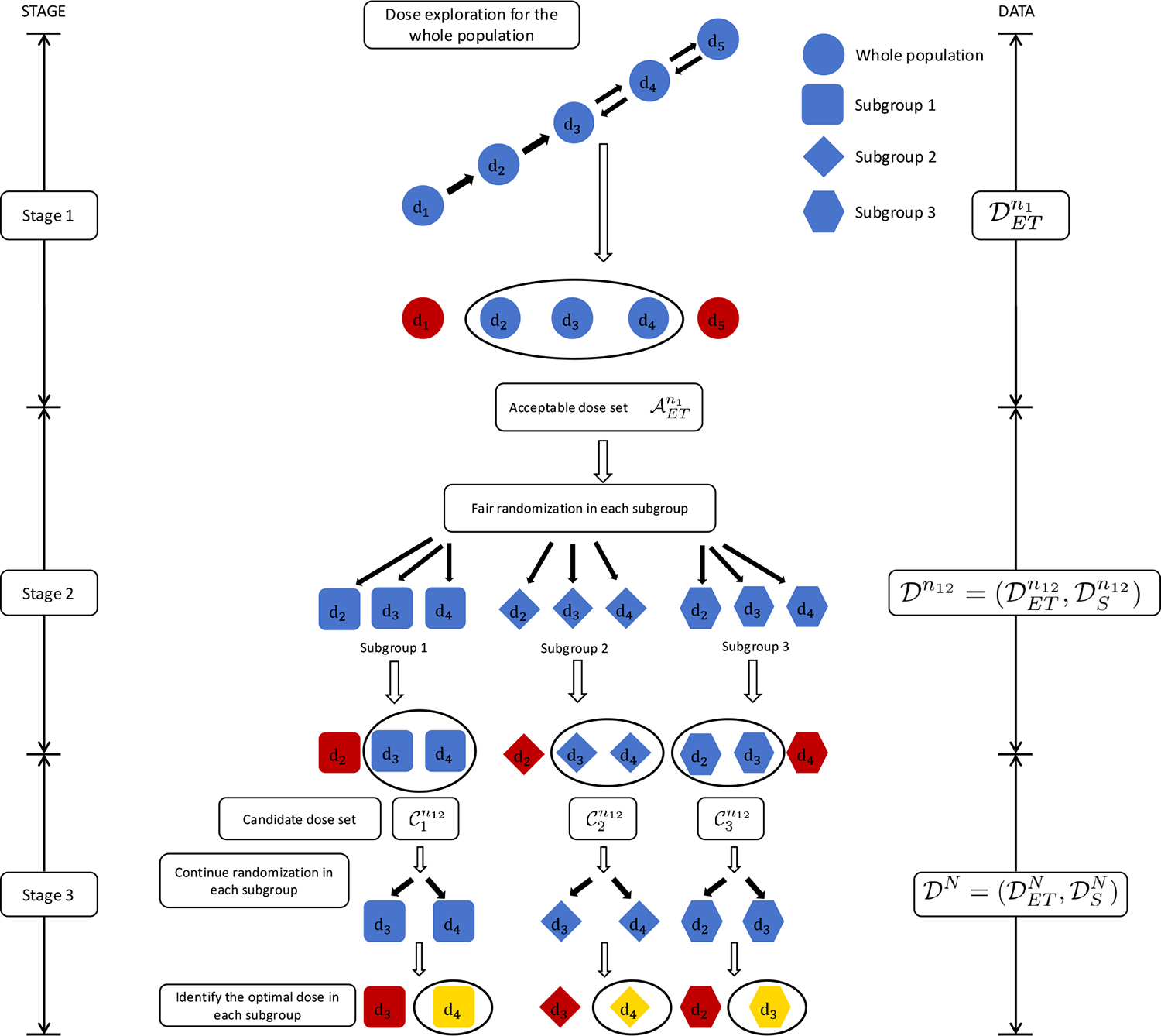
A new family of precision Bayesian dose optimization designs, PGen I-II, based on early efficacy, early toxicity, and long-term time to treatment failure is proposed. A PGen I-II design refines a Gen I-II design by accounting for patient heterogeneity characterized by subgroups that may be defined by prognostic levels, disease subtypes, or biomarker categories. The design makes subgroup-specific decisions, which may be to drop an unacceptably toxic or inefficacious dose, randomize patients among acceptable doses, or identify a best dose in terms of treatment success defined in terms of time to failure over long-term follow-up. A piecewise exponential distribution for failure time is assumed, including subgroup-specific effects of dose, response, and toxicity. Latent variables are used to adaptively cluster subgroups found to have similar dose-outcome distributions, with the model simplified to borrow strength between subgroups in the same cluster. Guidelines and user-friendly computer software for implementing the design are provided. A simulation study is reported that shows the PGen I-II design is superior to similarly structured designs that either assume patient homogeneity or conduct separate trials within subgroups.
Keywords: Bayesian adaptive design; cell therapy; dose optimization; phase I-II clinical trials; precision medicine.
© The Author(s) 2025. Published by Oxford University Press on behalf of The International Biometric Society. All rights reserved. For commercial re-use, please contact reprints@oup.com for reprints and translation rights for reprints. All other permissions can be obtained through our RightsLink service via the Permissions link on the article page on our site-for further information please contact journals.permissions@oup.com.
Figures
References
-
- Babb J, Rogatko A, and Zacks S (1998). Cancer phase I clinical trials: Efficient dose escalation with overdose control. Statistics in Medicine, 17, 1103–1120. - PubMed
-
- Chib S, and Greenberg E (1998). Analysis of multivariate probit models. Biometrika, 85, 347–361.
-
- Gooley TA, Martin PJ, Fisher LD and Pettinger M (1994) Simulating as a design tool for phase I/II clinical trials: an example from bone marrow transplantation. Controlled Clinical Trials, 15, 450–462. - PubMed
-
- Green PJ (1995). Reversible jump Markov chain Monte Carlo computation and Bayesian model determination. Biometrika, 82(4), 711–732.
MeSH terms
Grants and funding
LinkOut - more resources
Full Text Sources
