


Biophilic design, neuroarchitecture and therapeutic home environments: harnessing medicinal properties of intentionally-designed spaces to enhance digital health outcomes
- PMID: 40708654
- PMCID: PMC12287082
- DOI: 10.3389/fmed.2025.1610259
Biophilic design, neuroarchitecture and therapeutic home environments: harnessing medicinal properties of intentionally-designed spaces to enhance digital health outcomes
Abstract
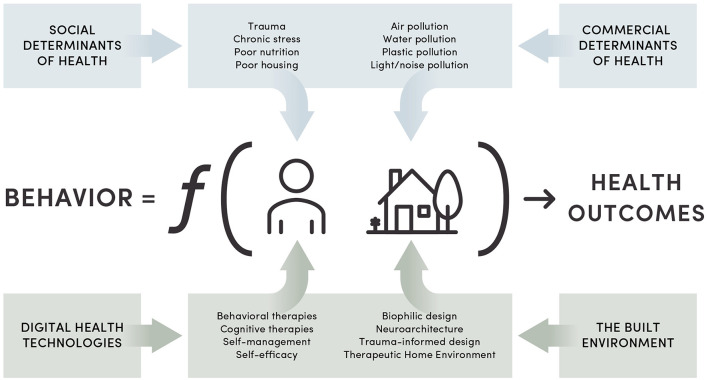
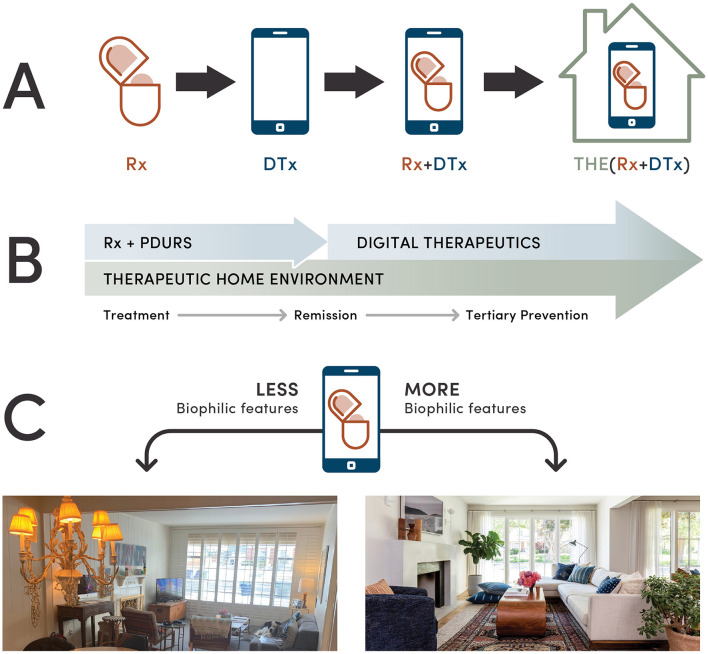
Digital health technologies (DHT) support patient-centered care by delivering behavioral, educational, self-efficacy and self-management interventions. Yet, multifactorial chronic diseases are shaped by complex interactions between genetics, environment and behavior, embodied in social and commercial determinants of health. Given that people in the United States spend on average 18 h per day at home, the impact of home environment on a person's health is underutilized in medicine. Herein, we discuss opportunities to improve therapy outcomes through bridging digital interventions with intentionally-designed restorative and multisensory environments that simultaneously foster physiological and emotional homeostasis. Harnessing positive effects of biophilic design, neuroarchitecture and therapeutic home environments can enhance the effectiveness of digital interventions, including digital therapeutics (DTx), wearables and drug + digital combination therapies that utilize "prescription drug use-related software" (PDURS) framework. Real-world barriers to advance these solutions include a lack of public awareness about connections between the built environment, health and wellbeing, the knowledge gap in long-term clinical outcomes of biophilic interventions, and a limited funding for advancing "biophilic design as an adjunctive therapy" applications. In conclusion, creating digital health ecosystems that favor symbiosis between digital health interventions and enriched environments can promote sustained behavior change, elevate precision care and improve value-based healthcare outcomes.
Keywords: biophilia; built environment; household; housing; mobile medical app; prescription digital therapeutics; salutogenic; virtual reality.
Copyright © 2025 Bulaj, Forero and Huntsman.
Conflict of interest statement
GB is a founder and owner of OMNI Self-care, LLC, a health promotion and consulting company supporting evidence-based self-care and e-commerce solutions to improve health outcomes. OMNI Self-care has a contract agreement with Dayhouse Studio. GB is a co-inventor on two issued US patents related to digital health technologies 9,569,562 and 9,747,423 “Disease Therapy Game Technology” and patent-pending application “Multimodal Platform for Treating Epilepsy”. These patents are owned by the University of Utah. GB and DH are co-inventors on a patent-pending technology “System and method for improving therapeutic interventions using household goods e-commerce platform.” DH is the founder and owner of Dayhouse Studio, a health-centric biophilic interior design firm, and the Dayhouse Living magazine. MF is a VC investor, board member and strategic advisor to healthcare startups in areas of digital health, precision medicine and women's health. She is the Founder of MF7 Ventures, Senior Advisor for Accelmed Partners and Seed Healthcare, and board director of Click Therapeutics among many other portfolio companies.
Figures
Similar articles
-
Computer and mobile technology interventions for self-management in chronic obstructive pulmonary disease.Cochrane Database Syst Rev. 2017 May 23;5(5):CD011425. doi: 10.1002/14651858.CD011425.pub2. Cochrane Database Syst Rev. 2017. PMID: 28535331 Free PMC article.
-
Sexual Harassment and Prevention Training.2024 Mar 29. In: StatPearls [Internet]. Treasure Island (FL): StatPearls Publishing; 2025 Jan–. 2024 Mar 29. In: StatPearls [Internet]. Treasure Island (FL): StatPearls Publishing; 2025 Jan–. PMID: 36508513 Free Books & Documents.
-
Interventions to improve safe and effective medicines use by consumers: an overview of systematic reviews.Cochrane Database Syst Rev. 2014 Apr 29;2014(4):CD007768. doi: 10.1002/14651858.CD007768.pub3. Cochrane Database Syst Rev. 2014. PMID: 24777444 Free PMC article.
-
How to Implement Digital Clinical Consultations in UK Maternity Care: the ARM@DA Realist Review.Health Soc Care Deliv Res. 2025 May;13(22):1-77. doi: 10.3310/WQFV7425. Health Soc Care Deliv Res. 2025. PMID: 40417997 Review.
-
Accreditation through the eyes of nurse managers: an infinite staircase or a phenomenon that evaporates like water.J Health Organ Manag. 2025 Jun 30. doi: 10.1108/JHOM-01-2025-0029. Online ahead of print. J Health Organ Manag. 2025. PMID: 40574247
References
-
- Biskupiak Z, Ha VV, Rohaj A, Bulaj G. Digital therapeutics for improving effectiveness of pharmaceutical drugs and biological products: preclinical and clinical studies supporting development of drug + digital combination therapies for chronic diseases. J Clin Med. (2024) 13:403. 10.3390/jcm13020403 - DOI - PMC - PubMed
LinkOut - more resources
Full Text Sources
Miscellaneous
