


Pharmacological effects, molecular mechanisms and strategies to improve bioavailability of curcumin in the treatment of neurodegenerative diseases
- PMID: 40709087
- PMCID: PMC12287103
- DOI: 10.3389/fphar.2025.1625821
Pharmacological effects, molecular mechanisms and strategies to improve bioavailability of curcumin in the treatment of neurodegenerative diseases
Abstract
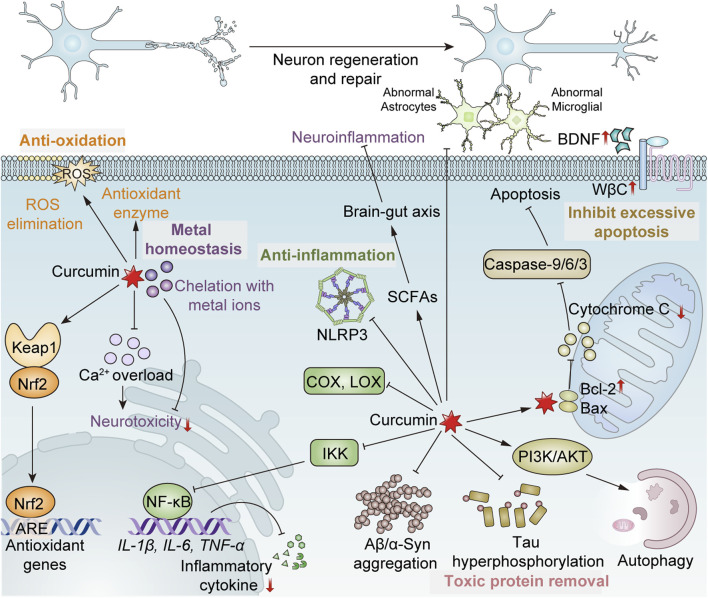
With the global population aging, the incidence of neurodegenerative diseases (NDs), such as Alzheimer's disease, Parkinson's disease, Huntington's disease and amyotrophic lateral sclerosis, has been progressively increasing. However, effective therapeutic strategies and clinical drugs for these disorders remain scarce. Curcumin, a natural polyphenolic compound primarily derived from the herbaceous plant Curcuma longa L., has been proposed as a promising candidate for ND treatment based on the excellent antioxidant, anti-inflammatory and neuroprotective properties. Its pharmacological activities encompass scavenging reactive oxygen species, mitigating toxic protein aggregation and cytotoxicity, repairing mitochondrial dysfunction, and inhibiting excessive neuronal apoptosis. Compared with synthetic drugs, curcumin demonstrates a more favorable safety profile with fewer side effects. Nevertheless, its clinical application is substantially hindered by poor bioavailability, which stems from low aqueous solubility, inefficient intestinal absorption, and rapid metabolism and systemic elimination. Conventional administration methods often fail to achieve effective concentrations in vivo. Further clinical trials are also required to validate the therapeutic efficacy and potential adverse effects in human subjects. This article systematically reviews the pathogenesis of NDs and the knowledge on curcumin including pharmacological effects, neuroprotective mechanisms, functions across specific NDs and advanced strategies to enhance the bioavailability, with the aim of promoting the development and clinical translation of curcumin-based therapeutics for NDs.
Keywords: bioavailability; curcumin; natural medicine; neurodegenerative disease; pharmacological activity.
Copyright © 2025 Wang, Zhou, Pang, Ma, Li, Song, Hou and Wang.
Conflict of interest statement
The authors declare that the research was conducted in the absence of any commercial or financial relationships that could be construed as a potential conflict of interest.
Figures
References
-
- Ahmed M., Basheer S., AL Mughram M. H., Iqbal D. N., Qamar S., Saeed A., et al. (2024). Structural development of curcumin: a natural product arsenal for diverse therapeutic targets-seizing opportunities through serendipity and rational design. J. Mol. Struct. 1324, 140815. 10.1016/j.molstruc.2024.140815 - DOI
-
- Akinyemi A. J., Okonkwo P. K., Faboya O. A., Onikanni S. A., Fadaka A., Olayide I., et al. (2017). Curcumin improves episodic memory in cadmium induced memory impairment through inhibition of acetylcholinesterase and adenosine deaminase activities in a rat model. Metab. Brain Dis. 32 (1), 87–95. 10.1007/s11011-016-9887-x - DOI - PubMed
Publication types
LinkOut - more resources
Full Text Sources
