


Epigenetic Regulation of B Cell Memory Formation: A Poised Model for B Cell Epigenetic Reprograming
- PMID: 40709286
- PMCID: PMC12289371
- DOI: 10.1155/jimr/9328523
Epigenetic Regulation of B Cell Memory Formation: A Poised Model for B Cell Epigenetic Reprograming
Abstract
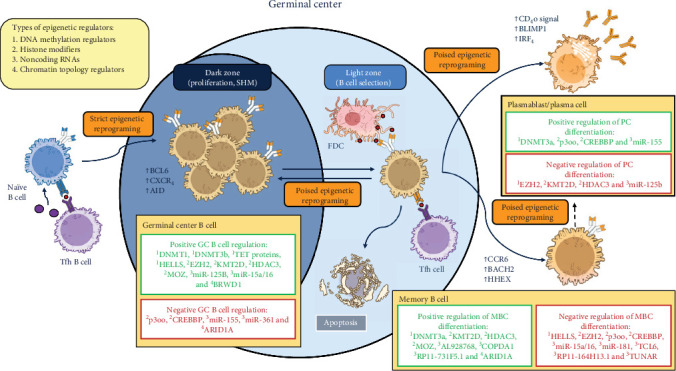
The formation of B cell immunological memory happens after the first encounter with a pathogen. At the germinal center (GC), B cells experience complex transcriptional and epigenetic transitions to differentiate into memory B cells (MBCs) and plasma cells (PCs). In particular, the differentiation of GC B cells into MBCs has been poorly understood, and no clear conclusions on the signals and transcription factors leading to this cell fate have been identified. Recent discoveries in epigenetics and immune memory have elucidated the essential role of epigenetic regulators in establishing the memory B cell (MBC) fate. DNA methylation regulators, histone modifiers, noncoding RNAs (ncRNAs), and chromatin remodelers orchestrate a dynamic reprograming of the MBC phenotype. Positive and negative epigenetic regulators of the B cell program collaborate at each differentiation stage and allow for complex chromatin topology rearrangements and dynamic exposure to transcription and translation. Following MBC fate determination at the GC, the acquired epigenetic modifications induce a poised regulatory state where genes are epigenetically marked to remain transcriptionally inactive, but primed for rapid activation upon stimuli. Thus, a poised epigenetic control over gene expression governs MBC formation and a novel model of epigenetic reprograming is proposed. This model provides a novel perspective on how the B cell fate is determined in the GC and memory is formed, offering insights for improved vaccination and therapeutical approaches.
Keywords: B cell fate determination; B cell memory; epigenetics; germinal center; memory B cells; poised genes.
Copyright © 2025 Carlos Valverde-Hernandez. Journal of Immunology Research published by John Wiley & Sons Ltd.
Conflict of interest statement
The author declares no conflicts of interest.
Figures
References
Publication types
MeSH terms
LinkOut - more resources
Full Text Sources
Miscellaneous
