


The Impact of As-Built Surface Characteristics of Selective-Laser-Melted Ti-6Al-4V on Early Osteoblastic Response for Potential Dental Applications
- PMID: 40710445
- PMCID: PMC12295017
- DOI: 10.3390/jfb16070230
The Impact of As-Built Surface Characteristics of Selective-Laser-Melted Ti-6Al-4V on Early Osteoblastic Response for Potential Dental Applications
Abstract
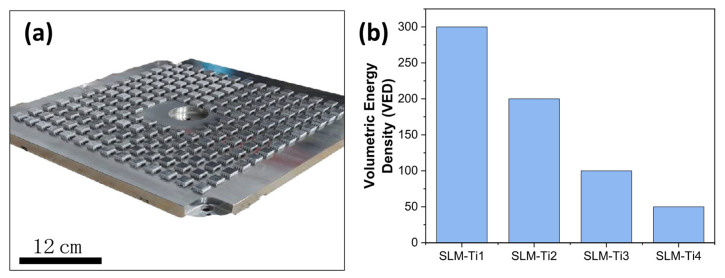
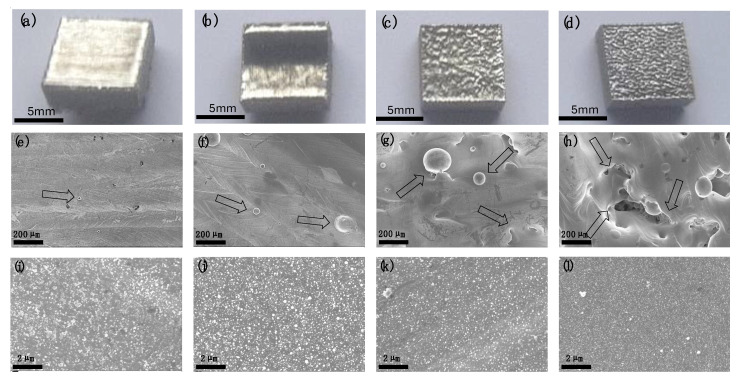
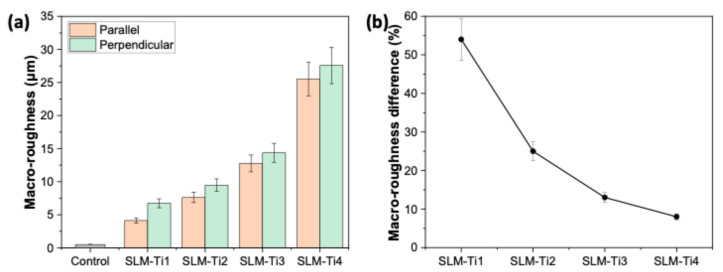
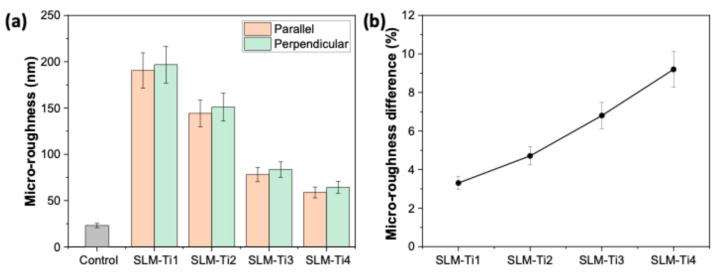
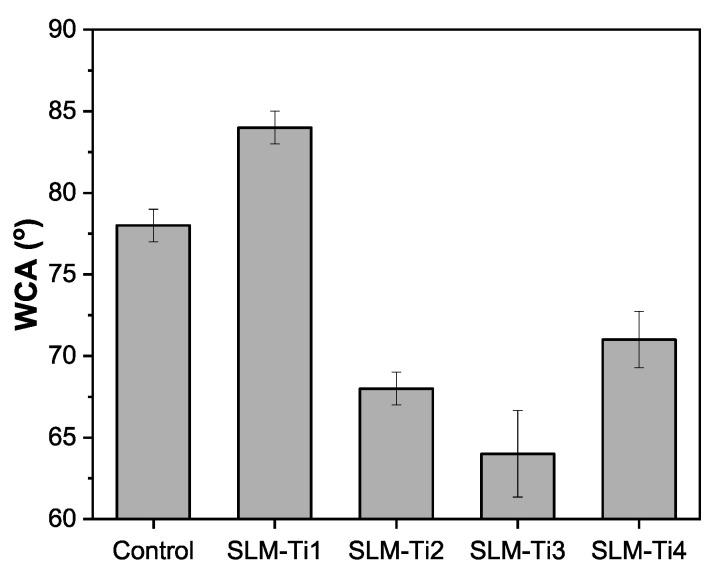
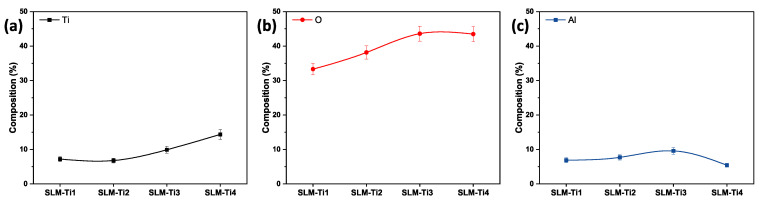
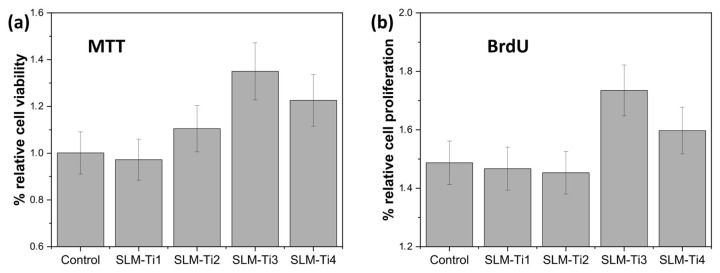
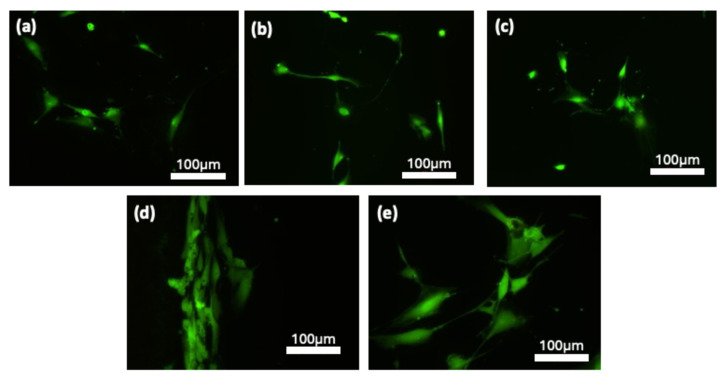
This study investigates the potential of Selective Laser Melting (SLM) to tailor the surface characteristics of Ti6Al4V directly during fabrication, eliminating the need for post-processing treatments potentially for dental implants. By adjusting the Volumetric Energy Density (VED) through controlled variations in the laser scanning speed, we achieved customized surface textures at both the micro- and nanoscale levels. SLM samples fabricated at moderate VED levels (50-100 W·mm3/s) exhibited optimized dual-scale surface roughness-a macro-roughness of up to 25.5-27.6 µm and micro-roughness of as low as 58.8-64.2 nm-resulting in significantly enhanced hydrophilicity, with water contact angles (WCAs) decreasing to ~62°, compared to ~80° on a standard grade 5 machined Ti6Al4V plate. The XPS analysis revealed that the surface oxygen content remains relatively stable at low VED values, with no significant increase. The surface topography plays a significant role in influencing the WCA, particularly when the VED values are low (below 200 W·mm3/s) during SLM, indicating the dominant effect of surface morphology over chemistry in these conditions. Biological assays using osteoblast-like MG-63 cells demonstrated that these as-built SLM surfaces supported a 1.5-fold-higher proliferation and improved cytoskeletal organization relative to the control, confirming the enhanced early cellular responses. These results highlight the capability of SLM to engineer bioactive implant surfaces through process-controlled morphology and chemistry, presenting a promising strategy for the next generation of dental implants suitable for immediate placement and osseointegration.
Keywords: Selective Laser Melting (SLM); TiAl6V4; dental implant; osteoblast; surface topography.
Conflict of interest statement
The authors declare no conflicts of interest.
Figures
References
-
- Murr L.E., Gaytan S.M., Ramirez D.A., Martinez E., Hernandez J., Amato K.N., Shindo P.W., Medina F.R., Wicker R.B. Metal Fabrication by Additive Manufacturing Using Laser and Electron Beam Melting Technologies. J. Mater. Sci. Technol. 2012;28:1–14. doi: 10.1016/S1005-0302(12)60016-4. - DOI
-
- Alharbi N., Osman R.B., Wismeijer D. Additive Manufacturing Techniques in Prosthodontics: Where Do We Currently Stand? A Critical Review. Int. J. Prosthodont. 2016;29:474–484. - PubMed
-
- Prashanth K.G., Scudino S., Klauss H.J., Surreddi K.B., Löber L., Wang Z., Chaubey A.K., Kühn U., Eckert J. Microstructure and mechanical properties of Al–12Si produced by selective laser melting: Effect of heat treatment. Mater. Sci. Eng. A. 2015;590:153–160. doi: 10.1016/j.msea.2013.10.023. - DOI
Grants and funding
LinkOut - more resources
Full Text Sources
