


Cross-Sectional and Longitudinal Assessment of Sociodemographic and Lifestyle Determinants of Metabolic Syndrome and Hypertriglyceridemic Waist Phenotypes in 139,634 Spanish Workers
- PMID: 40710574
- PMCID: PMC12298749
- DOI: 10.3390/metabo15070474
Cross-Sectional and Longitudinal Assessment of Sociodemographic and Lifestyle Determinants of Metabolic Syndrome and Hypertriglyceridemic Waist Phenotypes in 139,634 Spanish Workers
Abstract
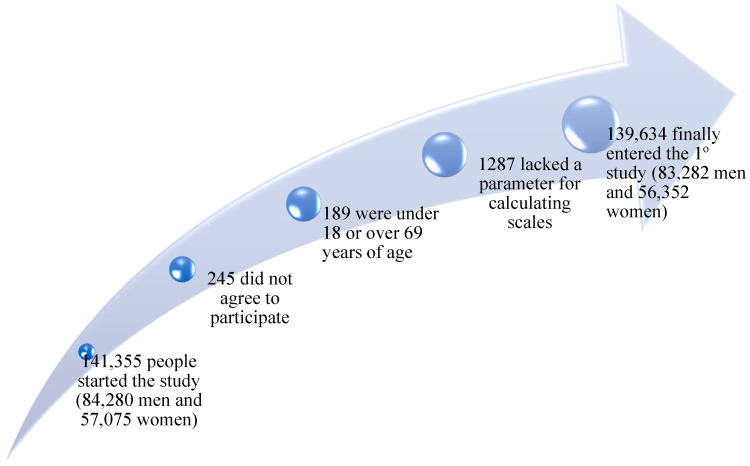
Objective: The objective of this study was to analyze the prevalence and key sociodemographic and lifestyle determinants of metabolic syndrome (MetS) and the hypertriglyceridemic waist (HTGW) phenotype in a large occupational cohort. Background: Metabolic syndrome (MetS) and the hypertriglyceridemic waist (HTGW) phenotype, defined as the simultaneous presence of elevated waist circumference and high triglyceride levels, are major predictors of cardiometabolic morbidity and mortality. Despite their clinical relevance, data on their distribution and determinants in large occupational populations remain limited. Methods: A cross-sectional analysis was conducted on 139,634 employed adults (56,352 women and 83,282 men) across Spain, based on standardized clinical evaluations and validated questionnaires assessing physical activity, diet, smoking, alcohol consumption, education, and occupational class. Logistic regression models were used to estimate associations with MetS and HTGW. A longitudinal subsample of 40,431 individuals was followed over a 10-year period (2009-2019) to assess trends in metabolic risk phenotypes. Results: Male sex, older age, lower educational attainment, and unhealthy lifestyle behaviors were associated with a higher prevalence of both MetS and the HTGW phenotype. Physical inactivity, low adherence to the Mediterranean diet, and alcohol consumption were significantly associated with increased risk. The HTGW phenotype proved useful in identifying high-risk individuals, with a steadily increasing prevalence over time. Conclusions: Sociodemographic disparities and modifiable lifestyle factors significantly influence the prevalence and progression of MetS and HTGW in the Spanish workforce. Preventive strategies should emphasize early workplace screening, promotion of healthy behaviors, and reduction in educational and socioeconomic inequalities to mitigate cardiometabolic risk.
Keywords: cardiometabolic risk; lifestyle; metabolic syndrome; occupational epidemiology; social determinants; visceral adiposity.
Conflict of interest statement
The authors declare no conflicts of interest related to this study.
References
-
- Ndumele C.E., Neeland I.J., Tuttle K.R., Chow S.L., Mathew R.O., Khan S.S., Coresh J., Baker-Smith C.M., Carnethon M.R., Després J.-P., et al. A Synopsis of the Evidence for the Science and Clinical Management of Cardiovascular-Kidney-Metabolic (CKM) Syndrome: A Scientific Statement From the American Heart Association. Circulation. 2023;148:1636–1664. doi: 10.1161/CIR.0000000000001186. - DOI - PubMed
-
- Strauss M., Lavie C.J., Lippi G., Brzęk A., Vollenberg R., Sanchis-Gomar F., Leischik R. A systematic review of prevalence of metabolic syndrome in occupational groups-Does occupation matter in the global epidemic of metabolic syndrome? Prog. Cardiovasc. Dis. 2022;75:69–77. doi: 10.1016/j.pcad.2022.09.003. - DOI - PubMed
LinkOut - more resources
Full Text Sources
