


School health professionals' understanding of culture: a scoping review
- PMID: 40713056
- PMCID: PMC12306337
- DOI: 10.1136/bmjopen-2025-100689
School health professionals' understanding of culture: a scoping review
Abstract
Introduction: Culture underpins social interaction between school health professionals and children. Both practice and research suggest that cultural variations, migration and intercultural interactions pose potential challenges in encounters between school health professionals and children and may relate to the health professionals' understanding of their own culture as a factor in such encounters. Still, for the school health services (SHS), reviews collating existing research on school health professionals' understanding of culture are lacking.
Objectives: This review aims to identify, describe and analyse existing research on school health professionals' (ie, school nurses, school social workers, school doctors and school psychologists) understanding of culture.
Design: A scoping review of peer-reviewed and published scientific articles on school health professionals' understanding of culture.
Inclusion criteria: Articles published between 2013 and 2024 on culture, SHS and school nurses, school doctors, school social workers or school psychologists.
Methods and analysis: Searches were conducted in October 2023 and September 2024 in 10 databases. Two reviewers independently screened the article titles, abstracts and full texts for inclusion. Extracted data were analysed using descriptive statistics and qualitative content analysis. The qualitative content analysis focused on content related to theoretical considerations, key findings and conceptualisations of culture.
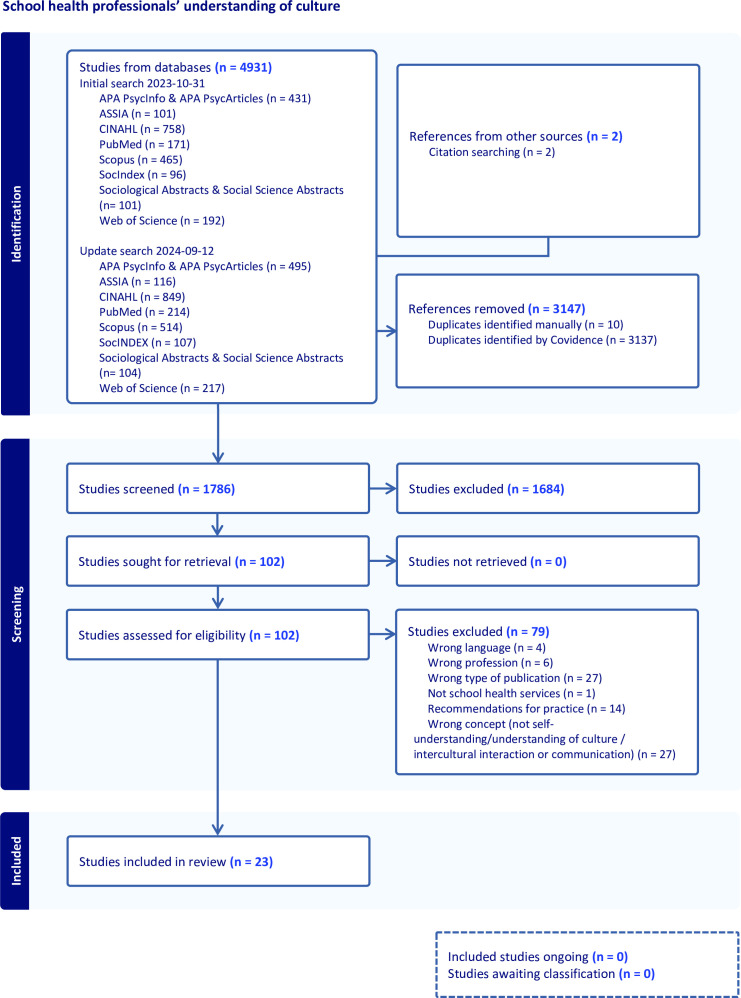
Results: From 1784 screened articles, 100 articles were screened in full text and 21 articles fulfilled the eligibility criteria. After identifying two additional articles through manual searches, a total of 23 articles were included in the review. The findings show that the articles primarily applied a quantitative study design, focused on school psychologists and school nurses and were conducted in the USA and Nordic-Baltic area. Self-understanding was mainly studied using validated instruments, leaving the conceptualisation of culture to the researchers. Still, only about half of all the articles described the theoretical conceptualisation of culture. Studies of intercultural interaction focused on the challenges of encountering 'diverse' children and raised concerns about barriers and hindrances to the encounters.
Conclusions: This review shows that SHS professionals' understanding of culture has mainly been studied within two SHS professions, within a narrow geographical sphere and without a theoretical stance on culture. Thus, more qualitative research, a clearer theoretical conceptualisation of culture and more research on SHS professionals' practice and self-understanding are needed.
Keywords: Health Equity; Health Services; PUBLIC HEALTH; Primary Prevention; Review; Schools.
© Author(s) (or their employer(s)) 2025. Re-use permitted under CC BY. Published by BMJ Group.
Conflict of interest statement
Competing interests: None declared.
Figures
References
-
- Gudykunst W, Kim YY. Communicating with strangers: an approach to intercultural communication. 4th. Boston: McGraw-Hill; 2003. edn.
-
- Stier J. In: Digital human sciences: new objects – new approaches. Petersson S, editor. Stockholm: Stockholm University Press; 2021. Revisiting the human–society–technology nexus: intercultural communication studies as a looking glass for scientific self-scrutiny in the digital human sciences; pp. 49–74.
-
- World Health Organization World report on the health of refugees and migrants. 2022 https://www.who.int/teams/healthand-migration-programme/world-report-on-... Available.
Publication types
MeSH terms
LinkOut - more resources
Full Text Sources
Medical
