


Deep convolutional neural network based archimedes optimization algorithm for heart disease prediction based on secured IoT enabled health care monitoring system
- PMID: 40715282
- PMCID: PMC12297644
- DOI: 10.1038/s41598-025-12581-8
Deep convolutional neural network based archimedes optimization algorithm for heart disease prediction based on secured IoT enabled health care monitoring system
Abstract
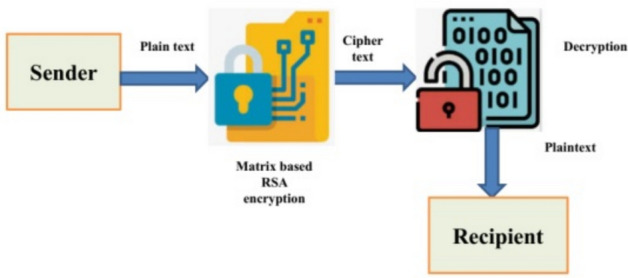
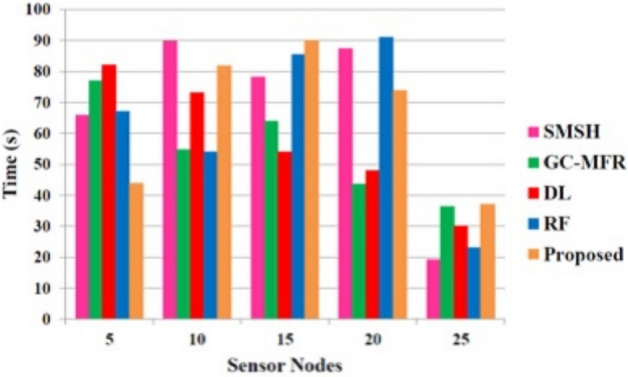
The Internet of Things (IoT) is a rapidly evolving and user-friendly technology that connects everything and enables effective communication between linked things. In hospitals and other healthcare centers, healthcare monitoring systems have exploded in popularity over the last decade, and wireless healthcare monitoring devices using diverse technologies have a huge interest in several countries worldwide. The existing studies in healthcare IoT met a few shortcomings in terms of privacy, security, higher data dimensionality, higher cost, larger execution time, and so on. To tackle these issues, we proposed a novel IoT-enabled and secured healthcare monitoring framework (IoT-SHMF) for heart disease prediction. The data are taken from the Cleveland Heart Disease database. First, authentication is performed through registration, login, and patient data verification. The Matrix-based RSA encryption technology and a blockchain-based data storage concept provide safe data transmission and authorization. Subsequently, the secured data is downloaded by the hospital management (HM) system. The HM system scrutinizes the decrypted data. Finally, the Deep Convolutional Neural Network-based Archimedes Optimization (DCNN-AO) algorithm classifies the normal and abnormal classes of heart disease. The implementation work of the proposed model is simulated using JAVA software with different performance measures. Various performance metrics with state-of-art methods validate the effectiveness of the proposed model. The proposed IoT-based system ensures better security by about 98%. The decryption time of our proposed approach, when the sensor nodes are equal to 25, is 37 seconds.
Keywords: Archimedes optimization algorithm; Biomedical signal processing; DCNN; Deep learning; Heart disease prediction; Intelligent health diagnostics; IoT-based healthcare monitoring system; Matrix-based RSA encryption; Medical data security; Secure health monitoring.
© 2025. The Author(s).
Conflict of interest statement
Declarations. Competing interests: The authors declare no competing interests.
Figures





References
-
- Attia, O., Khoufi, I., Laouiti, A. & Adjih, C. An IoT-Blockchain Architecture Based on Hyperledger Framework for Healthcare Monitoring Application10.1109/NTMS.2019.8763849 (2019).
-
- Anuradha, M. et al. Iot enabled cancer prediction system to enhance the authentication and security using cloud computing. Microprocess. Microsyst.80, 103301 (2020).
-
- Pradhan, K. & Chawla, P. Medical internet of things using machine learning algorithms for lung cancer detection. J. Manag. Anal.7, 591–623 (2020).
-
- Savitha, V., Karthikeyan, N., Karthik, S. & Sabitha, R. A distributed key authentication and okm-anfis scheme based breast cancer prediction system in the iot environment. J. Ambient Intell. Hum. Comput.12, 1757–1769 (2021).
-
- Aydın, S. Deep learning classification of neuro-emotional phase domain complexity levels induced by affective video film clips. IEEE J. Biomed. Health Inform.24, 1695–1702 (2019). - PubMed
MeSH terms
LinkOut - more resources
Full Text Sources
Medical
Miscellaneous
