. 2025 Jul 25;15(1):27115.
doi: 10.1038/s41598-025-12952-1.

Circulating biomarkers in patients with progressive fibrosing interstitial lung disease treated with nintedanib: a pilot study

Affiliations

Circulating biomarkers in patients with progressive fibrosing interstitial lung disease treated with nintedanib: a pilot study

Vitale Miceli et al. Sci Rep. .

Abstract

Progressive fibrosing interstitial lung diseases (PF-ILDs) are characterized by persistent progression and have limited treatment options. The identification of reliable biomarkers to monitor fibrosis and therapeutic response remains a clinical challenge. This study investigated circulating plasma biomarkers associated with PF-ILDs and their potential role in monitoring disease evolution during nintedanib treatment. From 127 putative fibrosis biomarkers, seven candidates were identified with high diagnostic value (area under the curve [AUC] > 0.7), of which five (IGFBP2, PTX3, LGALS1, LGALS9, and MMP2) showed significant dynamic changes (assessed by longitudinal plasma proteomic analysis) in PF-ILD patients treated with 12-months nintedanib, correlating with improvements in forced vital capacity and diffusing capacity of the lung for carbon monoxide. Principal component analysis identified a shift in molecular profiles over time, suggesting nintedanib-induced modulation of these biomarkers. Receiver operating characteristic analysis demonstrated that while LGALS9 maintained a stable predictive value during nintedanib treatment, LGALS1, IGFBP2, PTX3, and MMP2 exhibited increasing AUC scores, indicating their potential role in monitoring fibrosis progression. We also identified optimal biomarker cut-off values at 12 months, which may provide reliable thresholds for fibrosis assessment. In conclusion, our exploratory analysis identified five biomarkers whose plasma concentrations changed during antifibrotic treatment, highlighting their potential prognostic value. Further validation in larger cohorts is needed to confirm their clinical utility.


Conflict of interest statement

Declarations. Competing interests: The authors declare no competing interests. Ethical approval: The study was conducted in accordance with the Declaration of Helsinki. Samples were obtained with fully informed written consent, and ethics approval was obtained from the IRCCS ISMETT’s Institutional Research Review Board supervisors (project number: IRRB/08/22) and the relevant local ethics committee.

Figures

Fig. 1
Fig. 1
Flow chart illustrating the steps for biomarker screening.
Fig. 2
Fig. 2
Receiver operating characteristic (ROC) curves of the biomarkers showing similar trends of expression in cohort 1 and cohort 2. The analysis was conducted on 10 healthy subjects and 33 ILD patients (GSE24206 and GSE21411 datasets).
Fig. 3
Fig. 3
Decline from baseline in forced vital capacity (FVC) and diffusing capacity of the lung for carbon monoxide (DLCO). (A) and (B) mean changes from 6 M Pre in FVC over the 12-month trial period in the overall population. (C) and (D) mean changes from 6 M Pre in DLCO over the 12-month trial period in the overall population. The analysis included 19 ILD patients assessed at 6 months before treatment (6 M Pre), baseline (0 M), and 3 months post-treatment initiation (3 M Post), and 14 ILD patients evaluated at 6 months (6 M Post) and 12 months (12 M Post) after starting nintedanib. *p < 0.05 vs. baseline (0 M). Bars indicate the standard deviation.
Fig. 4
Fig. 4
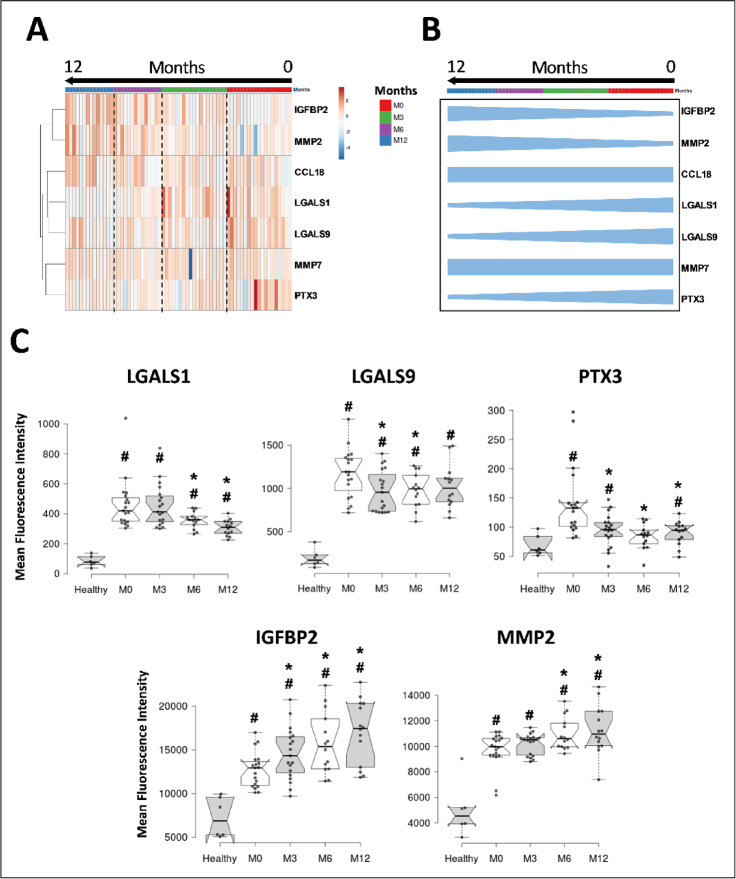
(A) Cluster analysis to compare the plasma protein expression of the seven selected biomarkers during the treatment period with nintedanib (12 months). (B) Expression trend of the biomarkers during the treatment period. (C) Box plots of the abundance of biomarkers that showed variations in patients’ plasma during nintedanib treatment. The analysis included 6 healthy subjects (Healthy), 19 ILD patients assessed at baseline (M0), and 3 months post-treatment initiation (M3), and 14 ILD patients evaluated at 6 months (M6) and 12 months (M12) after starting nintedanib. #p < 0.05 vs. healthy subjects. *p < 0.05 vs. M0.
Fig. 5
Fig. 5
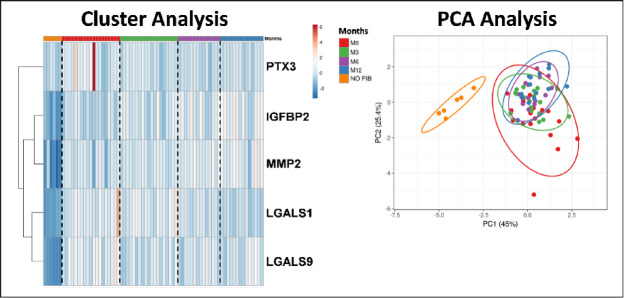
Cluster and principal component analysis (PCA) of selected biomarkers which showed significant variation in expression during the nintedanib treatment. The analysis included 6 healthy subjects (NO FIB), 19 ILD patients assessed at baseline (M0), and 3 months post-treatment initiation (M3), and 14 ILD patients evaluated at 6 months (M6) and 12 months (M12) after starting nintedanib.
Fig. 6
Fig. 6
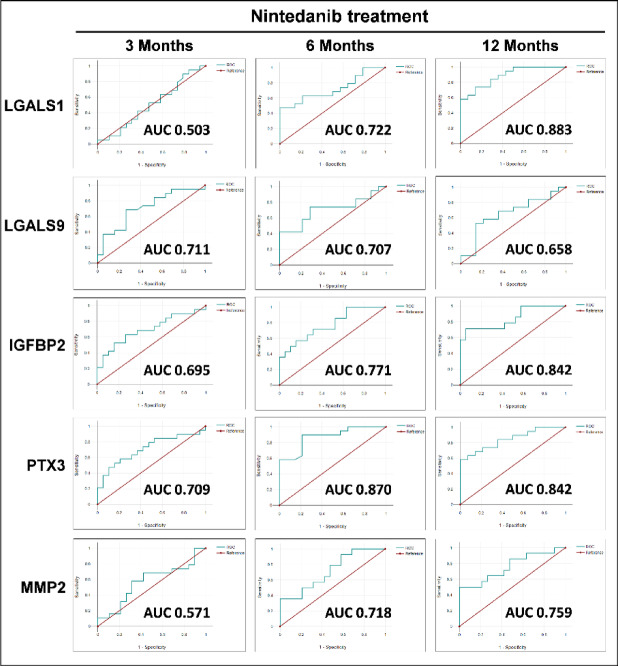
Receiver operating characteristic (ROC) curves of the biomarkers which showed predictive values during treatment with nintedanib. The analysis was conducted on 19 ILD patients at 3-month nintedanib treatment vs. 19 ILD patients at baseline (3 Months), 14 ILD patients at 6-month nintedanib treatment vs. 19 ILD patients at baseline (6 Months), and 14 ILD patients at 12-month nintedanib treatment vs. 19 ILD patients at baseline (12 Months).
Fig. 7
Fig. 7
Molecular model of pulmonary fibrosis illustrating the potential involvement of the biomarkers identified in our study (black boxes). The image was created using Microsoft PowerPoint 2013 (Microsoft Corporation, https://www.microsoft.com/powerpoint).

References

    1. Travis, W. D. et al. An official American thoracic society/european respiratory society statement: update of the international multidisciplinary classification of the idiopathic interstitial pneumonias. Am. J. Respir. Crit. Care Med.188, 733–748 (2013). - PMC - PubMed
    1. Kaunisto, J. et al. Demographics and survival of patients with idiopathic pulmonary fibrosis in the FinnishIPF registry. ERJ Open Res.5 (2019). - PMC - PubMed
    1. Cottin, V., Teague, R., Nicholson, L., Langham, S. & Baldwin, M. The burden of progressive-fibrosing interstitial lung diseases. Front. Med.9, 799912 (2022). - PMC - PubMed
    1. Cottin, V. et al. Fibrosing interstitial lung diseases: Knowns and unknowns. Eur. Respir. Rev.28 (2019). - PMC - PubMed
    1. Brown, K. K. et al. The natural history of progressive fibrosing interstitial lung diseases. Eur. Respir. J.55 (2020). - PMC - PubMed