. 2025 Jul 26;15(1):27284.
doi: 10.1038/s41598-025-13558-3.

Longitudinal dynamics of clinical and neurophysiological changes in parkinson's disease over four and a half years

Affiliations

Longitudinal dynamics of clinical and neurophysiological changes in parkinson's disease over four and a half years

Estefanía Santana-Román et al. Sci Rep. .

Abstract

Parkinson's disease (PD) is a clinically heterogeneous neurodegenerative disorder whose trajectory is shaped by progressive motor impairment and cortical dysfunction. However, longitudinal studies integrating clinical scales with direct neurophysiological assessments remain scarce. In this 4.5-year cohort study, we conducted one of the longest clinical-electrophysiological follow-ups in PD to date, evaluating 22 patients across early and advanced stages using both Movement Disorder Society-Unified Parkinson's Disease Rating Scale (MDS-UPDRS) scores and transcranial magnetic stimulation (TMS). We demonstrate that the cortical silent period (CSP), a marker of GABAergic inhibition, progressively lengthens over time and is associated with motor decline, suggesting its potential as a dynamic biomarker of disease progression. Resting motor threshold (rMT) and motor asymmetry also deteriorated longitudinally, with changes most pronounced following the COVID-19 pandemic-suggesting that environmental stressors may accelerate PD pathophysiology. Unlike prior short-term studies, our findings reveal persistent cortical reorganization over several years, independent of sex, and underscore the clinical relevance of TMS-derived metrics in tracking disease progression. These findings suggest that CSP may serve as a non-invasive and scalable biomarker for monitoring Parkinson's disease progression and informing neurophysiological endpoints in future therapeutic studies.

Keywords: Disease progression; Longitudinal study; Motor asymmetry; Parkinson’s disease; Transcranial magnetic stimulation.


Conflict of interest statement

Declarations. Competing interests: The authors declare no competing interests.

Figures

Fig. 1
Fig. 1
Longitudinal changes in MDS-UPDRS Part I, II, and III scores, and the asymmetry index across evaluation periods. MDS-UPDRS scores significantly varied over time, with the most pronounced changes occurring between the pre-pandemic and post-pandemic periods. Error bars indicate 95% confidence intervals, *p < 0.05, **p < 0.01, ***p < 0.001.
Fig. 2
Fig. 2
Longitudinal variations in resting motor threshold and cortical silent period in the more affected and less affected hemispheres. Both transcranial magnetic stimulation parameters underwent significant changes over time, with the most pronounced differences observed between the pre-pandemic and post-pandemic periods, mirroring the pattern in MDS-UPDRS scores. Error bars indicate 95% confidence intervals, *p < 0.05, **p < 0.01, ***p < 0.001.
Fig. 3
Fig. 3
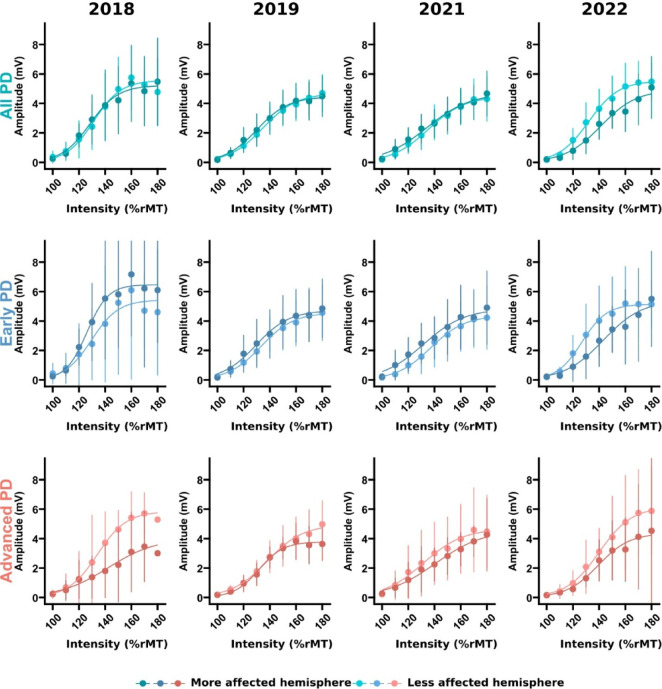
Transcranial magnetic stimulation recruitment curves across evaluation periods for the more affected and less affected hemispheres, stratified by all Parkinson’s disease (PD) patients, early PD, and advanced PD subgroups. Solid lines represent fitted sigmoid curves; error bars indicate 95% confidence intervals; stimulus intensity is expressed as a percentage of the resting motor threshold (rMT).
Fig. 4
Fig. 4
Overview of the study design. This longitudinal study tracked a Parkinson’s disease cohort from 2018 to 2022, assessing MDS-UPDRS scores and transcranial magnetic stimulation (TMS) parameters. Evaluations were conducted during two pre-pandemic periods (2018 and 2019) and two post-pandemic periods (2021 and 2022). In-person visits were suspended between March 2020 and March 2021 due to the COVID-19 pandemic.

References

    1. Moustafa, A. A. et al. Motor symptoms in parkinson’s disease: A unified framework. Neurosci. Biobehav Rev.68, 727–740. 10.1016/j.neubiorev.2016.07.010 (2016). - DOI - PubMed
    1. Chaudhuri, K. R., Healy, D. G. & Schapira, A. H. Non-motor symptoms of parkinson’s disease: diagnosis and management. Lancet Neurol.5, 235–245. 10.1016/s1474-4422(06)70373-8 (2006). - DOI - PubMed
    1. Lacy, B., Piotrowski, H. J., Dewey, R. B. Jr. & Husain, M. M. Severity of depressive and motor symptoms impacts quality of life in parkinson’s disease patients at an academic movement clinic: A cross-sectional study. Clin. Park Relat. Disord. 8, 100180. 10.1016/j.prdoa.2022.100180 (2023). - DOI - PMC - PubMed
    1. Holden, S. K., Finseth, T., Sillau, S. H. & Berman, B. D. Progression of MDS-UPDRS scores over five years in de Novo Parkinson disease from the parkinson’s progression markers initiative cohort. Mov. Disord Clin. Pract.5, 47–53. 10.1002/mdc3.12553 (2018). - DOI - PMC - PubMed
    1. Bartl, M. et al. Longitudinal change and progression indicators using the movement disorder Society-Unified parkinson’s disease rating scale in two independent cohorts with early parkinson’s disease. J. Parkinsons Dis.12, 437–452. 10.3233/jpd-212860 (2022). - DOI - PubMed