


Increasing age, neural invasion, extramural vascular invasion, and short-course radiotherapy in locally advanced rectal cancer are associated with decreased tumor regression: a retrospective cohort study
- PMID: 40715570
- PMCID: PMC12301277
- DOI: 10.1007/s10151-025-03180-w
Increasing age, neural invasion, extramural vascular invasion, and short-course radiotherapy in locally advanced rectal cancer are associated with decreased tumor regression: a retrospective cohort study
Abstract
Background: We investigated factors associated with pathologic complete response (pCR) and tumor regression grade (TRG) on the basis of clinical and pathological variables and their impact on cancer-free survival (CFS) after surgery for locally advanced rectal cancer (LARC).
Methods: All patients with LARC undergoing neoadjuvant treatment before curative total mesorectal excision surgery were included in a prospective institutional database connected to the National Mortality Registry. One-way analysis of variance and Pearson's chi-squared test were utilized to compare TRG groups. The Kaplan-Meier method and regression models were used to evaluate CFS, radiation modality, and staging factors.
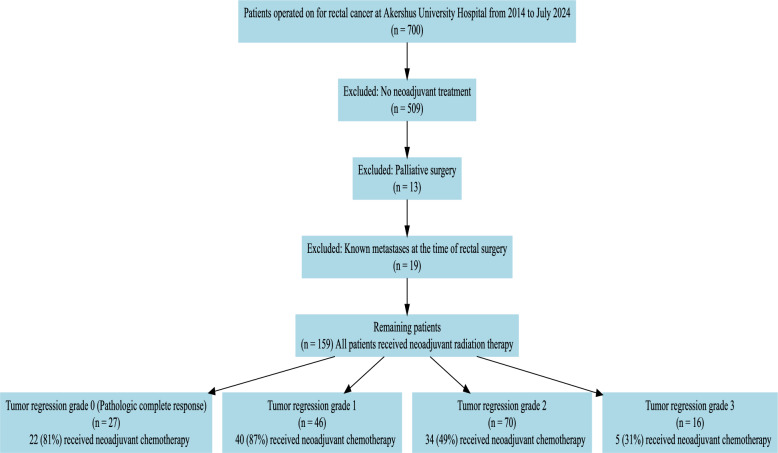
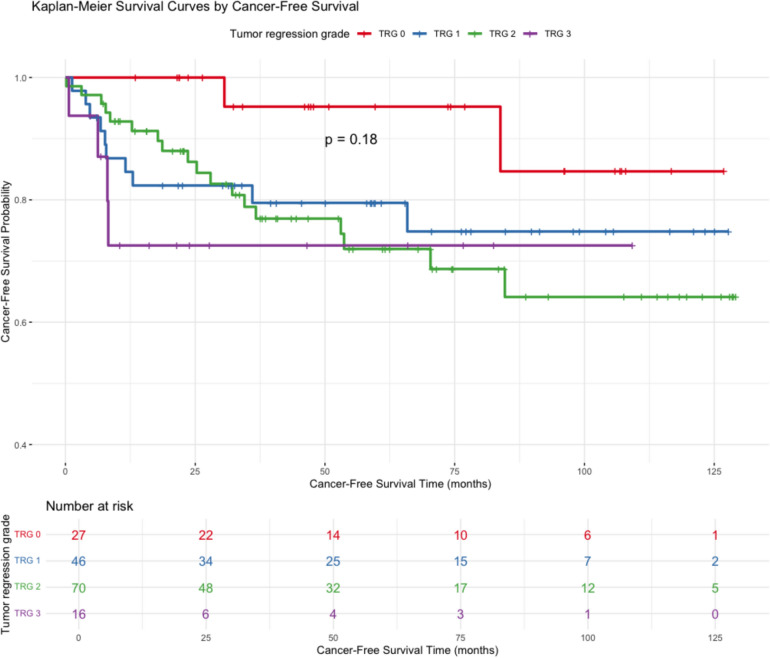
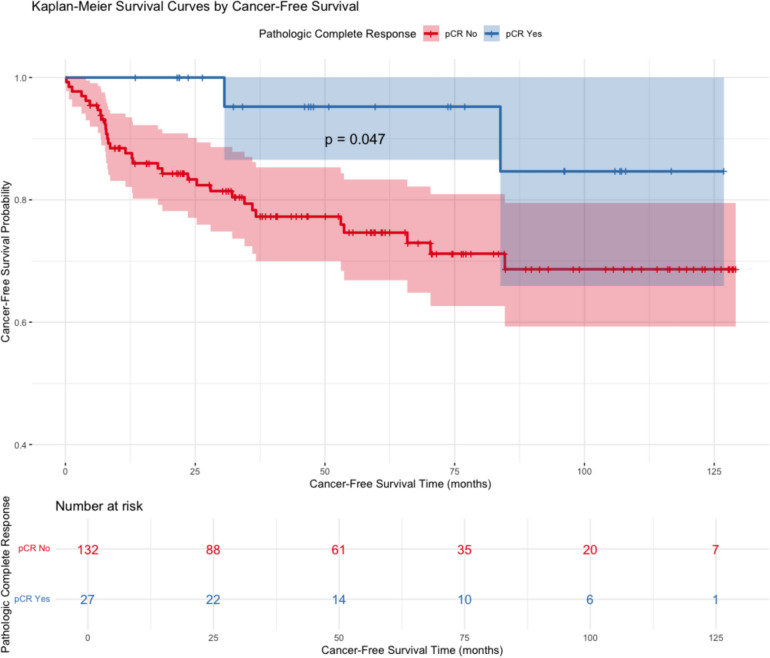
Results: Of 700 patients operated on for rectal cancer between 2014 and 2024, 159 (22.7%) had LARC without known systemic cancer. Twenty-seven patients had pCR (TRG 0, 17.0%), 46 TRG 1 (29.0%), 70 TRG 2 (44.0%), and 16 TRG 3 (10%). Poor tumor regression was associated with increasing age (p = 0.009), vascular (p < 0.001) and neural invasion (p = 0.005), less differentiated tumors (p < 0.001), short-course 5 Gy × 5 (p < 0.001) rather than long-course 2 Gy × 25 radiotherapy, and omission of neoadjuvant chemotherapy (p < 0.001). Older age was a predictor of short-course radiotherapy and omission of chemotherapy (p < 0.001). Follow-up time was 46.6 months (IQR 20-80.3 months). No differences were found in CFS between TRG groups 0-3 (p = 0.18), however pCR was associated with improved CFS (p = 0.047).
Conclusions: Decreased tumor regression was associated with reduced radiotherapy and chemotherapy, neural and vascular invasion, poor differentiation, and increasing age. The latter may reflect reduced application of neoadjuvant treatment in older patients. Complete responders experienced increased cancer-free survival.
Keywords: Chemoradiotherapy; Neoadjuvant therapy; Pathologic complete response; Rectal neoplasms; Tumor regression grade.
© 2025. The Author(s).
Conflict of interest statement
Declarations. Conflict of interest: The authors declare no competing interests. Ethical and Informed Consent: The Regional Committee for Medical and Health Research Ethics (REK 650256) has approved the study. This study is based on data from a quality registry, and in accordance with Norwegian law, informed consent is not required.
Figures
References
-
- Bray F et al (2024) Global cancer statistics 2022: GLOBOCAN estimates of incidence and mortality worldwide for 36 cancers in 185 countries. CA Cancer J Clin 74(3):229–263 - PubMed
MeSH terms
Grants and funding
LinkOut - more resources
Full Text Sources
