


Exploring the influence of path environment factors on walking behavior in urban parks with configuration attribute control
- PMID: 40720482
- PMCID: PMC12303266
- DOI: 10.1371/journal.pone.0329278
Exploring the influence of path environment factors on walking behavior in urban parks with configuration attribute control
Abstract
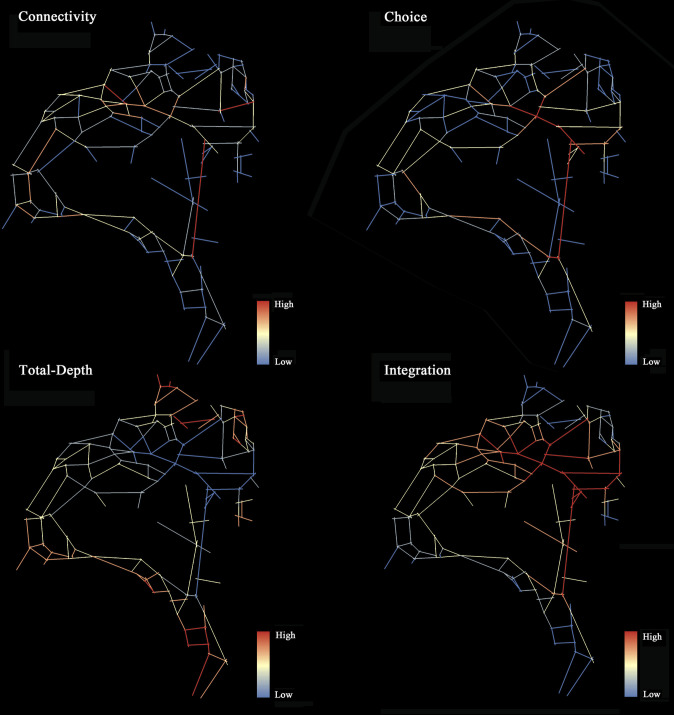
The existing evidence regarding the influence of visual and physical environmental features of park pathways on walking behavior is limited and contentious, partly due to the lack of control over pathway configurational attributes and walking behavior measurement methods. This study addresses this gap by using space syntax and GPS to quantify the structural attributes and pedestrian counts within the pathways in Fengqing Park. Through stratified regression analysis, we examined the impact of environmental factors on walking behavior while controlling for pathway configurational attributes. The findings reveal that even after accounting for pathway configurational attributes, visual (R² = 0.223) and physical (R² = 0.173) environmental factors significantly affect walking behavior. Specifically, pathways with greater choice (β = 0.359, p < 0.01) and depth (β = 0.179, p < 0.05) are more favored. In terms of visual elements, landscape architecture (β = 0.143, p < 0.05) enhances walking behavior, while the presence of water bodies (β = -0.168, p < 0.01) negatively affects it. With respect to the physical environment, path width (β = 0.514, p < 0.01), length (β = 0.163, p < 0.05), and surface smoothness (β = 0.152, p < 0.05) play significant roles in influencing walking behavior. This study contributes to advancing our understanding of the impact of the environmental features of urban park pathways on walking behavior, reconciling research disparities in this domain, and providing guidance for the design and improvement of park pathways.
Copyright: © 2025 Dong et al. This is an open access article distributed under the terms of the Creative Commons Attribution License, which permits unrestricted use, distribution, and reproduction in any medium, provided the original author and source are credited.
Conflict of interest statement
The authors have declared that no competing interests exist.
Figures



References
-
- Gaikwad A, Shinde K. Use of parks by older persons and perceived health benefits: A developing country context. Cities. 2019;84:134–42. doi: 10.1016/j.cities.2018.08.001 - DOI
-
- Li D, Xu H, Kang Y, Steemers K. Systematic Review: Landscape Characteristics Correlated with Physical Activity of the Elderly People. Land. 2023;12(3):605. doi: 10.3390/land12030605 - DOI
-
- Arifwidodo SD, Chandrasiri O. The effects of park improvement on park use and park-based physical activity. JOURNAL OF ARCHITECTURE AND URBANISM. 2021;45(1):73–9. doi: 10.3846/jau.2021.11845 - DOI
-
- Park K. Park and Neighborhood Attributes Associated With Park Use: An Observational Study Using Unmanned Aerial Vehicles. Environment and Behavior. 2019;52(5):518–43. doi: 10.1177/0013916518811418 - DOI
MeSH terms
LinkOut - more resources
Full Text Sources
Miscellaneous
