High seroprevalence of antibodies to Dengue, Chikungunya, and Zika viruses in Dire Dawa, Ethiopia: A cross-sectional survey in 2024
- PMID: 40720538
- PMCID: PMC12352872
- DOI: 10.1371/journal.pntd.0013357
High seroprevalence of antibodies to Dengue, Chikungunya, and Zika viruses in Dire Dawa, Ethiopia: A cross-sectional survey in 2024
Abstract
Background: Aedes-borne diseases infect millions of people each year. In the last decade several arbovirus outbreaks have been reported in Ethiopia. Arbovirus diagnosis and surveillance is lacking, and the true burden is unknown.
Methods: In this study we conducted a seroprevalence survey using a commercially available test kit that tests for immunological responses to IgM and IgG for dengue (DENV), Zika (ZIKV), and chikungunya (CHIKV) viruses in Dire Dawa city, eastern Ethiopia. A total of 339 individuals were sampled using a household-based clustered design. As a contextual comparison, a secondary survey was conducted among 180 individuals in Addis Ababa, where no Aedes-borne virus outbreaks have been reported.
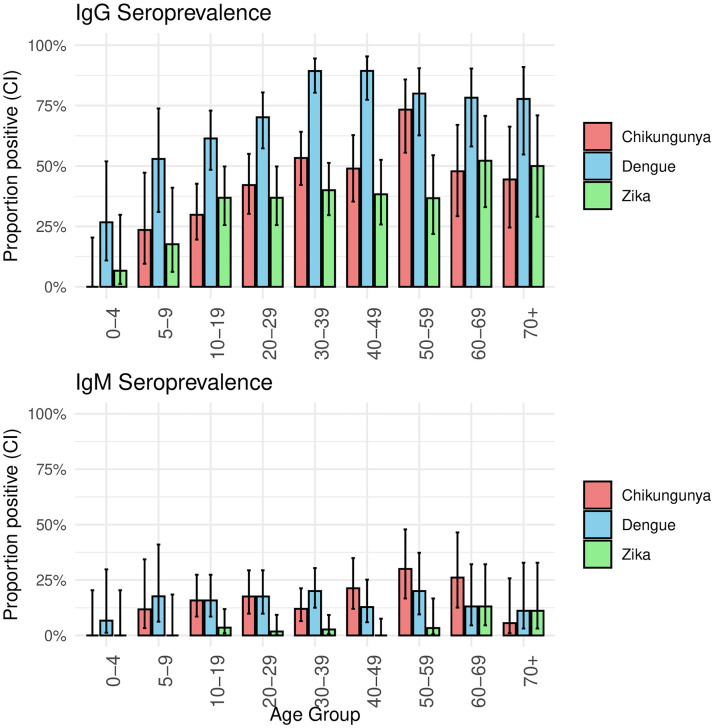
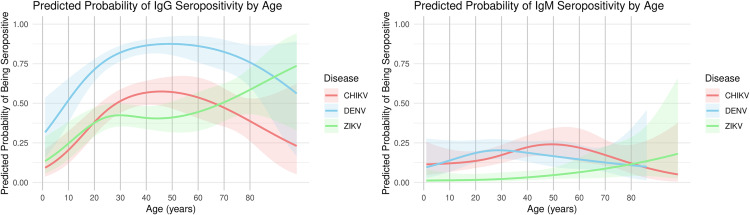
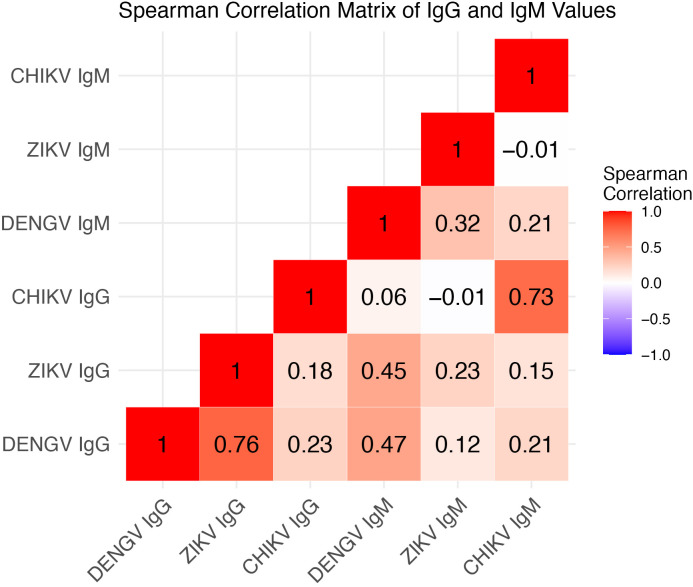
Findings: We found a high IgG seroprevalence for DENV (76%), CHIKV (44%), and ZIKV (38%), and <20% IgM seropositivity across all viruses. In contrast, minimal seropositivity was detected in Addis Ababa (where the highest seropositivity we found was to IgM for DENV at approximately 3%.) Age-specific trends showed early and widespread DENV exposure, with over half of the population seropositive by age 10. Quantitative antibody levels indicated strong correlation between DENV and ZIKV IgG, suggesting potential cross-reactivity. However, higher DENV IgG titers among ZIKV-positive individuals raise the possibility of true prior co-exposure. Intraclass correlation analyses revealed household-level clustering for DENV and CHIKV responses but not for ZIKV.
Conclusions: These results suggest intense and possibly ongoing transmission of Aedes-borne viruses in Dire Dawa, particularly dengue and chikungunya. Apparent ZIKV exposure warrants cautious interpretation given the potential for cross-reactivity, but cannot be ruled out. Our findings underscore the need for improved arbovirus surveillance and diagnostic capacity in Ethiopia, especially in urban centers where competent vectors are established.
Copyright: © 2025 Parker et al. This is an open access article distributed under the terms of the Creative Commons Attribution License, which permits unrestricted use, distribution, and reproduction in any medium, provided the original author and source are credited.
Conflict of interest statement
The authors have declared that no competing interests exist.
Figures
Update of
-
High Seroprevalence to Aedes-borne arboviruses in Ethiopia: a Cross-sectional Survey in 2024.medRxiv [Preprint]. 2024 Sep 26:2024.09.19.24313917. doi: 10.1101/2024.09.19.24313917. medRxiv. 2024. Update in: PLoS Negl Trop Dis. 2025 Jul 28;19(7):e0013357. doi: 10.1371/journal.pntd.0013357. PMID: 39371144 Free PMC article. Updated. Preprint.
References
-
- Chikungunya fact sheet [Internet]. [cited 2024 Aug 26]. Available from: https://www.who.int/news-room/fact-sheets/detail/chikungunya
-
- Staples JE, Breiman RF, Powers AM. Chikungunya Fever: An Epidemiological Review of a Re-Emerging Infectious Disease. Clin Infect Dis. 2009;49(6):942–8. - PubMed
-
- Mora-Salamanca AF, Porras-Ramírez A, De la Hoz Restrepo FP. Estimating the burden of arboviral diseases in Colombia between 2013 and 2016. Int J Infect Dis. 2020;97:81–9. - PubMed
-
- Zika virus [Internet]. [cited 2024 Aug 26]. Available from: https://www.who.int/news-room/fact-sheets/detail/zika-virus
MeSH terms
Substances
Grants and funding
LinkOut - more resources
Full Text Sources
Medical
Research Materials