


Value-based simulation in healthcare: a new model for metrics reporting
- PMID: 40721827
- PMCID: PMC12305902
- DOI: 10.1186/s41077-025-00368-w
Value-based simulation in healthcare: a new model for metrics reporting
Abstract
Background: Healthcare simulation services are increasingly expected to demonstrate their value-a term that remains highly context-dependent and frequently misunderstood. While traditional models such as Kirkpatrick and Phillips have supported early evaluation efforts, they embed hierarchical assumptions about which types of data matter most. These assumptions can constrain recognition of simulation's broader contributions and lead to misguided or inefficient measurement practices.
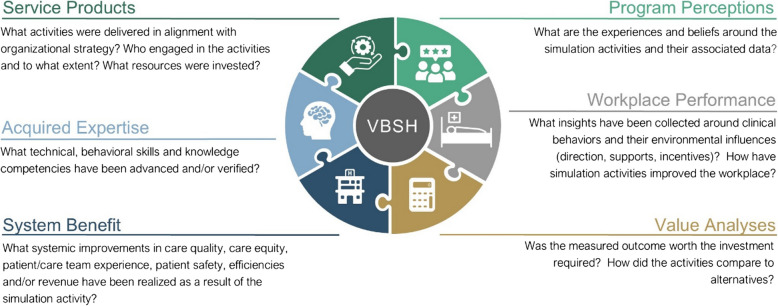
Main body: In this paper, we propose the value-based simulation in healthcare (VBSH) model, an adaptation of Phillips' framework that offers simulation-specific nomenclature and a service-level lens. Structured as a taxonomy rather than a hierarchy, the VBSH model comprises six freestanding but interdependent categories: Service Products, Program Perceptions, Acquired Expertise, Workplace Performance, System Benefit, and Value Analyses. This model is designed to support simulation teams and organizational leaders in selecting relevant measurement strategies, aligning simulation work with institutional goals, and co-creating metrics that are operationally meaningful.
Conclusion: By reframing simulation as a vector for insight, improvement, and transformation-not just training delivery-the VBSH model aims to shift the conversation from metric power to metric relevance, fostering a more accurate, efficient, and context-aware narrative of simulation's value in healthcare.
Keywords: Healthcare simulation; Organizational impact; Program evaluation; Simulation metrics; Translational simulation; Value-based simulation.
© 2025. The Author(s).
Conflict of interest statement
Declarations. Ethics approval and consent to participate: Not applicable. Consent for publication: Not applicable. Competing interests: Rebecca Szabo is on the Editorial Board for Advances in Simulation.
Figures
References
-
- Phillips PP. Measuring ROI in healthcare: tools and techniques to measure the impact and ROI in healthcare improvement projects and programs. 1st ed. New York: McGraw-Hill Education LLC; 2013. p. 1. (McGraw-Hill’s AccessMedicine).
-
- Nestel D, Brazil V, Hay M. You can’t put a value on that… or can you? Economic evaluation in simulation-based medical education. Med Educ. 2018;52(2):139–41. - PubMed
-
- Zendejas B, Wang AT, Brydges R, Hamstra SJ, Cook DA. Cost: the missing outcome in simulation-based medical education research: a systematic review. Surgery. 2013;153(2):160–76. - PubMed
-
- Lin Y, Cheng A, Hecker K, Grant V, Currie GR. Implementing economic evaluation in simulation-based medical education: challenges and opportunities. Med Educ. 2018;52(2):150–60. - PubMed
LinkOut - more resources
Full Text Sources
