


Can Environmentally-Specific Transformational Leadership Foster Employees' Green Voice Behavior? A Moderated Mediation Model of Psychological Empowerment, Ecological Reflexivity, and Value Congruence
- PMID: 40723729
- PMCID: PMC12292308
- DOI: 10.3390/bs15070945
Can Environmentally-Specific Transformational Leadership Foster Employees' Green Voice Behavior? A Moderated Mediation Model of Psychological Empowerment, Ecological Reflexivity, and Value Congruence
Abstract
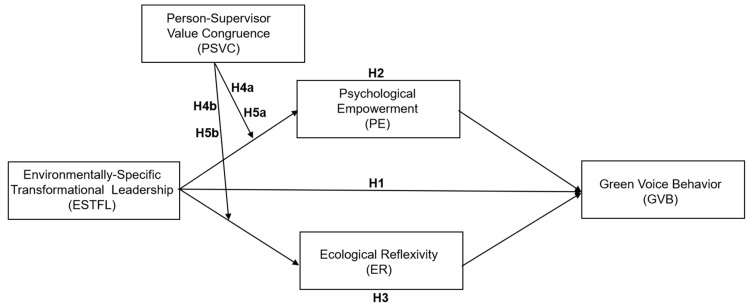
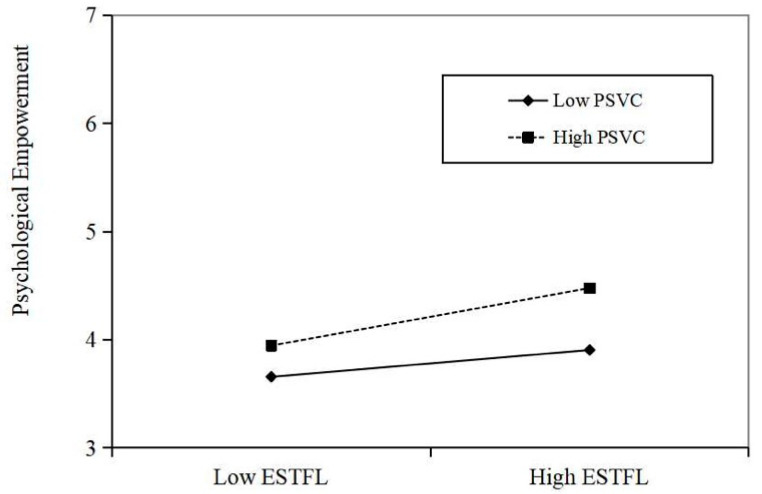
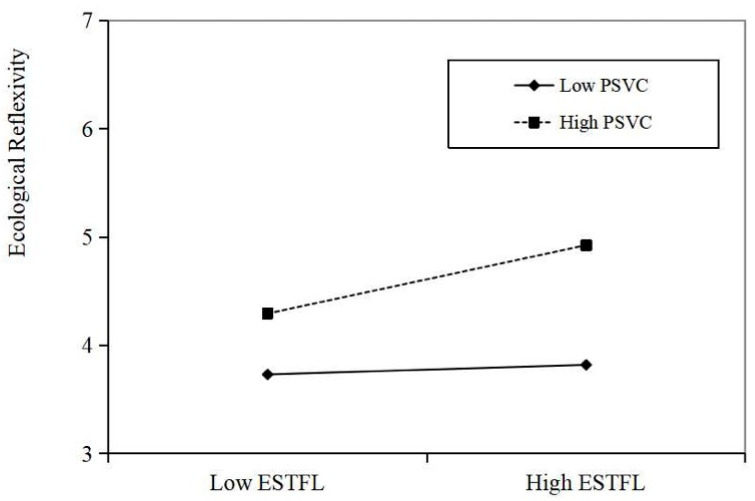
Employees' green voice behavior (GVB), as a specific category of extra-role green behavior, plays a vital role in promoting a firm's sustainable development. However, its underlying mechanism has not been sufficiently explored. Drawing on social learning theory (SLT), this study proposes a research model that examines the indirect influence of environmentally-specific transformational leadership (ESTFL) on GVB via psychological empowerment (PE) and ecological reflexivity (ER) as well as the moderating role of person-supervisor value congruence (PSVC). To achieve the research goals, we conducted a two-wave online survey via the convenience sampling method to collect data from 530 employees and 106 direct supervisors working in the manufacturing, hospitality and service, energy production, construction, transportation, information and communication, and finance industries in China. Regression analyses and CFA based on SPSS and Mplus were employed to test and validate the research model. Our findings show that PE and ER both partially mediated the positive association between ESTFL and GVB. Moreover, PSVC moderated the mediating effects of ESTFL on GVB via PE and ER. This study advances empirical research regarding how leadership impacts GVB by revealing dual cognitive mechanisms and identifying its boundary condition. It also offers managerial implications for leaders and enterprises in China to promote employees' GVB and improve sustainable management.
Keywords: ecological reflexivity; environmentally-specific transformational leadership; green voice behavior; person-supervisor value congruence; psychological empowerment.
Conflict of interest statement
The authors declare no conflicts of interest.
Figures
References
-
- Aboramadan M., Barbar J., Alhabil W., Alhalbusi H. Green servant leadership and green voice behavior in Qatari higher education: Does climate for green initiative matter? International Journal of Sustainability in Higher Education. 2023;25(3):539–555. doi: 10.1108/IJSHE-03-2023-0112. - DOI
-
- Aboramadan M., Kundi Y. M., Becker A. Green human resource management in nonprofit organizations: Effects on employee green behavior and the role of perceived green organizational support. Personnel Review. 2021;51(7):1788–1806. doi: 10.1108/PR-02-2021-0078. - DOI
-
- Afsar B., Maqsoom A., Shahjehan A., Afridi S. A., Nawaz A., Fazliani H. Responsible leadership and employee’s proenvironmental behavior: The role of organizational commitment, green shared vision, and internal environmental locus of control. Corporate Social Responsibility and Environmental Management. 2020;27(1):297–312. doi: 10.1002/csr.1806. - DOI
-
- Afsar B., Shahjehan A., Shah I. Research handbook on employee pro-environmental behaviour. Edward Elgar Publishing Ltd.; 2018. Leadership and employee pro-environmental behaviours.
-
- Akhtar M. W., Karatepe O. M., Syed F., Husnain M. Leader knowledge hiding, feedback avoidance and hotel employee outcomes: A moderated mediation model. International Journal of Contemporary Hospitality Management. 2022;34(2):578–600. doi: 10.1108/IJCHM-04-2021-0545. - DOI
LinkOut - more resources
Full Text Sources
