


Bilirubin Metabolism and Thyroid Cancer: Insights from ALBI and PALBI Indices
- PMID: 40723913
- PMCID: PMC12293926
- DOI: 10.3390/biom15071042
Bilirubin Metabolism and Thyroid Cancer: Insights from ALBI and PALBI Indices
Abstract
Background: This study evaluated the association between bilirubin subtypes (total, indirect, and direct bilirubin) and thyroid cancer risk, with a particular focus on stratified analyses using the ALBI (Albumin-Bilirubin) and PALBI (Platelet-Albumin-Bilirubin) indices by sex, smoking and drinking status, and age under 50 years.
Methods: Data were obtained from 133,596 participants in the Korean Cancer Prevention Study-II (KCPS-II) cohort. During a mean follow-up period of 13.55 years, 2314 cases of thyroid cancer (ICD-10: C73) were identified. Serum bilirubin levels and ALBI and PALBI indices were analyzed using Cox proportional hazards regression models stratified by age, sex, smoking, and alcohol consumption status to estimate hazard ratios (HRs) and 95% confidence intervals (CIs).
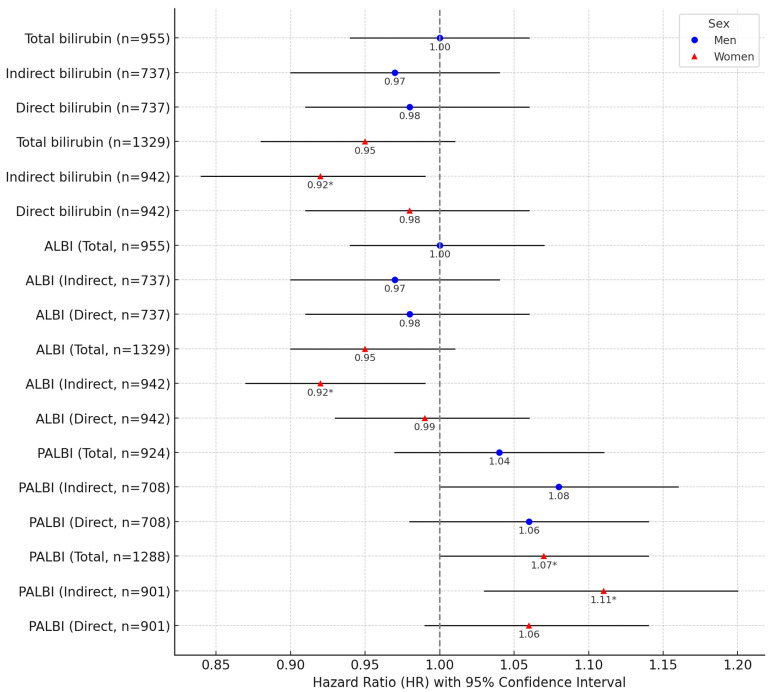
Results: In women, indirect bilirubin showed the strongest inverse association with thyroid cancer risk. ALBI and PALBI indices based on indirect bilirubin also demonstrated significant associations. A 1 standard deviation (SD) increase in indirect bilirubin was associated with a decreased risk of thyroid cancer (HR: 0.92, 95% CI: 0.84-0.99), and the ALBI index similarly showed an inverse association (HR: 0.92, 95% CI: 0.87-0.99). In contrast, the PALBI index was positively associated with thyroid cancer risk (HR: 1.11, 95% CI: 1.03-1.20). Among women who had never smoked, significant associations were observed for indirect bilirubin (HR: 0.91, 95% CI: 0.83-1.00), ALBI (HR: 0.93, 95% CI: 0.86-1.00), and PALBI (HR: 1.14, 95% CI: 1.05-1.23). In analyses stratified by alcohol consumption, the PALBI index was associated with increased thyroid cancer risk in non-drinkers, former drinkers, and ever drinkers, with respective risk increases of 15%, 18%, and 9%.
Conclusions: In women, indirect bilirubin was significantly and inversely associated with thyroid cancer risk, and the ALBI and PALBI indices incorporating indirect bilirubin showed consistent results. These findings suggest that indirect bilirubin may play a critical role in the metabolic pathways underlying thyroid cancer in women.
Keywords: albumin; antioxidants; bilirubin; oxidative stress; thyroid neoplasms.
Conflict of interest statement
The authors declare that they have no competing interests.
Figures
References
MeSH terms
Substances
Grants and funding
- No. 2021-00020-3/This study was supported by a MEF Fellowship conducted as part of the "Education and Research Capacity Building Project at University of Medicine and Pharmacy at Ho Chi Minh City," implemented by the Korea International Cooperation Agency (KOICA) in 2023
- none/This study was supported by research funding from Basgen Bio for the years 2021-2026.
LinkOut - more resources
Full Text Sources
Medical
