


Nationwide Spatial Patterns and Maternal and Birth-Related Factors Associated with Orofacial Clefts in Brazil
- PMID: 40724062
- PMCID: PMC12295512
- DOI: 10.3390/ijerph22070995
Nationwide Spatial Patterns and Maternal and Birth-Related Factors Associated with Orofacial Clefts in Brazil
Abstract
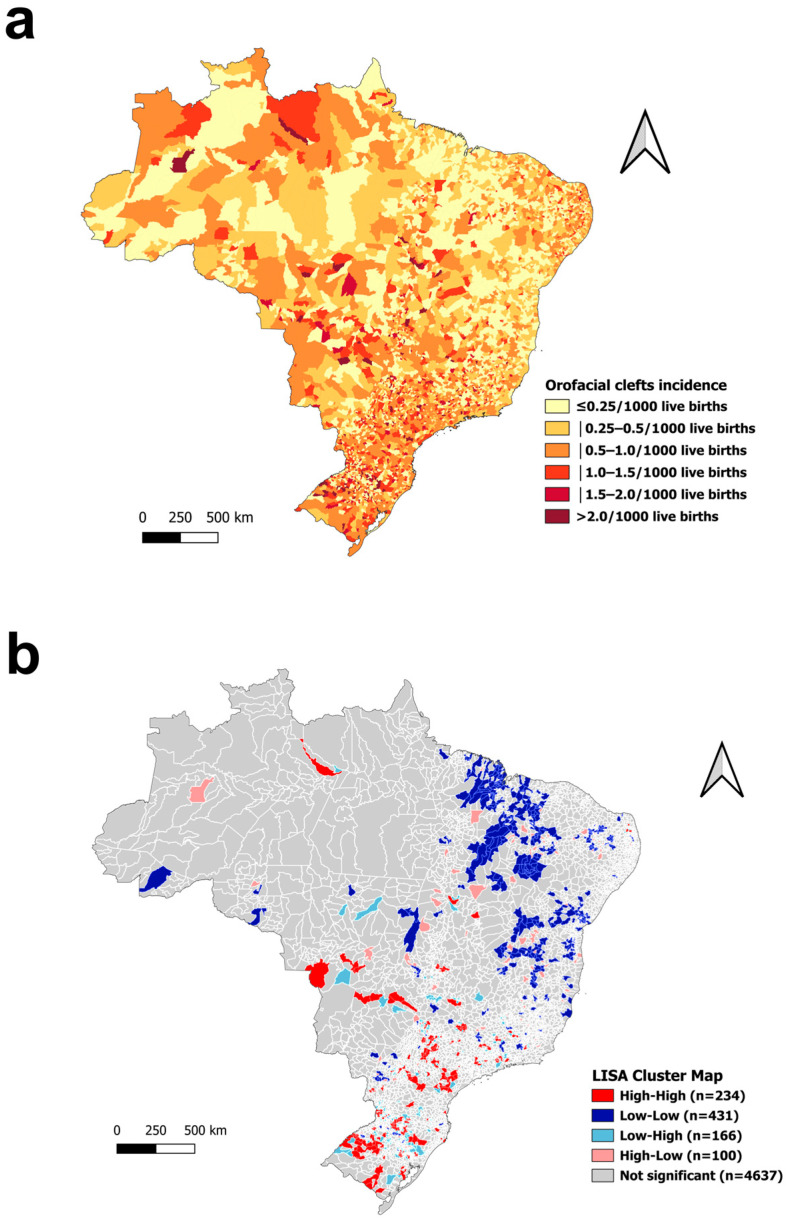
This study aimed to identify spatial clustering and maternal and birth-related factors associated with the incidence of orofacial clefts in Brazil from 2001 to 2022. A nationwide ecological study was conducted in Brazil using data from 2001 to 2022 obtained from the Brazilian Live Birth Information System (SINASC). The municipality was used as the spatial unit of analysis. Variables included maternal age and education, newborn sex, gestational age, birth weight, and skin color/ethnicity. Univariate and bivariate global and local Moran's I indices were used to assess spatial autocorrelation. A total of 234 municipalities (4.2%) formed high-high spatial clusters, primarily in the South and Southeast, while 431 municipalities (7.7%) formed low-low clusters, mostly in the Northeast (Moran's I = 0.121, 95% CI: 0.107 to 0.135). High-high clusters had a lower median proportion of adolescent mothers (≤19 years: 17.4%) and a higher proportion of mothers aged ≥ 35 years (12.9%) compared to low-low clusters (23.5% and 8.7%, respectively; p < 0.001). High-high clusters also had fewer mothers with less than seven years of education (31.0% vs. 45.9%, p < 0.001) and higher rates of preterm births and low birth weight (p < 0.001). The proportion of White newborns was higher in high-high clusters than in low-low clusters (82.8% vs. 13.6%, p < 0.001). These findings suggest that orofacial cleft incidence in Brazil is spatially associated with maternal sociodemographic characteristics, perinatal outcomes, and newborn race/ethnicity.
Keywords: Brazil; epidemiology; orofacial clefts; spatial analysis.
Conflict of interest statement
The authors declare no conflicts of interest.
Figures
References
-
- Salari N., Darvishi N., Heydari M., Bokaee S., Darvishi F., Mohammadi M. Global prevalence of cleft palate, cleft lip and cleft palate and lip: A comprehensive systematic review and meta-analysis. J. Stomatol. Oral Maxillofac. Surg. 2022;123:110–120. doi: 10.1016/j.jormas.2021.05.008. - DOI - PubMed
MeSH terms
Grants and funding
LinkOut - more resources
Full Text Sources
Medical
