


Entropy-Regularized Attention for Explainable Histological Classification with Convolutional and Hybrid Models
- PMID: 40724439
- PMCID: PMC12295624
- DOI: 10.3390/e27070722
Entropy-Regularized Attention for Explainable Histological Classification with Convolutional and Hybrid Models
Abstract
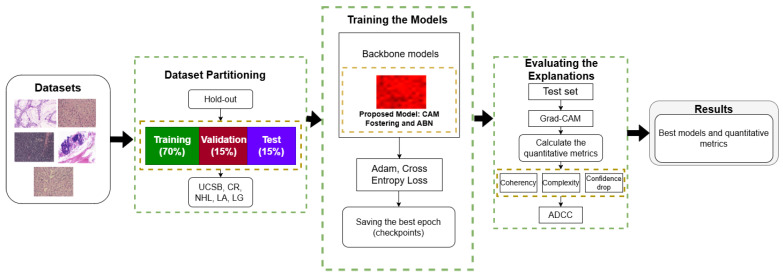
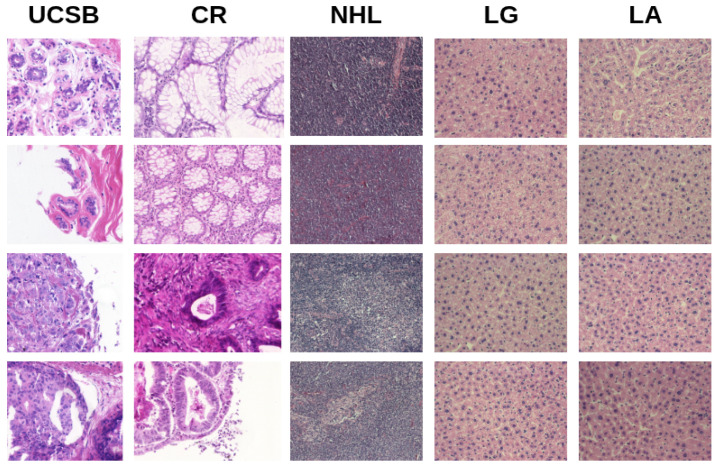
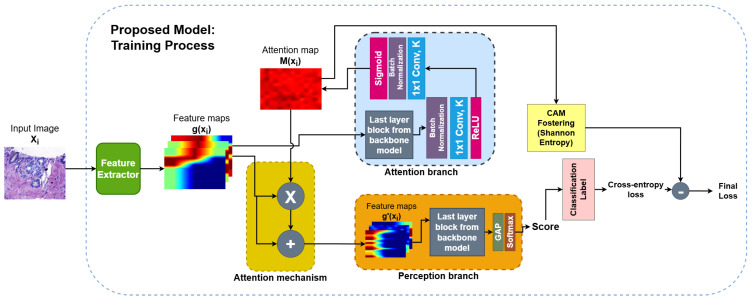
Deep learning models such as convolutional neural networks (CNNs) and vision transformers (ViTs) perform well in histological image classification, but often lack interpretability. We introduce a unified framework that adds an attention branch and CAM Fostering, an entropy-based regularizer, to improve Grad-CAM visualizations. Six backbone architectures (ResNet-50, DenseNet-201, EfficientNet-b0, ResNeXt-50, ConvNeXt, CoatNet-small) were trained, with and without our modifications, on five H&E-stained datasets. We measured explanation quality using coherence, complexity, confidence drop, and their harmonic mean (ADCC). Our method increased the ADCC in five of the six backbones; ResNet-50 saw the largest gain (+15.65%), and CoatNet-small achieved the highest overall score (+2.69%), peaking at 77.90% on the non-Hodgkin lymphoma set. The classification accuracy remained stable or improved in four models. These results show that combining attention and entropy produces clearer, more informative heatmaps without degrading performance. Our contributions include a modular architecture for both convolutional and hybrid models and a comprehensive, quantitative explainability evaluation suite.
Keywords: CAM Fostering; Grad-CAM; attention branches; convolutional neural networks; histological images; vision transformers.
Conflict of interest statement
The authors declare no conflict of interest.
Figures

References
-
- Krizhevsky A., Sutskever I., Hinton G.E. ImageNet Classification with Deep Convolutional Neural Networks. In: Pereira F., Burges C., Bottou L., Weinberger K., editors. Proceedings of the Advances in Neural Information Processing Systems; Lake Tahoe, NV, USA. 3–6 December 2012; New York, NY, USA: Curran Associates, Inc.; 2012.
-
- He K., Zhang X., Ren S., Sun J. Deep Residual Learning for Image Recognition; Proceedings of the 2016 IEEE Conference on Computer Vision and Pattern Recognition (CVPR); Las Vegas, NV, USA. 27–30 June 2016; pp. 770–778. - DOI
-
- Vaswani A., Shazeer N., Parmar N., Uszkoreit J., Jones L., Gomez A.N., Kaiser L., Polosukhin I. Attention Is All You Need. [(accessed on 23 June 2025)];arXiv. 2023 Available online: http://arxiv.org/abs/1706.03762.1706.03762
-
- Liu S., Wang L., Yue W. An efficient medical image classification network based on multi-branch CNN, token grouping Transformer and mixer MLP. Appl. Soft Comput. 2024;153:111323. doi: 10.1016/j.asoc.2024.111323. - DOI
-
- Dwivedi K., Dutta M.K., Pandey J.P. EMViT-Net: A novel transformer-based network utilizing CNN and multilayer perceptron for the classification of environmental microorganisms using microscopic images. Ecol. Inform. 2024;79:102451. doi: 10.1016/j.ecoinf.2023.102451. - DOI
Grants and funding
- #305386/2024-7/National Council for Scientific and Technological Development
- 302833/2025-0/National Council for Scientific and Technological Development
- 001/Coordenação de Aperfeicoamento de Pessoal de Nível Superior
- APQ-00727-24/Fundação de Amparo à Pesquisa do Estado de Minas Gerais
- 2022/03020-1/Fundação de Amparo à Pesquisa do Estado de São Paulo
LinkOut - more resources
Full Text Sources
Medical
