


Social Support's Dual Mechanisms in the Loneliness-Frailty Link Among Older Adults with Diabetes in Beijing: A Cross-Sectional Study of Mediation and Moderation
- PMID: 40724738
- PMCID: PMC12294273
- DOI: 10.3390/healthcare13141713
Social Support's Dual Mechanisms in the Loneliness-Frailty Link Among Older Adults with Diabetes in Beijing: A Cross-Sectional Study of Mediation and Moderation
Abstract
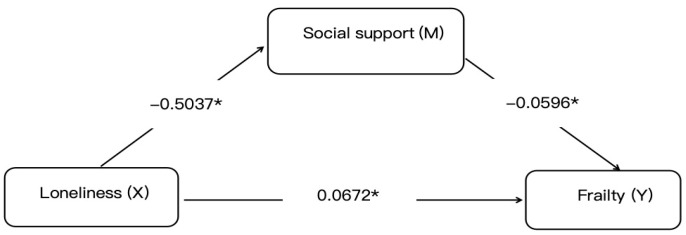
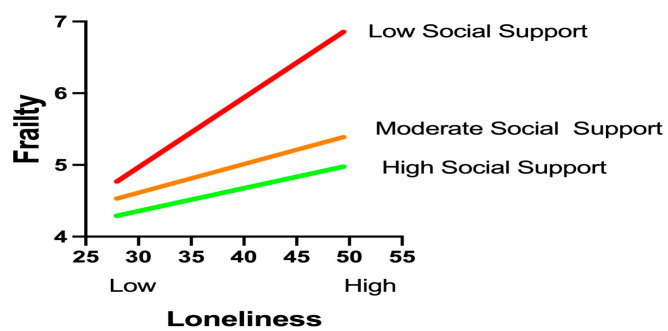
Background: The mechanisms linking loneliness to frailty in older adults with diabetes remain unclear. Guided by the Loneliness-Health Outcomes Model, this study is the first to simultaneously validate the dual mechanisms (mediation and moderation) of social support in the loneliness-frailty relationship among older Chinese adults with diabetes. Methods: A cross-sectional study enrolled 442 community-dwelling adults aged ≥60 years with type 2 diabetes in Beijing. Standardized scales assessed loneliness (UCLA Loneliness Scale), frailty (Tilburg Frailty Indicator), and social support (SSRS). Analyses included Pearson's correlations, hierarchical regression, and PROCESS macro to evaluate mediating/moderating effects, after adjusting for demographics and comorbidities. Results: The frailty prevalence was 55.2%. Loneliness was positively correlated with frailty (r = 0.327, p < 0.01), while social support showed inverse associations with both loneliness (r = -0.496) and frailty (r = -0.315) (p < 0.01). Social support partially mediated loneliness's effect on frailty (indirect effect: 30.86%; 95% CI: 0.028-0.087) and moderated this relationship (interaction β = -0.003, p = 0.011). High-risk clusters (e.g., aged ≥80 years, widowed, and isolated individuals) exhibited combined "high loneliness-low support-high frailty" profiles. Conclusions: Social support reduces the frailty risk through dual mechanisms. These findings advocate for tiered clinical interventions: (1) targeted home-visit systems and resource allocation for high-risk subgroups (e.g., solo-living elders aged ≥80 years); and (2) the integration of social support screening into routine diabetes care to identify individuals below the protective threshold (SSRS < 45.47). These findings advance psychosocially informed strategies for diabetes management in aging populations.
Keywords: frailty; geriatric nursing; loneliness; social support; type 2 diabetes (T2D).
Conflict of interest statement
The authors declare no financial or non-financial conflicts of interest. This research did not involve any commercial or financial relationships that could be construed as potential conflicts of interest.
Figures
References
-
- International Diabetes Federation . IDF Diabetes Atlas. 10th ed. International Diabetes Federation; Brussels, Belgium: 2021.
-
- Liu Z., Liu Z., Wang J., Sun H., Xia Y., Wu Y., Li H., Zhang Y., Chen H., Zhang J., et al. Social Isolation in Chinese Older Adults. Lancet Reg. Health West. Pac. 2022;23:100458.
-
- National Bureau of Statistics of China . Seventh National Population Census Bulletin. National Bureau of Statistics; Beijing, China: 2021.
LinkOut - more resources
Full Text Sources
