


Placental Shear Wave Elastography Assessment in Early and Late Fetal Growth Restriction
- PMID: 40725672
- PMCID: PMC12295446
- DOI: 10.3390/jcm14144980
Placental Shear Wave Elastography Assessment in Early and Late Fetal Growth Restriction
Abstract
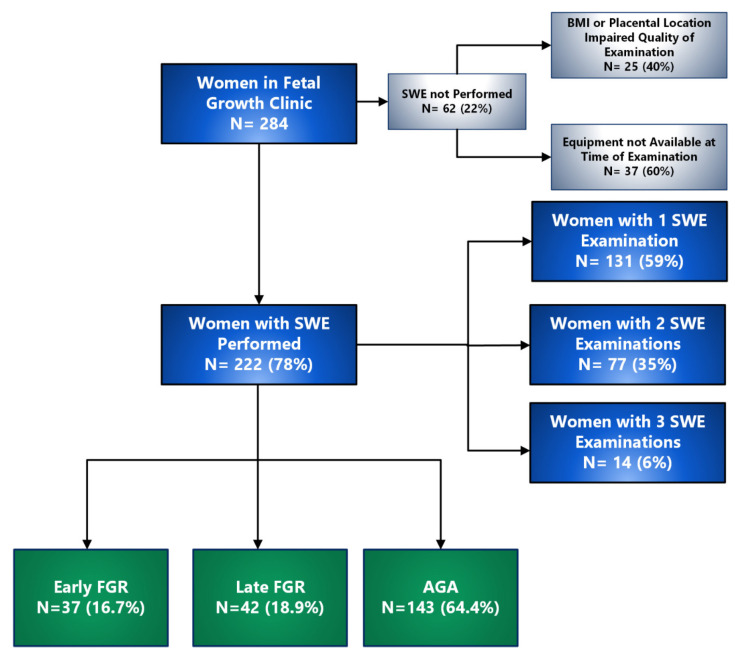
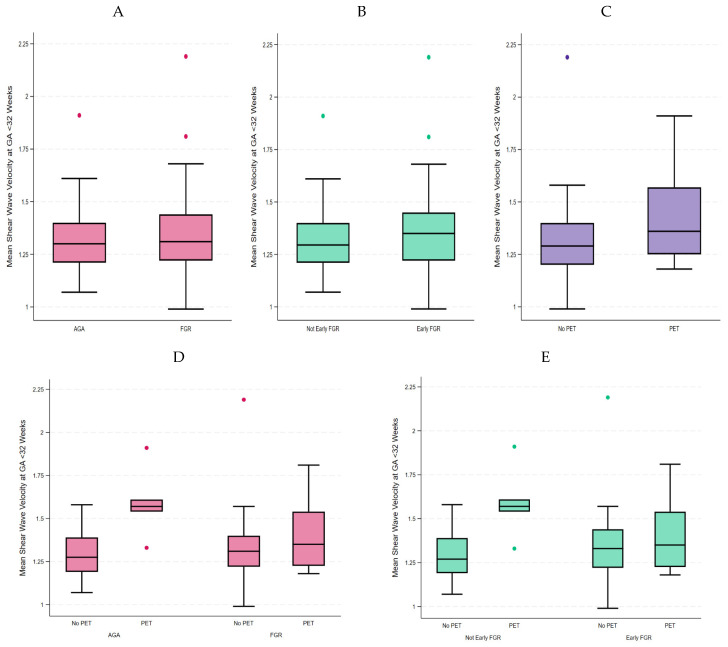
Background/Objectives: The application of shear wave elastography (SWE) for the assessment of placental disease is still unproven and there is limited data correlating placental biomechanical properties with aberrations in fetal growth. This study investigated changes in placental shear wave velocity (SWV) in early and late fetal growth restriction (FGR). Methods: We analyzed three study cohorts: Pregnancies with appropriate growth for gestational age (AGA) and those with early (<32 weeks') and late (>32 weeks') FGR. Mean SWV at two time points was compared in the following cohorts: all FGR vs. AGA, early FGR vs. late FGR, early FGR vs. AGA, and late FGR vs. AGA. Results: The study comprised 222 women-79 (35.6%) FGR and 143 (64.4%) AGA. Of the FGR pregnancies, 37 (46.8%) were early and 42 (53.2%) were late. On multivariate analysis mean, SWV was not increased in FGR compared to AGA placentae (β 0.21, 95% CI -0.17-0.60, p 0.28). It was also not increased in early FGR compared to late FGR or AGA placentae (β 0.36, 95% CI -0.06-0.77, p 0.09). We observed an effect measure modification by pre-eclampsia, increasing mean SWV to a greater extent in AGA compared to FGR cases. Conclusions: Although previous studies have shown an association between placental SWV and FGR, our study showed no difference between cases and controls. The interaction of pre-eclampsia indicated that SWE may have a greater role in pre-eclampsia than in FGR alone. Further investigation of the influence of increased maternal vascular pressure on placental stiffness would be beneficial.
Keywords: fetal growth restriction; placental elastography; placental stiffness; pre-eclampsia; shear wave elastography; ultrasound.
Conflict of interest statement
The authors declare no conflicts of interest. The funders had no role in the design of the study; in the collection, analyses, or interpretation of data; in the writing of the manuscript; or in the decision to publish the results.
Figures


References
-
- Lawn J.E., Ohuma E.O., Bradley E., Idueta L.S., Hazel E., Okwaraji Y.B., Erchick D.J., Yargawa J., Katz J., Lee A.C.C., et al. Small babies, big risks: Global estimates of prevalence and mortality for vulnerable newborns to accelerate change and improve counting. Lancet. 2023;401:1707–1719. doi: 10.1016/S0140-6736(23)00522-6. - DOI - PubMed
-
- de Mendonça E.L.S.S., de Lima Macêna M., Bueno N.B., de Oliveira A.C.M., Mello C.S. Premature birth, low birth weight, small for gestational age and chronic non-communicable diseases in adult life: A systematic review with meta-analysis. Early Human Dev. 2020;149:105154. doi: 10.1016/j.earlhumdev.2020.105154. - DOI - PubMed
Grants and funding
LinkOut - more resources
Full Text Sources
Miscellaneous
