


Generative AI-Powered Mental Wellness Chatbot for College Student Mental Wellness: Open Trial
- PMID: 40726405
- PMCID: PMC12303582
- DOI: 10.2196/71923
Generative AI-Powered Mental Wellness Chatbot for College Student Mental Wellness: Open Trial
Abstract
Background: Colleges have turned to digital mental health interventions to meet the increasing mental health treatment needs of their students. Among these, chatbots stand out as artificial intelligence-driven tools capable of engaging in human-like conversations that have demonstrated some effectiveness in reducing depression and anxiety symptoms.
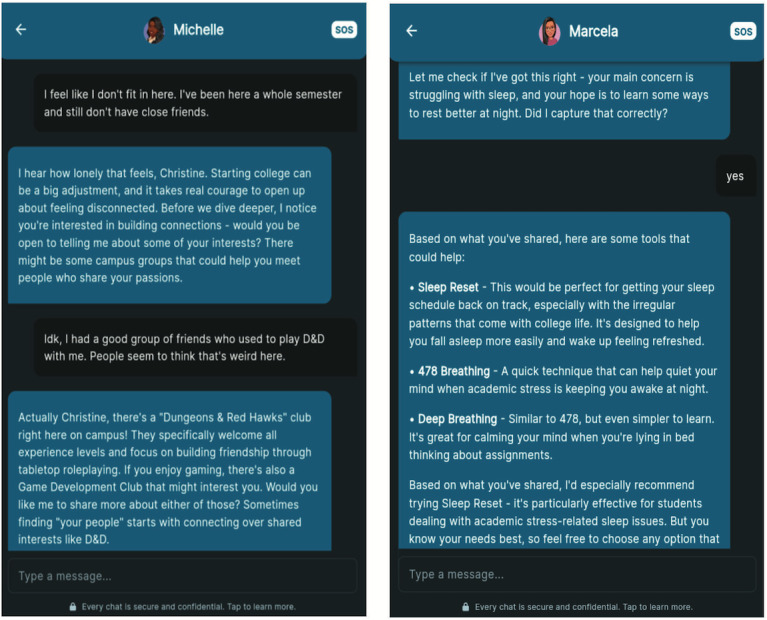
Objective: This study aimed to assess the feasibility and acceptability of using Wayhaven, an artificial intelligence chatbot, among college students with elevated depression or anxiety symptoms. We also aimed to examine the preliminary effectiveness of Wayhaven in improving symptoms of anxiety and depression, hopelessness, agency, and self-efficacy among students.
Methods: Participants were 50 racially and ethnically diverse college students with elevated depression or anxiety symptoms (n=45, 80% female; mean age 22.12, SD 4.42 years). Students were asked to use Wayhaven over the course of 1 week and completed assessments at preintervention, after 1 session, and 1 week.
Results: Wayhaven use was associated with a significant decrease in depression (β=-1.62; P<.001), anxiety (β=-2.15; P<.001), and hopelessness (β=-.64; P<.001) and a significant increase in agency (β=.64; P=.32), self-efficacy (β=.53; P=.02), and well-being (t40=2.90; P=.006; d=0.45) across the study period. Most students also reported being satisfied with Wayhaven and it being a tool they would recommend to their peers.
Conclusions: Findings suggest that Wayhaven may be a viable mental wellness resource for diverse students with elevated depression or anxiety symptoms.
Keywords: anxiety; artificial intelligence; chatbots; college students; depression.
© Jazmin Reyes-Portillo, Amy So, Kelsey McAlister, Christine Nicodemus, Ashleigh Golden, Colleen Jacobson, Jennifer Huberty. Originally published in JMIR Formative Research (https://formative.jmir.org).
Conflict of interest statement
Figures
Similar articles
-
Longitudinal Relationships Between Depressive Attributional Style and Internalizing Symptoms in an Autism-Enriched Sample of Incoming College Students.Autism Adulthood. 2025 Apr 3;7(2):185-200. doi: 10.1089/aut.2024.0090. eCollection 2025 Apr. Autism Adulthood. 2025. PMID: 40309015
-
Use of Online Tools for Mental Health Among Racially and Ethnically Diverse College Students: Mixed Methods Study.JMIR Hum Factors. 2025 Jun 13;12:e60628. doi: 10.2196/60628. JMIR Hum Factors. 2025. PMID: 40513094 Free PMC article.
-
Future Me, a Prospection-Based Chatbot to Promote Mental Well-Being in Youth: Two Exploratory User Experience Studies.JMIR Form Res. 2025 Jul 18;9:e74411. doi: 10.2196/74411. JMIR Form Res. 2025. PMID: 40680255 Free PMC article.
-
Psychological therapies for women who experience intimate partner violence.Cochrane Database Syst Rev. 2020 Jul 1;7(7):CD013017. doi: 10.1002/14651858.CD013017.pub2. Cochrane Database Syst Rev. 2020. PMID: 32608505 Free PMC article.
-
Psychedelic-assisted therapy for treating anxiety, depression, and existential distress in people with life-threatening diseases.Cochrane Database Syst Rev. 2024 Sep 12;9(9):CD015383. doi: 10.1002/14651858.CD015383.pub2. Cochrane Database Syst Rev. 2024. PMID: 39260823
References
-
- Gorman B, Hargraves L, Huynh S, Parker S, Wiafe B. Transitions; 2020. [01-01-2025]. Early findings from Transitions I: mental health, stress and health-related behaviors.https://transitions.web.unc.edu/wp-content/uploads/sites/22616/2020/10/T... URL. Accessed.
MeSH terms
LinkOut - more resources
Full Text Sources
Medical
