An overview of RecQ helicases and related diseases
- PMID: 40728512
- PMCID: PMC12339026
- DOI: 10.18632/aging.206291
An overview of RecQ helicases and related diseases
Abstract
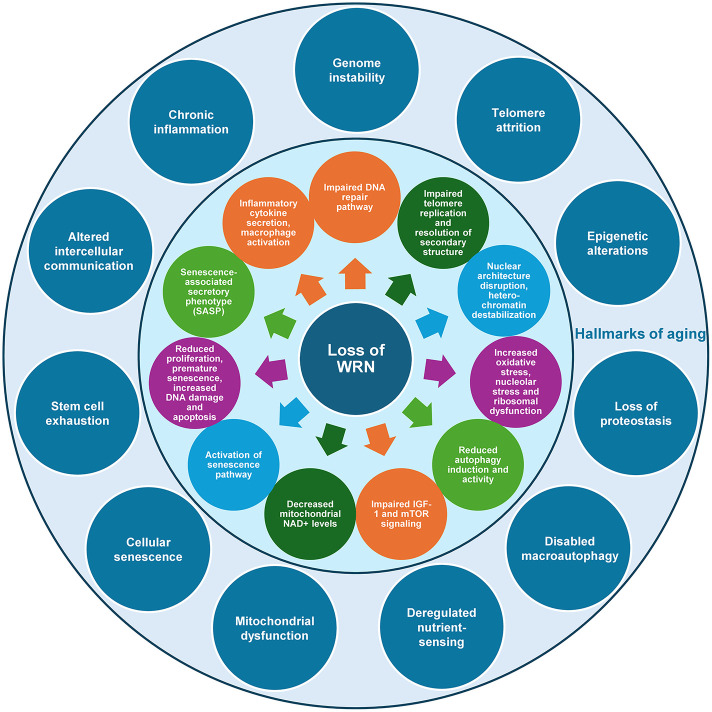
RecQ helicases are known as "caretakers" of the genome for their conserved helicase activities to resolve different complex DNA structures. Aberrant accumulation of unsolved DNA structures could lead to defects in DNA replication, gene transcription, and unrepaired DNA lesions. Pathogenic mutations on BLM, WRN, and RECQL4 are associated with several pathological conditions, namely Bloom syndrome (BS), Werner syndrome (WS), and Rothmund-Thomson syndrome (RTS). These syndromes are characterized by genomic instability and cancer predisposition. Additionally, some RecQ helicase diseases are linked to developmental defects and premature aging. In this review, we provide an overview of the RecQ helicases, focusing on the molecular functions and mechanisms, as well as the consequences of their dysfunction in cellular processes. We also discuss the significance of RecQ helicases in preventing various genetic disorders (BS, WS, RTS) and the insights obtained from the different animal models developed for studying the pathophysiology of RecQ helicase deficiencies.
Keywords: DNA repair; RecQ helicase; accelerated aging; cellular senescence; maintenance of genome stability.
Conflict of interest statement
Figures

References
-
- Puranam KL, Blackshear PJ. Cloning and characterization of RECQL, a potential human homologue of the Escherichia coli DNA helicase RecQ. J Biol Chem. 1994; 269:29838–45. - PubMed
-
- Nakayama H, Nakayama K, Nakayama R, Irino N, Nakayama Y, Hanawalt PC. Isolation and genetic characterization of a thymineless death-resistant mutant of Escherichia coli K12: identification of a new mutation (recQ1) that blocks the RecF recombination pathway. Mol Gen Genet. 1984; 195:474–80. 10.1007/BF00341449 - DOI - PubMed
Publication types
MeSH terms
Substances
LinkOut - more resources
Full Text Sources