


Viral etiology of severe acute respiratory infections in hospitalized patients, Shandong, China
- PMID: 40729341
- PMCID: PMC12306791
- DOI: 10.1371/journal.pone.0328439
Viral etiology of severe acute respiratory infections in hospitalized patients, Shandong, China
Abstract
Background: Severe Acute Respiratory Infection (SARI) represents a critical global public health challenge, accounting for substantial severe morbidity and hospitalization burdens with distinct geographical patterns in etiological profiles. This study systematically characterizes the epidemiological and clinical phenotypes of SARI patients in Shouguang county, Shandong Province, China.
Methods: A prospective observational study was conducted at Shouguang People's Hospital between August 28, 2023 and April 30, 2024, enrolling 1,730 hospitalized patients with SARI from the Departments of Infectious Diseases and Respiratory and Critical Care Medicine. Standardized electronic case report forms were used to systematically collect the demographic characteristics, clinical manifestations and laboratory testing results. Oropharyngeal swab specimens were collected within 24 hours of admission for each patient and stored at -80°C. Multiplex real-time quantitative PCR (RT-qPCR) was performed using the ABI 7500 system to detect 11 respiratory viruses infection, including influenza A virus (IFA), influenza B virus (IFB), respiratory syncytial virus (RSV), parainfluenza virus (HPIV), human coronaviruses (HCoV), human metapneumovirus (HMPV), rhinovirus (HRV), enterovirus (EV), human bocavirus (HBoV), human adenovirus (HAdV), and SARS-CoV-2 (COVID-19).
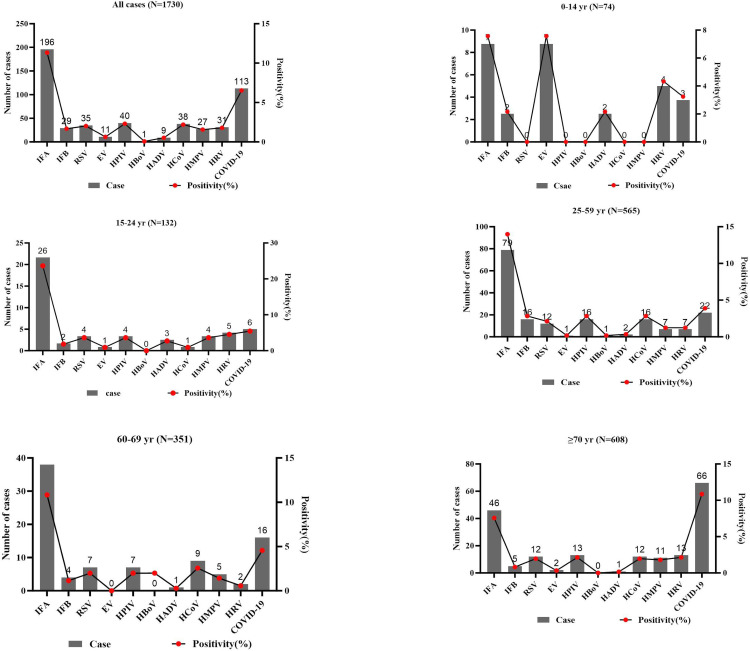
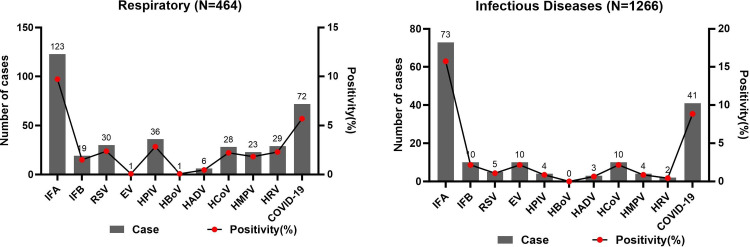
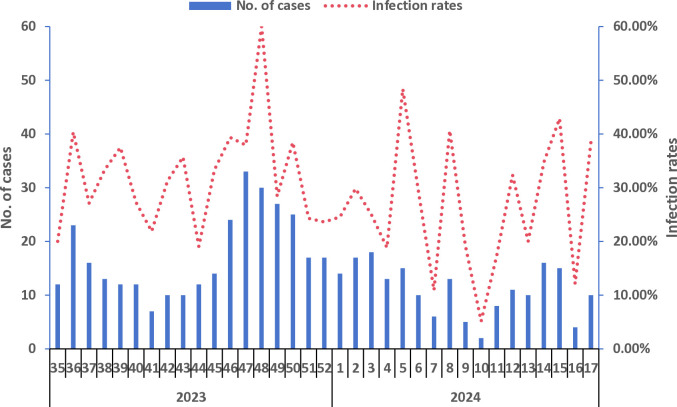
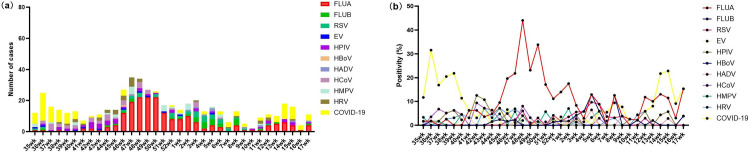
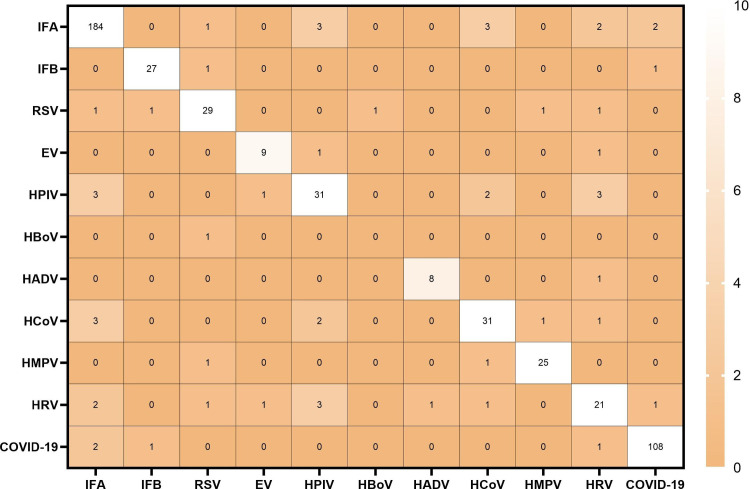
Results: 501 samples (28.96%) were tested positive for at least one virus. The most frequently detected viruses and their infection rates were as follows: IFA (11.33%), COVID-19 (6.53%), HPIV (2.31%), HCoV (2.20%), RSV (1.79%), IFB (1.68%), HMPV (1.56%), EV (0.64%), HADV (0.52%), and HBoV (0.06%). Among patients aged 0-14 years, IFA and EV had the highest infection rates, both at 9.46% (7/74). In the 15-24 age group, IFA exhibited the highest infection rate at 19.70% (26/132). In patients aged ≥70 years, COVID-19 was the most frequently detected virus, with a infection rate of 10.69% (65/608). The overall virus infection rate peaked at 60.00% (30/50) in epidemiological week 48 of 2023. During weeks 46-50 of 2023, the overall infection rate remained consistently high (range: 28.42-60.00%). Significant differences in infection rates were observed across hospital departments (χ² = 5.52, P < 0.05), The Department of Infectious Diseases demonstrated a higher infection rate of 34.91% (162/464) compared to 29.07% (368/1266) in the Department of Respiratory Medicine.
Conclusion: Viral etiological analysis of SARI patients in Eastern China identified IFA, COVID-19, and HPIV as the three predominant virus, with influenza virus exhibiting the highest frequency of co-infection with other respiratory viruses. Our study further revealed significant heterogeneity in virus distribution across different hospital departments, age groups, and admission periods. The most common clinical manifestations were cough and fever, with distinct symptomatic profiles observed among infections caused by different viruss. These findings provide scientific evidence to inform government strategies for optimizing the prevention and management of respiratory infectious diseases.
Copyright: © 2025 Li et al. This is an open access article distributed under the terms of the Creative Commons Attribution License, which permits unrestricted use, distribution, and reproduction in any medium, provided the original author and source are credited.
Conflict of interest statement
The authors declare that they have no competing interests.
Figures
Similar articles
-
Dynamics of respiratory virus transmission in children during and after COVID-19 outbreak control in Baiyin, China.BMC Infect Dis. 2025 Jul 7;25(1):901. doi: 10.1186/s12879-025-11285-8. BMC Infect Dis. 2025. PMID: 40624459 Free PMC article.
-
Evaluation of common respiratory viruses other than SARS-CoV-2 in hospitalized children during the COVID-19 pandemic.BMC Infect Dis. 2025 Jul 11;25(1):910. doi: 10.1186/s12879-025-11293-8. BMC Infect Dis. 2025. PMID: 40646473 Free PMC article.
-
Epidemiological characteristics of acute viral and mycoplasma respiratory infections in Yongzhou, China: a retrospective descriptive study.Front Public Health. 2025 Jul 17;13:1614985. doi: 10.3389/fpubh.2025.1614985. eCollection 2025. Front Public Health. 2025. PMID: 40746698 Free PMC article.
-
Physical interventions to interrupt or reduce the spread of respiratory viruses.Cochrane Database Syst Rev. 2023 Jan 30;1(1):CD006207. doi: 10.1002/14651858.CD006207.pub6. Cochrane Database Syst Rev. 2023. PMID: 36715243 Free PMC article.
-
Signs and symptoms to determine if a patient presenting in primary care or hospital outpatient settings has COVID-19.Cochrane Database Syst Rev. 2022 May 20;5(5):CD013665. doi: 10.1002/14651858.CD013665.pub3. Cochrane Database Syst Rev. 2022. PMID: 35593186 Free PMC article.
References
-
- Silva-Afonso R de F, Platas-Abenza G, Guerrero-Soler M, Gallardo-Rodríguez P, Gil-Sánchez F, Pérez-Paz G, et al. Effectiveness of immunization strategies for preventing severe acute respiratory infection during the 2023/2024 season in a Spanish health department. Enferm Infecc Microbiol Clin (Engl Ed). 2025. doi: 10.1016/j.eimce.2025.03.017 - DOI - PubMed
-
- Mauro MV, Greco S, Pellegrini M, Campagna T, Caprino F, Elia N, et al. Epidemiology and Clinical impact of single and multi-viral respiratory infections in post-pandemic era. New Microbiol. 2024;47(1):28–32. - PubMed
Publication types
MeSH terms
LinkOut - more resources
Full Text Sources
Miscellaneous
