


Exploring a Shared History of Colonization, Historical Trauma, and Links to Alcohol Use With Native Hawaiians: Qualitative Study
- PMID: 40729771
- PMCID: PMC12306949
- DOI: 10.2196/68106
Exploring a Shared History of Colonization, Historical Trauma, and Links to Alcohol Use With Native Hawaiians: Qualitative Study
Abstract
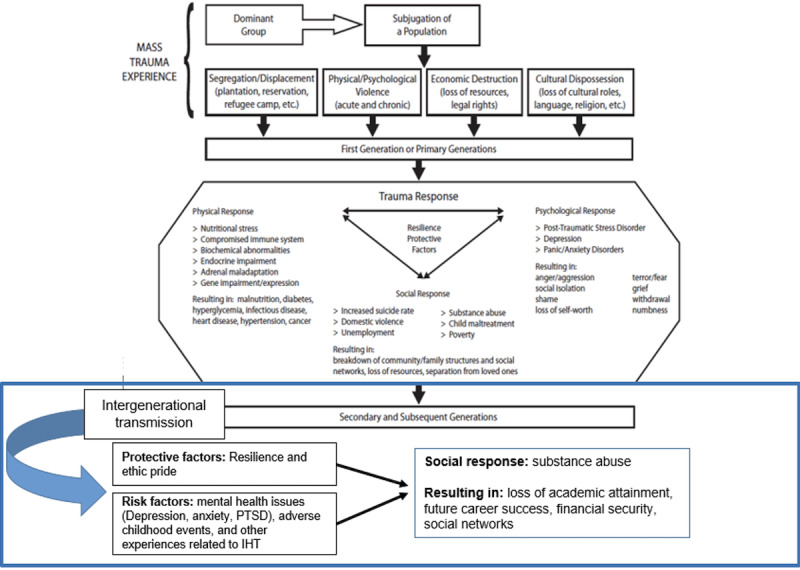
Background: Most studies using historical trauma theory have focused on American Indian tribes. There remains a dearth of research exploring historical trauma and substance use among Native Hawaiians. Native Hawaiians and American Indians experience a startlingly high degree of physical and mental health disparities and alcohol and other substance misuse. Indigenous scholars posit that historical trauma is intergenerationally transmitted to subsequent generations and is the primary cause of today's health and substance use disparities among these Indigenous populations.
Objective: This study aimed to explore the lived experiences of colonization, historical trauma, and alcohol use among Native Hawaiians living in rural Hawaii.
Methods: This qualitative study was guided by Husserl's transcendental phenomenological design. The historical trauma conceptual framework and story theory guided the study. The Native Hawaiian Talk-Story method was used to collect data from 10 Native Hawaiian adult participants in one-to-one interviews. The modified Stevick-Keen-Colaizzi method was used for data analysis.
Results: In total, four themes emerged: (1) alcohol did not exist in Hawaii before European explorers arrived; (2) alcohol helped expand colonialism in Hawaii; (3) alcohol is used today as a coping strategy for feelings of grief and anger over losses (land, people, cultural traditions, and language); and (4) the kupuna (elders) teach the younger generations to drink alcohol.
Conclusions: Native Hawaiians, like American Indians, experienced historical trauma, which is transmitted intergenerationally, resulting in mental and physical health disparities, substance misuse, and feelings of discrimination. The introduction of alcohol by European explorers provides the foundation for problematic alcohol use among Native Hawaiians today.
Keywords: Indigenous health; alcohol use; health disparity; historical trauma; intergenerational trauma; substance misuse.
© Cynthia Taylor Greywolf, Donna Marie Palakiko, Pallav Pokhrel, Elizabeth A Vandewater, Merle Kataoka-Yahiro, John Casken. Originally published in the Asian/Pacific Island Nursing Journal (https://apinj.jmir.org).
Conflict of interest statement
Figures
References
-
- Greywolf CT. University of Hawaiʻi at Mānoa; 2020. [23-07-2025]. Exploring a shared history of colonization, historical trauma and links to alcohol use with Native Hawaiians living in rural Hawaiʻi in the 21st century [Dissertation]https://scholarspace.manoa.hawaii.edu/server/api/core/bitstreams/1699fe3... URL. Accessed. - PMC - PubMed
-
- Greywolf C, Lowe J, Casken J, Kataoka-Yahiro M, Millender E. Discrimination, racism, social inequality, and injustice experienced among Native Hawaiians through the lens of historical trauma. [23-07-2025];IJSBAR. 2023 69(1):36–46. https://www.gssrr.org/index.php/JournalOfBasicAndApplied/article/view/15378 URL. Accessed.
-
- Brown M. Āina under the influence: the criminalization of alcohol in 19th-century Hawai ‘i. Theor Criminol. 2003;7(1):89–110. doi: 10.1177/1362480603007001201. doi. - DOI
LinkOut - more resources
Full Text Sources
